admin
admin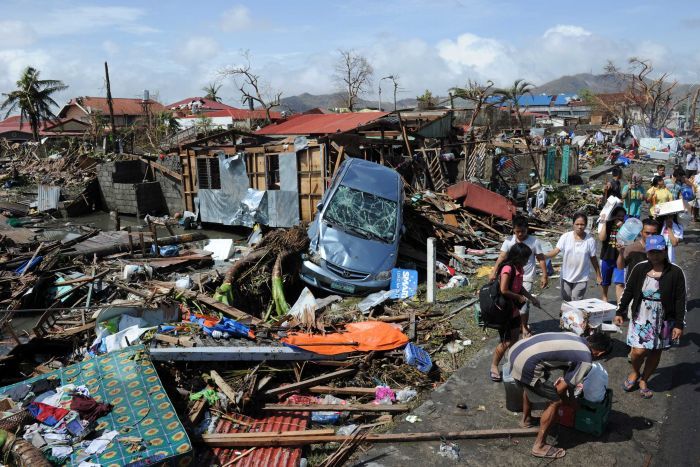

MORE than 10 000 people are feared dead after the fiercest typhoon ever recorded laid waste to The Philippines’ east, overwhelming emergency services and leaving bodies rotting in the streets of shattered cities and towns. Tacloban, the provincial capital of Leyte, was smashed by 315km/hr winds and ocean surges that flattened homes, turned cars into “tumbleweeds” and hurled ships hundreds of metres inland, creating a putrid swamp of debris and death.
In scenes reminiscent of the lethal 2004 Boxing Day tsunami that hit the region, waves of up to 3m drowned those who had not been killed in collapsed buildings or by flying rubble.
Coconut palms were snapped like twigs.
More than 600 000 people were being evacuated from low-lying parts of Vietnam last night as Super Typhoon Haiyan charged across the South China Sea, on track to strike the northern province of Nghe An and affect the capital, Hanoi.
Nghe An has a population of three million people, and many millions more in southern China, Laos and Cambodia stand to be struck by gales and flooding rain.
The Department of Foreign Affairs said a 49-year-old Australian man was among the confirmed dead in The Philippines.
He is understood to be former Sydney Catholic priest and high-profile child-sex-abuse whistleblower Kevin Lee, who had joined his Filipina wife and mother of their newborn child after being stripped of his parish responsibilities in Sydney for marrying in secret.
The manager of Tacloban airport said the bodies of 100 people lay where they had died, while 100 more were injured, some seriously. Storm chaser John Morgerman described an “utterly ghastly” scene in the provincial centre of 220 000.
There was “widespread looting and unclaimed bodies decaying in the open”, he wrote on Facebook.
“The typhoon moved fast and didn’t last long . . . but it struck with terrifying ferocity.”
Foreign Affairs Minister Julie Bishop said Australia would immediately provide $390 000 worth of emergency relief for sleeping mats, blankets, mosquito nets, water containers and medical kits.
Non-government organisations such as World Vision and Oxfam are gearing up to send in teams, with estimates that 1,2 million people have been made homeless or displaced by the typhoon in The Philippines. Though weakening, it retained a powerful punch as it advanced on northern Vietnam for an expected landfall today.
When it struck The Philippines on Friday, with winds of up to 315km/hr, Super Typhoon Haiyan was the world’s strongest tropical cyclone since Hurricane Camille hit the US in 1969 with 305km/hr winds.
It was the 25th typhoon to tear through The Philippines this year, a country that endures a seemingly never-ending pattern of tropical cyclones, earthquakes, volcano eruptions and floods.
The horrifying rise in the feared death toll came as the US pledged military support and as countless survivors across a huge swath of The Philippines went without help for a third day.
US Defence Secretary Chuck Hagel said helicopters, fixed-wing aircraft and surface maritime search-and-rescue equipment were being sent, following a direct request from Manila.
UN Secretary-General Ban Ki-moon said UN humanitarian agencies would respond “rapidly” to help people in need.
Leyte provincial Governor Dominic Petilla told police there had been 10 000-plus deaths on the island, mostly by drowning and building collapse.
Between 70 per cent and 80 per cent of homes in the path of typhoon had been destroyed, he said.
Tacloban city administrator Tecson Lim warned that the death toll in the city alone “could go up to 10 000”.
Witnesses told of destruction on an epic scale, with concrete slabs the only part of many homes remaining, cars flipped over and power lines destroyed.
“There are cars thrown like tumbleweeds and the streets are strewn with debris,” said Sebastian Rhodes Stampa, the head of a UN disaster assessment co-ordination team, in Tacloban.
“The last time I saw something of this scale was in the aftermath of the Indian Ocean tsunami,” he said, referring to the disaster eight years ago that claimed 220 000 lives.
While Leyte was believed to have been the worst-hit province, the carnage extended over a 600km stretch of islands through the central Philippines.
A few dozen other deaths had been confirmed in some of these areas, but authorities admitted they were completely overwhelmed and many communities were yet to be contacted.
Military spokesman Lieutenant Colonel Ramon Zagala said among the communities yet to be contacted was Guiuan, a fishing town of about 40 000 people on Samar island that was the first to be hit after Haiyan roared in from the Pacific Ocean.
The tourist island of Malapascua, north of Cebu, appeared to be in ruins, according to aerial photographs, with people there unaccounted for.
At least 30 people had died in Samar. — The Australian.com.au.


 Online Reporter