Online Reporter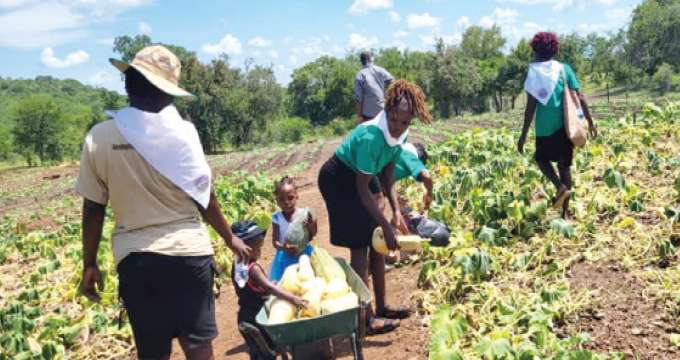
Fairness Moyana in Hwange
WHAT was once a degraded wetland in Hwange District has now become a thriving source of food security, nutrition, and economic empowerment for families at Kasibo Irrigation Scheme.
Community members, traditional leaders, agricultural extension officers, and stakeholders recently gathered for a field day at the flourishing two-hectare irrigation scheme, where Chief Wange commended the unity and hard work that have transformed livelihoods in the area.
Addressing the gathering, Chief Wange applauded the community for embracing sustainable agriculture and working together to improve household incomes and food security.
“As a people, we must continue to encourage oneness and unity. Let’s work together, support each other, and remain focused on our shared goals,” he said. “Farming must now be treated as a business because agriculture is no longer just for survival, but a source of income, employment, and economic growth.”
The traditional leader urged community members, especially youths, to actively participate in agricultural initiatives and embrace modern farming methods.
“To our young people, you are the future leaders of tomorrow. Agriculture holds great opportunities for you, and your involvement ensures the continuity and growth of our community,” he added.
Chief Wange also emphasised the importance of environmental conservation, applauding the community for rehabilitating and protecting the wetland that now sustains the irrigation scheme.
“Wetlands are valuable natural resources that sustain our farming activities. Conservation is not an option; it is a responsibility we all share for the benefit of future generations,” he said.
The irrigation scheme, which draws water from the rehabilitated wetland, has become a beacon of resilience in the dry and climate-vulnerable district.
Apart from maize currently under cultivation, the garden also produces vegetables such as rape, chomolia, beetroot, and butternut, while a fish pond and orchard provide families with access to a balanced and nutritious diet.
The project is also aligned with Government initiatives aimed at achieving food security, rural industrialisation, nutrition improvement, and climate resilience under the Agriculture and Food Systems Transformation Strategy and Vision 2030.
For many women in the community, the garden has become a pathway to economic independence.
One of the members, Sithabile Ncube, said the project had significantly changed her family’s life.
“This garden has empowered me economically to a point where I have also been assisting my husband in paying for our children’s school fees and other household needs. It has also given me economic independence, enabling me to buy small livestock as well as household furniture,” she said.
Kasibo Irrigation Scheme vice chairperson, Elizabeth Sibanda, said the initiative had brought remarkable improvements to livelihoods within the community.
“Before this project, many families struggled to access enough food and income, especially during drought periods,” she said.
“Today, members are earning money from the sale of produce, improving their homes, paying school fees, and meeting household needs. The economic value of this garden is visible across the community.”
Sibanda added that the project was also playing an important social role by supporting vulnerable groups.
“As members, we agreed that part of the produce from the garden should assist elderly people within the community, while some of it supports the local school feeding programme so that children can learn better while having access to nutritious meals,” she said.
Despite the success, the scheme is facing infrastructure challenges that threaten its sustainability.
Sibanda revealed that one of the major concrete water storage tanks had developed serious cracks and was at risk of collapsing.
“We are appealing for assistance from well-wishers, partners, and relevant authorities to help us repair the damaged tank or construct a new one. Water is the backbone of this project, and without proper storage infrastructure, the future of the scheme could be affected,” she said.
The irrigation scheme is also supported by two additional 10,000-litre water storage tanks, which not only sustain farming activities but also serve as an important water source for domestic use within the community.
Community members say the success of the Kasibo Irrigation Scheme demonstrates how sustainable natural resource management, collective action, and climate-smart agriculture can transform rural livelihoods while preserving the environment for future generations.