

 admin
admin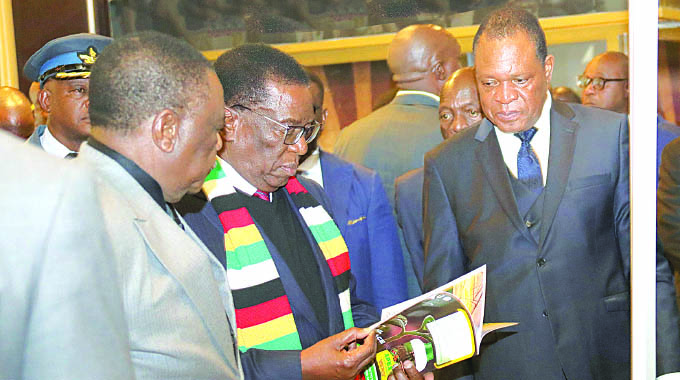
Rumbidzayi Zinyuke Senior Reporter
President Mnangagwa has called for sustainable partnerships and collaborations in the agriculture sector to drive the country’s irrigation initiatives in response to climate change-induced droughts.
This comes as the Government was working on a drive to move the country away from an over-reliance on rain-fed agriculture to focus on irrigation.
Officiating at the inaugural Zimbabwe Irrigation Investment Conference in Harare yesterday, the President said irrigation driven agriculture was under renewed attention in view of its centrality for the realisation of Sustainable Development Goals 1 and 2, on eliminating poverty and ending hunger.
He said the theme of the conference, “Public-private partnerships for sustainable and structured irrigation financing to deliver food security; everywhere, every day”, underscored the urgency with which the country must approach the development of innovative funding solutions and investment for irrigation in agriculture.
“It is a call to action for sustainable partnerships and collaboration. At this juncture, in our national, regional and continental quest to realise food security and sovereignty, essential resources must be appropriately channelled to complement State-funded irrigation development projects as well as improving efficiencies, production and productivity, in the agriculture sector. Ultimately, we must attain our common aspiration to be a continent that is able to feed itself,” he said.
Yesterday’s conference brought together stakeholders in the agriculture sector to discuss ways to boost irrigation development and provide opportunities for public-private sector engagements and a way towards climate proofing agricultural production.
Zimbabwe, along with other African countries, was affected by the El-Niño induced drought, leading to President Mnangagwa declaring the drought a disaster in April this year.
As part of mitigation measures, the Government has rolled out the Accelerated Irrigation Rehabilitation and Development Agenda which is a deliberate shift to expand the utilisation of the country’s water resources for irrigation.
The President said it was imperative for all stakeholders to think outside the box for the purpose of de-risking the nation from the vagaries of climate change.
“Similarly, stakeholders and communities alike, should accelerate the implementation and adoption of mechanisms to climate-proof our agriculture sector, beginning at household level. It is most fortunate that Zimbabwe under the Second Republic, has drawn invaluable lessons from the robust and responsive policies implemented to empower our people, so that they are able to produce their own food. Models centred around unproductive food aid are not sustainable and disempower communities from the right to chart their own destiny. There is a need, therefore, for policies, projects and funding models which strike an intricate balance between the protection of the dignity of communities, State guaranteed welfare support and the business case of investors to fund viable projects,” he said.
Between 2019 and 2024, Zimbabwe has increased the total hectarage under irrigation, by 24 percent and this represents the fastest irrigation development phase since the attainment of independence, and further gives a synopsis of the immense potential of what is possible with additional investments.
“We welcome investments and partnerships for the development of additional land for irrigation purposes around new dams for cereal production, high-value crops and pastures. We are determined to efficiently use our national water capacity stock, including underground water resources, for the holistic socio-economic development of our country and the region. Prospects exist for sustainable partnerships as we march forward, towards attaining the country’s irrigation potential of 2 million hectares,” he added.
He said the Second Republic would continue to foster a conducive business environment to facilitate private sector-led irrigation development and economic growth in line with the mantra “Zimbabwe is open for business”.
The positive results realised by Government entities and private sector players, who have partnered to finance, develop, and manage irrigation projects, were also applauded.
The President commended the introduction of the Rural Development 8.0 Model, which has brought in a cocktail of measures designed to uplift the quality of livelihoods of rural communities.
“Among these transformative interventions are the Village Business Units, which are being rolled out and will see the establishment of 35 000 agro-based companies across our villages. The model with boreholes and nutritional gardens, will result in intensive agriculture production, value addition and beneficiation centres.
“The rehabilitation of other community assets such as weirs and reservoirs are being attended to. Funding and partnerships for tailor-made agriculture starter packs, including affordable irrigation kits that meet the needs of smallholder farmers, are welcome,” he said.
He also noted that agriculture could never develop in isolation adding that there was an urgent need to invest in key enablers to drive holistic and sustainable development.
“This conference has demonstrated our shared commitment to address the impact of climate change, which is one of the existential challenges of our time, specifically as it impacts the agriculture sector. More than ever before, our food cereals, pastures and livestock ‘now require more water and not necessarily rain.’ As stakeholders in the sector, we have a duty to guarantee food security for our nation, the region, continent and indeed humanity. The responsibility upon us is weighty. We cannot afford to fail,” said the President.
Vice President Constantino Chiwenga, Defence Minister Oppah Muchinguri-Kashiri, Cabinet Ministers, senior Government officials and experts in the agriculture sector attended the conference.
Finance and Economic Development Minister Mthuli Ncube said the scale of investment required to deliver on Vision 2030 could not be funded by the Government on its own emphasising the need for collaborations with the private sector.
“My Ministry continues to support projects and programmes aimed at enhancing the growth of the irrigation sector which is one of key measures towards drought proofing agriculture and guaranteeing food security at both household and national level,” he said.



 Peter Tanyanyiwa
 Online Reporter