Mukudzei Chingwere Senior Reporter
SWEDEN will continue engaging with Zimbabwe despite closing its embassy in Harare, with cooperation expected to proceed through regional and thematic programmes, institutional partnerships and longstanding people-to-people relations.
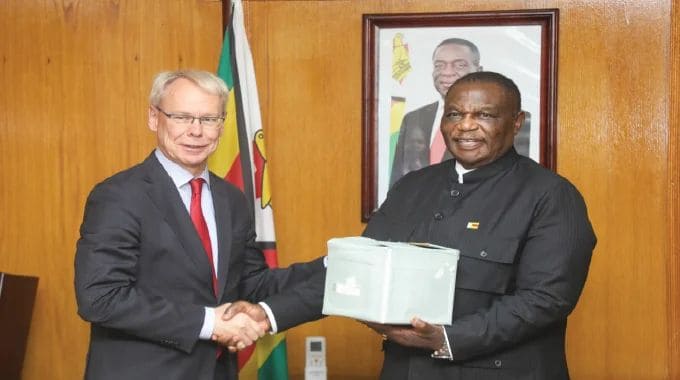
Speaking to journalists after paying a farewell courtesy call on Vice-President Dr Constantino
Chiwenga, outgoing Swedish Ambassador to Zimbabwe Per Lindgärde said the closure of the embassy would not bring an end to relations between the two countries.
Although Sweden was phasing out its bilateral development cooperation strategy, other channels of support would remain available to Zimbabwe.
“We are phasing out our bilateral development strategy. But there will be other streams of support coming to Zimbabwe from regional strategies, from thematic strategies,” he said.
“So there will be, for example, some support of some civil society organisations. And also cooperation between different authorities will continue.”
Ambassador Lindgärde identified public health as one of the areas in which institutional cooperation was expected to continue.
“Like the Swedish Public Health Agency, they are on their way to sign an MOU with the Ministry of Health. So that cooperation will continue,” he said.
Sweden has separately indicated that its support to Zimbabwe through multilateral organisations and the European union will not be affected by the embassy closure. Swedish authorities have also said they will continue supporting Swedish companies operating in Zimbabwe.
Ambassador Lindgärde said his discussions with VP Chiwenga reflected on the historical foundations of relations between the two countries and how these could provide a basis for future cooperation.
“We discussed actually for quite some time about the historic relations between Sweden and
Zimbabwe. We had the first Swedish missionaries coming to Zimbabwe in 1903, building some schools and health clinics. And then, of course, we supported the liberation struggle,” he said.
Sweden provided humanitarian assistance to Zimbabwe’s liberation movements, including ZANU and ZAPU.
Ambassador Lindgärde said the shared history remained an important foundation for continued engagement.
“We agreed that the historic relation between our countries is a very strong foundation for future cooperation,” he said.
“But the people-to-people ties and the historic relations will help us to continue having a very strong relation between our two countries.”
On Zimbabwe’s economic outlook, Ambassador Lindgärde said he had observed improvements in macroeconomic stability during his three-year tenure.
“I think we see positive developments happening in Zimbabwe on the economic sector,” he said.
“There is much more macroeconomic stability in the country since I came three years ago. We have seen that the inflation is coming down. You have now single-digit numbers.”
He cited the August inflation figure of 2,9 percent as an indication of progress, saying Zimbabwe was moving in the right direction economically.
Ambassador Lindgärde said sustained economic stability was also important to Zimbabwe’s arrears clearance process, which could help unlock access to development finance.
He expressed hope that clearing arrears to multilateral institutions would eventually enable
Zimbabwe to access an International Monetary Fund financing programme on concessional terms.
Such financing, he said, could support infrastructure development, which was essential to industrialisation.
“That will help develop the country even further when it comes to building the infrastructure, which will be crucial for the industrialisation of the country,” he said.
His remarks underscored Sweden’s intention to maintain engagement with Zimbabwe through alternative cooperation channels, even as its resident diplomatic presence and bilateral development programme are wound down.