

 dyton mupawaenda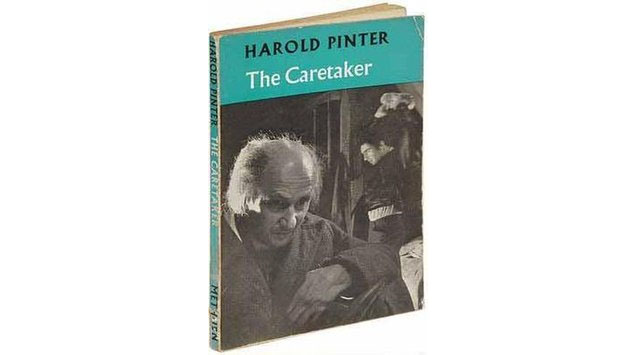
Elliot Ziwira-At the Bookstore
The reading of Harold Pinter’s timeless play, “The Caretaker”, is always a new experience.
No matter how many times one reads it, one comes up with different interpretations each time, depending on the mood and whatever experiences one would feel like evoking.
It boggles the mind how words or lack of them, have a certain way of interpreting experiences.
Though set in the British landscape of the 1950s, the play finds relevance in any part of the world at any given time, because of the universality of anguish, deceit, hopelessness, hypocrisy and oppression.
The human psyche, which draws excitement from trauma and misery, is as colour blind as it is insatiable in its scuttling of others’ dreams.
The socio-economic and socio-political challenges burdening global societies cannot be explored effectively without involving the reader.
Pinter is all too aware of that.
The playwright uses economy of words, characterisation, symbolism and setting to poke at the voyeuristic inclinations of mankind. Divided into three acts, the play tellingly examines the tribulations of three characters over a two-week period.
Two of the characters, Mick and Aston are brothers, and the third one, Mac Davies, also known as Bernard Jenkins, is an old tramp. At face value, the story can be your average sitcom, that is if you decide to see it that way. Not so much is said, but more is inferred through pauses and silence.
Though the characters do not seem to develop in terms of expression, they learn more from the fictional experience, which, of course, they cannot put enough words to.
The three characters are interesting in their own different ways as the reader is able to interpret the different thematic concerns raised. The play opens with Mick sitting silently in a room, doing nothing.
As he examines the room in its disorderly fashion, he does not seem to have any emotional attachment to it. This is rather surprising, as the reader learns in the subsequent Acts that he is the owner of the apartment.
He is said to be “in the building trade”, and “he is got his own van”, but there is nothing constructive about his outlook. His apartment, one of which rooms is the main stage throughout the play, is in bad shape.
Thus, he instructs his brother to give it a spruce up. However, because there is no shared dream, or any other ideological or psychological ties, the biological ties fail to bring their adverse dreams to a cirque.
Looking closely at this, one cannot fail to realise the tragedy of political folly. Nepotism rarely builds collective tangibles, nor does a dislocated interest help in the progress of a family, community or nation.
Mick appears to be that absent landlord, farmer or politician, who feeds on the naivety of his constituents, and finds glory in mediocrity. Aston, on the other hand, reminds one of Shimmer Chinodya’s “Chairman of Fools” (2005).
He is admitted to an institution, which is very much like Chinodya’s Annex, because of a mental or psychological condition.
Aston “talked too much”, which he says “was my mistake”, and is given an electric shock treatment that somehow upsets his psychological equilibrium.
As a young factory worker, he was fond of talk, for he “could see things. . . very clearly”, since “everything was so clear”. However, if such clarity of vision is seen as an affront on the oppressive machinery behind the factory, he has to be silenced.
Tragically, hope is lost to the future Aston embodies. His vision is blurred, his eloquence blunted, his pace slackened, and his voice silenced. He can no longer say much, even when he feels that he is being taken advantage of. He peremptorily works on simple tasks that he never finishes; like fixing a plug, clearing the backyard, and building a shed.
Naturally compassionate, Aston is taken advantage of by the parasitical Davies and the cunning Mick.
In Aston, one can see more than just a social problem, but the ruckus behind it, informed by the oppressive capitalist and imperialistic apparatus, which find fodder in grief, hopelessness, despondency and paralysis. He is the garbage collector who finds use in discarded effects.
The third character, Mac Davies, is more than a mouthful. As is the case with the other characters, he has foibles of his own, which can be interpreted in many ways, depending on what the reader brings in from his or her own interactions with the world.
Owing to his ungrateful, opportunistic, and know-it-all nature, characteristic of old age, Davies does not solicit sympathy from the reader, which, in some way, may be a bit harsh. He suffers an identity crisis as he does not appear to know who he is. He ferments antagonism between Mick and Aston, who somehow see through him, especially the former.
They both offer him a job as a caretaker of the place; Aston genuinely, and Mick only to take him along the same path he has for so long travelled; the thorny one where deceit lurks in the woods. Davies may be phony or the like, but he brings the brothers together, as they become aware of their shortcomings.
In the end, his pleading to be given a chance to prove himself hits a brick wall. Nonetheless, it makes him only human; prone to backlashes, folly and regret. Life has not been easy on him. He has “never had a dream in (his) life”, but he has realised that one cannot always accept anyone else’s shoes, knowing that they would not fit.
Shoes are symbolic of life; so, the idea that one-size-fits-all is a fallacy. On reading Harold Pinter’s “The Caretaker”, one is left wondering who, or what really needs to be taken care of, in a society that drags its dirty linen in the market square, and seeks hope in the junkyard.



 Online Reporter