admin
admin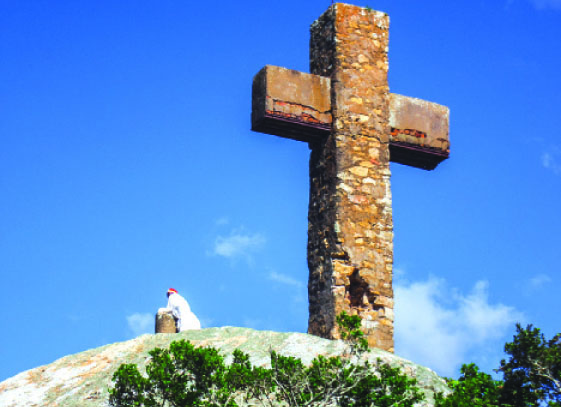
Liberty Dube
Tourism Correspondent
WHILE Buhera, Chipinge and Mutasa districts boast of tourism monuments and eco-tourism products such as Matendera, Ziwa, Chiwona, Muchuchu, Mutova, Gombe and Kagumbudzi; Mutare and Nyanga have their own impressive but less talked about monuments.
So much is mentioned about Matendera being a citadel of Buhera tourism, the spectacle Chibasane Falls being the face of tourism in Chipinge and Ziwa Ruins being an epitome of Nyanga’s tradition and identity.
For Mutare and Nyanga, marvelous archaeological sites such as the majestic Nyangwe Fort, the picturesque Cross Kopje and Fort Hill remains an integral part of Manicaland Province’s heritage.
Nyangwe Fort, located in Nyanga National Park, is a stone-aged fort believed to have been built around 400 years ago from stones.
Nyangwe is crowned by the original enclosure, which is surrounded by five further enclosures.
Most of these contain low stone circles of hut bases.
Nyangwe Fort, near Mare Dam, is the most extensive and best-preserved monument in the park.
It is on top of a small hill with good views over the Mare Valley.
Near the park headquarters is a reconstructed pit structure – the homestead around a pit structure has been rebuilt and a site museum established.
And as one drives down Christmas Pass in Mutare, towering over the Eastern Zone is an architectural wonder called Cross Kopje.
The Kopje, which is a high rocky hill separated from the vast mountainous terrain of Mutare houses, is a 10-metre high cross erected in memory of black soldiers who died in East Africa in World War 1.
The monument is most visible from Greenside suburb and from the scenic view of Christmas Pass.
In his fascinating book, ‘Memories of Manicaland (1980)’, Cecil M. Hulley states: “Everyone has admired the majesty of the Cross Kopje War Memorial standing on what was once known as Baboon Kopje in Umtali (now Mutare) and many have marveled at the engineering problems involved and the motive behind such an achievement”.
The Memorial Cross on Cross Kopje, a feature that dominates Mutare, was erected in commemoration of the 269 Africans soldiers of the 1st and 2nd Battalions of the Rhodesia Native Regiment (RNR) from Zimbabwe, Malawi and Mozambique who fought and died in the German East African campaign of the First World War.
The cross is inscribed: “LEST WE FORGET’. In memory of the 269 African soldiers who fought and died during World War 1.”
During the World War, now Zimbabwe (Southern Rhodesia then) was administered by a private chartered company, the British South Africa Company (BSAC).
As the objective of this company was to return dividends to its shareholders, entry into the war of Southern Rhodesia units was inevitably delayed by financial disputes between the company and the British government.
When it had been established that the military recruitment of white soldiers from Southern Rhodesia had exhausted the available supply, attention was turned to the recruitment of Africans.
This was not an easy political step to take.
The white settlers in Southern Rhodesia had always resisted “arming the natives” other than in small auxiliary organisation.
But more riflemen were needed for operations on the Nyasaland (Malawi now) and Northern Rhodesia (Zambia now) borders with German East Africa.
Some Europeans, especially those who were part of the native units during the war, felt that not enough had been done to memorialize the contribution of the African soldiers.
The feat of constructing a memorial for the Africans who died in East Africa, however, was completed by a Mutare, then Umtali, firm called the Methuen Brothers owned by Captain Stuart Methuen and his brother Colonel James Allin Methuen.
The military commandment of the then Umtali District in the Eastern Highlands of Southern Rhodesia and Lieutenant Colonel Methuen collected donations of money and material to construct a 10m high and one-metre-wide granite and cement cross.
The local authority provided the necessary stones and sand.
The location of the memorial was a high rocky hill then called Baboon Kopje, (now Cross Kopje) that overlooks the town and sat almost right on the border of Zimbabwe and Mozambique.
During the dedication ceremony, the then Mayor, Councilor W. Stevens unveiled the cross and Bishop of Southern Rhodesia, Right Reverend Bishop Bevan performed the dedication service in front of guard of honor mounted by BSAP and Portuguese native police from Beira in 1924.
Another monument, Fort Hill, was located close to the confluence of the Tsambe (St Augustine’s) and Mutare Rivers and close to the mining area of Penhalonga.
Historically this is the first permanent settlement of Umtali, now Mutare.
This was the camp site of the British South Africa (BSA) Police in November 1890.
The British had settled here to negotiate a treaty with Chief Mutasa over gold mining concessions.
This, however, came at a period during which the British and Portuguese were struggling for dominance over Manicaland.
Although many members of the Pioneer Column were disbanded after October 1, 1890; about 200 BSA Police officers were stationed at Fort Hill following the tension with the Portuguese over the Manicaland territory, thereby forming the largest concentration of men on the eastern borderlands.
The area dubbed “Fort Hill” was originally the site of Chief Mutasa’s kraal where early prospectors and both the Portuguese and BSA Company had tried to win the chief’s favour and permission to prospect for gold in the Penhalonga Valley.
The BSA Company, however, managed to win a mineral concession, oust the Portuguese and soon after establish Fort Hill near the present site of Penhalonga to “protect” the chief from the Portuguese.
The remains of Fort Hill are still visible – a square enclosure with an entrance on the north.
Inside the enclosure is a 2×3 meters hole neatly lined with stones that presumably sheltered ammunition.
Once the border dispute with the Portuguese was resolved, the BSA Company was not required to stay within the narrow confines of Fort Hill.
The numerous gold mining claims pegged in close proximity led to the decision made in December 1890 to relocate the settlement west to the site of Old Mutare.
The relocation was proposed for health reasons and because of local mining activities that threatened to interfere with future expansion of the settlement.
The buildings were also too flimsy to survive the narrow confines of the fort.
Any corrugated iron roofing, doors and windows were moved to Old Mutare.
Nevertheless, Fort Hill remains an important part of Manicaland’s history.
National Museums and Monuments of Zimbabwe marketing officer, Mr Lloyd Makonya said efforts have been made to engage various stakeholders to join hands in rehabilitating roads that lead to these and other monuments.
He said the sites’ have vast potential to boost the performance of the country’s tourism sector.
“It has to be appreciated that most of our stone built monuments are in remote areas with poorly developed infrastructure like roads, but we have been making efforts to engage various stakeholders in our districts to ensure that the roads leading to these monuments are accessible.
A very positive engagement has been done with Buhera Rural District Council which has already made significant progress in improving accessibility to sites like Matendera.
“In terms of marketing, we use different media platforms like radio, television and print media to publicize these places. Our programming involves activities like festivals which are held at some of these sites to improve awareness amongst the public.
“We also work with stakeholders like the Zimbabwe Tourism Authority, ZimParks and the respective RDCs in their various awareness campaigns to market such sites,” he said



 Online Reporter