Online Reporter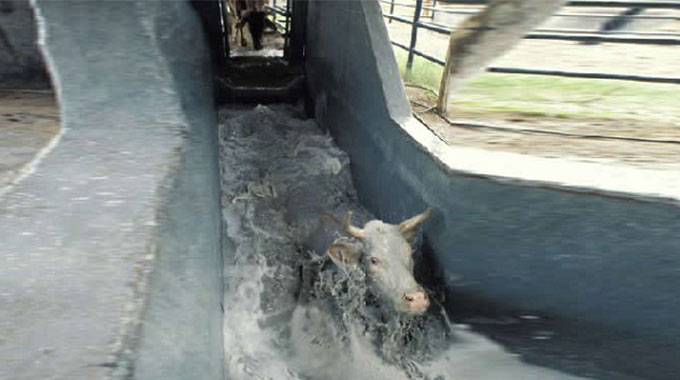
Dr Busani Moyo
CATTLE dipping is an essential livestock management practice that involves fully immersing cattle in an acaricide solution to control external parasites.
It primarily protects herds from deadly tick-borne diseases, prevents heavy blood loss and secures rural livelihoods and profitability. It gives ample time for cattle to graze without tick worry. The importance of cattle dipping includes:
Disease prevention: Regular dipping is critical for preventing lethal tick-borne diseases such as January disease (Theileriosis), Heartwater (Ehrlichiosis), Redwater (Babesiosis) and Gallsickness (Anaplasmosis).
Parasite control: It effectively manages, controls and eradicates external parasites including ticks, mites and lice that can cause severe skin damage and weaken the animal.
Improved productivity: By keeping cattle free of parasites, farmers maintain the animals’ health, resulting in better body weight, higher milk yields and better overall herd growth and productivity.
Communal herd protection: In communal grazing environments, where cattle from various households graze collectively, regular dipping stops the rapid spread of infections across the entire area.
To control the tick population the following are the tips. Failure to follow the tick control tips results in tick multiplication.
Tip 1: All cattle in an area should be dipped on a dipping day and immediately after mixing the dip wash (dip wash is a mixture of water and acaricide). All cattle should be dipped at short intervals, without allowing the acaricide (dip) particles to settle (sink) to the bottom.
In case animals come for dipping after long interval, they need to dip twice so as to agitate the dip wash. Farmers should note that the dip was they are using (eg amitraz) degrade with time.
Tip 2: Animals should be completely submerged. There are four things that prevent cattle from being completely submerged which are (i) if the diptank is silted (mud accumulation), (ii) if the water is above the dipping level this facilitate cattle to swim than jump in water, (iv) if the jump steps are not well designed or the entrance is too wide allowing two cattle to enter the dip tank at the same time.
Tip 3: Cattle should be dipped in correct target strength dipwash. The strength of the dipwash can be incorrectly done, (ii) if the dipwash is not agitated, (iii) if rain water enters into the diptank, (iv) if replenishment is not done correctly and (v) if instructions are not followed properly. It’s important to precisely follow manufacturer’s instruction of use. These include dilution rate, premixing techniques and precautions to be taken. Muddy dipwash (dirty) as another factor, reduces the efficacy of the target dipwash.
Also, sediments (siltation) reduce the capacity of the diptank causing cattle not to be fully submerged. Dip chemicals (acaricides) tend to bind particles of dirt, hair and dung that enter the dip, thus weakening the strength of the dipwash increasing the stripping rate. Farmers are encouraged to occasionally clean the dip tank in order to remove the accumulated sediments.
Tip 4. Cattle should be dipped at the correct intervals. If cattle are not dipped for a long time tick control is lost. The idea is to kill ticks when they are young, thus breaking the life cycle. The dipping interval is determined by type of tick (tick species), type of acaricide used and the season pattern.
Dr Busani Moyo is the Dean in the Faculty of Natural Resources Management and Agriculture at Gwanda State University. He holds a PhD in Animal Science, MSc Agriculture (Animal Science), BSc Agriculture Management, Diploma in Animal Production and Health, Certificate in Agriculture



 Bongani Ndlovu