Online Reporter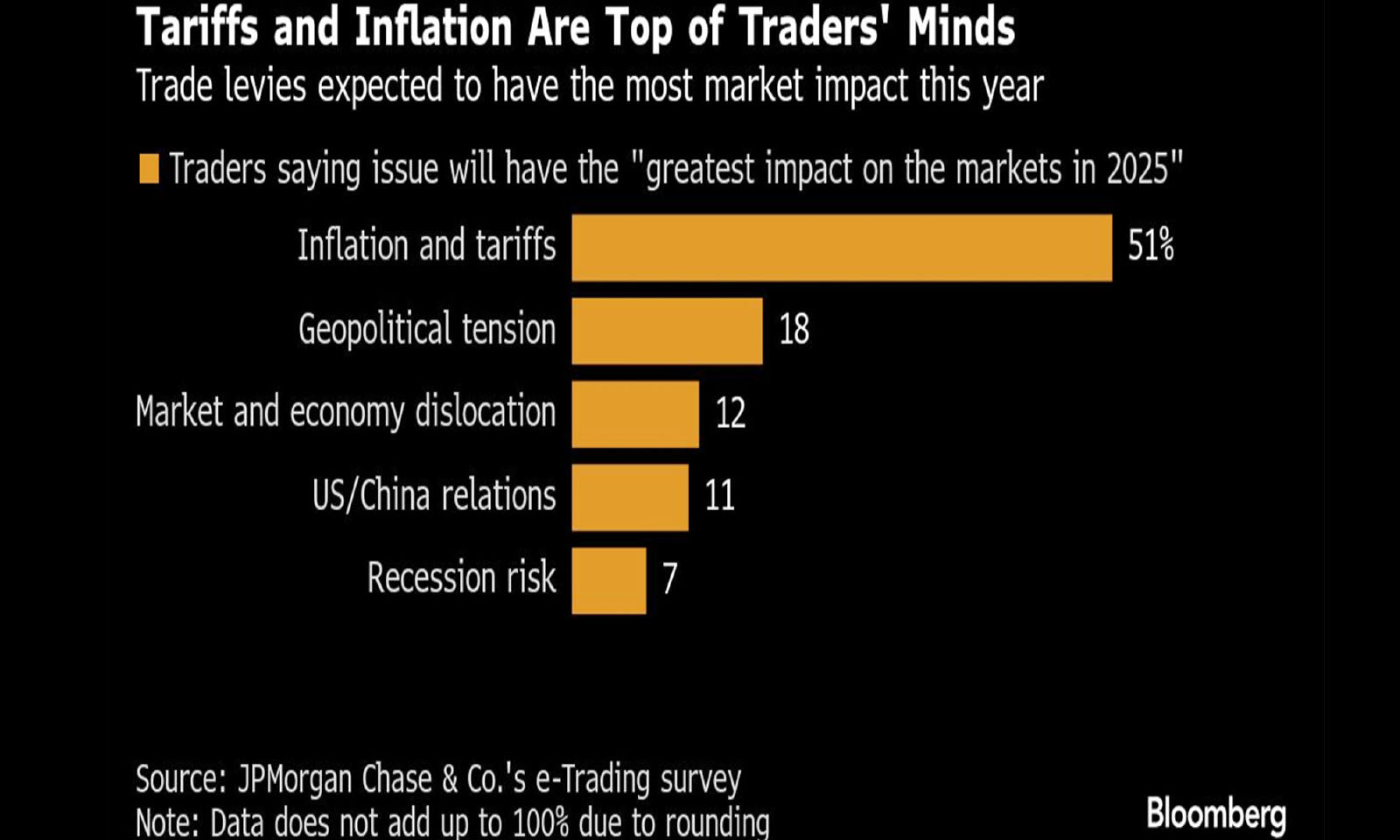
Global financial-market turbulence this week sparked by a series of US tariff announcements looks like just the beginning of a volatile year, according to a JPMorgan Chase & Co electronic trading survey.
Inflation and tariffs will have the biggest impact on markets in 2025, followed by geopolitical tension, according to the annual trading poll.
Some 41 percent surveyed highlighted volatility as their biggest anticipated daily trading challenge, up from 28 percent last year.
“What sets this year apart is the somewhat unexpected timing of volatility,” said Eddie Wen, JPMorgan’s global head of digital markets, in an interview.
“Markets are reacting to news headlines in surprising ways, and I expect this trend to continue in the current climate.”
Traders are on tenterhooks given the lack of clarity over what impact tariffs will have on different asset classes.
The annual survey of over 4,200 institutional traders was conducted last month before President Donald Trump disrupted global markets with a series of trade levies and about faces.
Those concerns are expected to boost trading of currencies like the Canadian dollar, Mexican peso and the offshore Chinese yuan, said Chi Nzelu, JPMorgan’s global head of FICC e-trading.
On Monday, the Mexican peso fell almost 3 percent before rebounding to finish the session 1,5 percent higher.
The Canadian dollar slid as much as 1.7 percent before reversing losses to close higher by 0,8 percent.
“These are really large moves for major currencies that sparked a lot of execution, from hedge funds to the retail market,” Nzelu said. “We’ll see how this year goes, but as it starts, we’re already seeing some of our busiest days.”
While hedge funds have been the most active in the foreign exchange market, the increased trading volumes around tariff news isn’t limited to that segment, he added.
The risk that higher import prices could rekindle inflation has lingered since Trump was elected president in November, dashing any expectations that the Federal Reserve will cut interest rates much further this year.
Trump had ordered 25 percent tariffs on all goods from Canada and Mexico to take effect on Tuesday but put them on hold after leaders of the two countries committed to greater efforts to stem the tide of illegal migration and illicit drug traffic.
Across-the-board tariffs of 10 percent on imports from China did go into effect but the White House hasn’t ruled out a pause.
All survey respondents said they expect to increase their electronic trading activity. That follows a years-long trend across asset classes, even for securities that are less liquid.
“Electronic trading is crucial because tariff announcements can occur over the weekend, prompting clients to seek liquidity to rebalance their portfolios at the start of the session,” said Nzelu, referring to the traditionally less liquid period that occurs during Sunday evenings in London.
“During these critical hours, they aim to access multiple channels, platforms and banks.”
Regarding platforms, traders are split between single-dealer (28 percent) and multi-dealer venues (38 percent), with 34 percent using both.
“Reduced execution/brokerage costs” is the top priority for those selecting single-dealer platforms, while reduction of information leakages is particularly important for crypto and cash equity traders. Meanwhile, some 71 percent respondents said they have no plans to trade cryptocurrencies.
That’s even as Bitcoin and other digital currencies hit record highs after Trump’s election victory.
The White House crypto czar David Sacks said the administration is studying the feasibility of creating a “Bitcoin reserve,” while some barriers for banks to offer digital-asset services appear to be falling.
“Recent headlines suggest that the new administration supports the market and recent changes have lowered the barriers for traditional banking community members to enter this space,” Wen said.
“The details are light at the moment, but we are keeping a close eye on how this develops.” — Bloomberg