Chronicle Editor
Leonard Ncube, [email protected]
FOR close to 20 months, Ms Farai Gumbo, a female teacher at BH42 Primary School in Lupane District walked 14km from her school to Kana 6 and back, just to wash her dreadlocks.
Ms Gumbo and another teacher were transferred from Kana 6 Primary School and deployed to BH42 Primary in 2021 during the third term to replace teachers that had left the school due to lack of clean water at the school.
BH42 is located in the Masukume area, Mzola East under Chief Menyezwa and is on the border with Gokwe and Binga.
The area faces serious water challenges and villagers share few water sources with animals.
While BH42 Primary School had a bush pump borehole, the water from the borehole was not clean.
The water stained clothes and as such could not be used for laundry.
Teachers used to walk for about two kilometres to village head Mr Tholo Ncube’s homestead to fetch water for domestic use.
In some instances, they asked pupils to bring them water but because the whole community also had a challenge with the resource, that was unsustainable.
Some villagers brought water containers in scotch-carts to sell to teachers and because of this challenge, many teachers left the school.
However, Ms Gumbo’s story is that of dedication, resilience and sacrifice in the midst of hardship.
She walked seven kilometres through the bush and valleys to Kana 6 Primary School to do her laundry and wash her dreadlocks which she dearly loved.
She almost left the school but because of the love and passion she has for children, she had to take the painful decision in February 2023 when she cut off her dreadlocks.
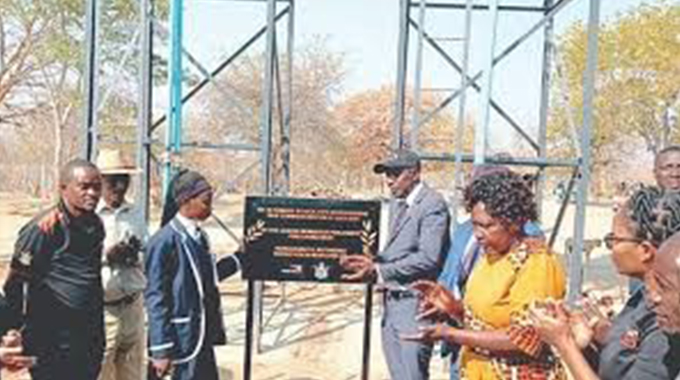
A news crew caught up with Ms Gumbo at the school recently during the commissioning of a piped water scheme by World Vision International Zimbabwe.
“It still haunts me because I loved my locks. They are more like a family thing because my siblings also wear dreadlocks. I have never applied a chemical onto my hair,” she said.
Working with Government and other partners, World Vision has come to the rescue of the school and community and installed a solar-powered borehole and taps to supply the school, teachers’ houses, school garden and community, marking the end of the era of rusty water that stains everything including people’s teeth.
“Initially I was deployed to Kana 6 where there is piped water and later transferred here because there were no teachers. When we got here, we were told that learners would bring us water from home.
“I complained after seeing some stained water in a bucket. The head explained the situation but since we were new, we could not go to villagers to ask for water. So we fetched water from the school borehole but we failed to use the water. My worst nightmare came when all my clothes got stained after washing them with the borehole water. Even the containers changed colour, I wanted to leave immediately,” said Ms Gumbo.
She said the village head visited the new teachers and explained the water situation to them.
He invited the new teachers to fetch water from his homestead like the other teachers.
Ms Gumbo said she could not carry a bucket several times to fetch enough water for cooking, washing, bathing and washing her dreadlocks.
“This place is hot so my dreadlocks needed to be washed regularly. So to conserve the little water I had, I would carry my clothes every weekend and walk to Kana 6 about seven kilometres away to do laundry and wash my locks because they needed running water.
“I arrived at the school during the third term in 2021 and this happened until February 2023 when I cut my dreadlocks because I was tired of walking seven kilometres to wash them. That is the saddest part of my life because I loved my locks.
“Since then, I have maintained short hair or had a simple carrot style. Now that we have clean water, I am ready to have my locks back. I have the old locks at home but I will not use them because they remind me of my struggles,” said Ms Gumbo.
Mr Isaac Ngwenya, BH42 Primary School head said the new piped water scheme is a blessing.
The school has 190 pupils and seven teachers.
Lupane is one of the districts whose schools, including BH42 have recorded zero percent pass rates before due to a cocktail of issues including poor learning and teaching conditions, shortage of teachers, long distances walked by pupils to school, poverty and hunger.
Some organisations, led by Lupane State University, have come up with initiatives to capacitate schools to improve pass rates.
A clean learning environment and accessible school reduces school drop-outs, early child marriages and teenage pregnancies.
“The school had water challenges. This borehole had coloured water and is not user friendly because lower grades cannot even pump. We sometimes hired scotch-carts to bring us water. Teachers were frustrated and many left,” said Mr Ngwenya.
He said now that the school had piped water, teachers had no reasons to leave the school.
“Children are also relieved because they would spend the whole day without drinking water as we used to fetch water two kilometres away at Mr Ncube’s homestead. This scheme will reduce absenteeism. We now have a garden and we will try to produce vegetables to feed the pupils,” said Mr Ngwenya.
Access to clean water and adequate sanitation facilities is a basic human right with multiple forward and backward economic linkages to key sectors including agriculture, energy and the mining sector.
The Second Republic is implementing the National Development Strategy 1 which is a vehicle towards Vision 2030 of an Upper Middle-Income Society.
However, availability of water and sanitation services remains a huge challenge in Zimbabwe with about 30 percent of households in the country having access to improved water sources and sanitation.
Government is working hard to ensure access to water and came up with a borehole drilling programme with a target for 35 000 boreholes countrywide to make sure each village has its own, through the Rural Infrastructure Development Agency (Rida), formerly District Development Fund (DDF).
Ms Sehliselo Khumalo from Rida who is the Lupane District Water and Sanitation committee chairperson said Lupane generally has challenges with access to clean water.
“We are grateful this school now has water. This borehole did not have clean water which was a challenge for learners and teachers. We worked with partners on this piped water scheme that is going to help the school and community because World Vision has put taps to enable the community to get clean water. We thank Government and these partners,” she said.
Agritex Lupane District Extension officer Ms Sukoluhle Dube challenged the school to invest in the garden.
“Government emphasises on creation of business units in schools so we are grateful that today we have commissioned this water scheme which is a first step towards that. Agriculture is an examinable subject and starts at primary level,” she said.
Access to clean water is key to achieving Government’s vision for an upper middle-income society. — @ncubeleon


 derick.khumalo