Online Reporter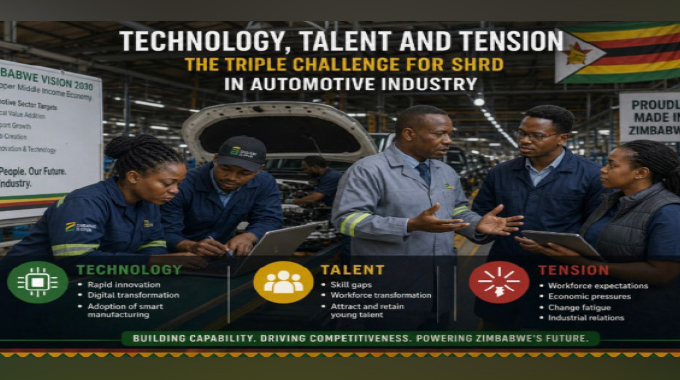
Shevonia Tafirenyika, [email protected]
Zimbabwe’s automotive retail sector is facing a period of unprecedented change. For many businesses, survival no longer depends solely on product availability or pricing. Customers are increasingly discerning, seeking expertise, reliability and fast, personalised service.
For Human Resources practitioners, this shift has turned the workforce into the frontline of competitive advantage, placing Strategic Human Resource Development (SHRD) at the heart of organisational strategy.
The concept of SHRD is unreliably simple in theory; align training, career development and performance management with the organisation’s strategic goals so that employees are both capable and motivated to deliver superior outcomes.
Globally, scholars such as Garavan, McCracken and McGuire argue that development must go beyond once off training and become a continuous, system wide process that enhances both current performance and future adaptability.
The resource-based view, popularised by Barney, suggests that employees with rare and inimitable skills represent a key source of sustained competitive advantage. Applied to Zimbabwe, SHRD promises not just a more capable workforce but also one that can differentiate formal retailers from informal traders who compete mainly on price.
However, translating theory into practice has proven far from straightforward. HR managers face multiple challenges in implementing SHRD within a volatile economic and operational environment. Budget constraints are among the most immediate hurdles.
Training programmes, whether aimed at technical automotive knowledge, digital skills, or customer service, require financial investment.
Yet many retailers must balance these costs against operational pressures, such as stock shortages, fluctuating exchange rates and the need to maintain daily sales performance. Pulling employees off the shop floor for training often conflicts with immediate operational demands, creating a tension between short-term survival and long-term capability building.
Even when training is delivered, retention issues complicate the picture. Skilled employees who acquire valuable knowledge may leave for better-paying opportunities, migrate to other regions, or establish their own businesses.
This “training for the market” phenomenon makes HR leaders wary of investing heavily, despite clear evidence that underdeveloped employees are less productive, less engaged and less likely to retain customers. Research in Zimbabwean retail shows that supportive work environments improve engagement and job satisfaction, but economic uncertainty and precarious employment still undermine workforce stability.
The pace of technological change adds another layer of complexity. New vehicle models, advanced diagnostic systems and digital sales platforms require employees to constantly update their skills. HR practitioners are under pressure to ensure that learning keeps pace with these developments, all while maintaining service levels.
This has led some organisations to adopt flexible learning approaches, including short coaching sessions, supplier-led product demonstrations, peer mentoring and digital micro-learning. Such strategies reduce cost, keep employees engaged and allow for real-time application of knowledge on the job.
Engagement itself remains a critical but fragile element of workforce performance. Kahn and Saks highlight the role of psychological engagement in driving commitment, discretionary effort and organisational outcomes.
Zimbabwean research confirms that employees who feel supported and fairly treated are more likely to invest their full energies into their roles.
Yet in contexts of economic strain, transport challenges and household responsibilities, engagement initiatives can be undermined by external pressures beyond the organisation’s control. HR teams increasingly recognise that supporting employee well-being is as vital as technical training, extending the scope of SHRD into a broader human centred strategy.
Measuring the impact of development efforts presents yet another challenge. While executives demand proof that investments in SHRD yield returns, sales and operational metrics often fluctuate due to macroeconomic factors rather than employee performance.
To address this, some retailers track customer satisfaction, repeat business, service turnaround and error reduction as proxy indicators. While imperfect, these measures offer a more nuanced understanding of the link between SHRD initiatives and performance outcomes.
Despite these hurdles, abandoning workforce development is not an option. In a sector where professional expertise and customer trust can outweigh price competition, even incremental, targeted learning interventions can have outsized effects.
By focusing on practical, contextually relevant development and fostering a supportive workplace culture, retailers can build resilience, strengthen employee loyalty and enhance the overall customer experience.
Ultimately, the story of SHRD in Zimbabwe’s automotive retail sector is one of adaptation and logicality. HR practitioners must navigate the tension between theory and reality, balancing investment in skills with operational imperatives, retention challenges and economic instability.
When managed effectively, SHRD transforms employees into strategic partners, equipping them to meet changing market demands and contributing to the long-term sustainability of many businesses.
In a marketplace where human capital increasingly determines success, the ability to develop, engage and retain a capable workforce is not merely an operational concern, it is the defining strategy of survival.
*Shevonia Tafirenyika is a Human Resources Management Masters student at Great Zimbabwe University and an HR practitioner at INDS Motors Spares. She writes here in her personal capacity and can be contacted on [email protected] or on +263779580443