

 Online Reporter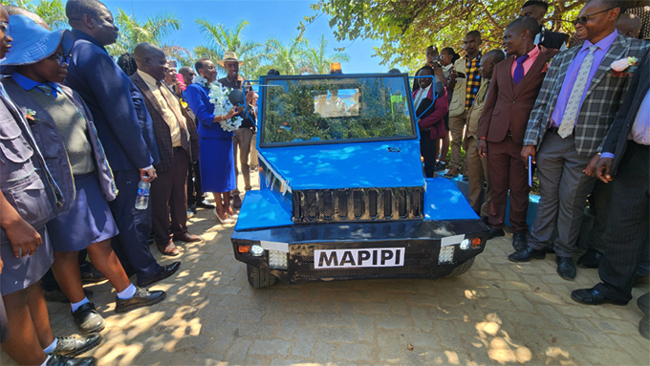
Tendai Gukutikwa
Post Reporter
FROM a distance, it could easily be mistaken for a compact military jeep — its bold stinger bars, squared body frame, and unapologetic sturdiness giving it the aura of a machine built for battle.
Raised suspension and wide 13-inch Dunlop wheels complete the rugged posture of an off-road vehicle designed to conquer rough terrain.
But step closer, and the surprise unfolds.
This is no factory-assembled product from a global production line. It is a hand-built light bakkie, engineered by 18-year-old Tinotenda Mapipi of Sakunje Village under Chief Chikore.
Powered by a Shingling 125p engine, the vehicle is a four-wheel motorbike conversion – the latest creation from a young innovator whose grassroots ingenuity is steadily earning him recognition as one of Zimbabwe’s most promising inventors.
The two-seater utility vehicle, with space for two additional passengers at the back, is fitted with a 15-litre fuel tank, a 12-volt battery, F18 suspension, and custom gear linkages capable of shifting five gears.
More than a mechanical experiment, it is a practical solution to a pressing community challenge.
The Manica Post caught up with Tinotenda for an interview recently, and had this to say:
“What made me do this project is the transport challenges we faced at school. When learners got sick, they needed to be taken to the clinic, which is about a kilometre away. Sometimes only one or two people were sick, but we had to use a big vehicle and waste fuel. So I made this small one. It is fuel-efficient, cost-saving, and suitable for rough terrain. I use it to take people to the clinic — it is more like an ambulance.”
Every modification reflects adaptation and learning.
Before building the bakkie, Tinotenda had experimented with aviation, designing and assembling a helicopter model while still in school.
Though the prototype failed to take flight, the setback became a lesson in resilience.
“The failed helicopter taught me that innovation is, not about immediate success, but about learning, adjusting, and trying again. Those lessons shaped the construction of this new vehicle,” he said.
During the interview, Tinotenda demonstrated his ingenuity further — shifting the acceleration system to the feet, integrating clutch and brake controls, and reinforcing the frame to withstand the weight of the body against the smaller motorbike engine.
Tinotenda’s journey did not begin with this vehicle.
In 2019, at just 12 years, he constructed a boat that was later used to ferry survivors during the devastating Cyclone Idai floods in Chipinge.
At a time when the entire communities were cut off by rising waters, his handmade vessel became a lifeline.
“That experience opened my eyes. I realised that what I build can help people,” he recalled.
His passion for vehicles dates back even further.
Born in 2007, Tinotenda grew up in a modest household after his parents separated when he was a year old.
Raised by his father, who operates a vehicle along the Chipinge route, he developed an unusual fascination with cars.
“We did not have a car of our own, but every time I saw one, I would scrutinise it so much. I had so much interest in how it works,” he said.
Academically, he describes himself with humility.
“It is not all of us who are intellectuals. Look at me, I did not even pass well,” he said candidly.
He wrote his ZIMSEC Ordinary Level examinations in 2025, and passed Science, FRS, Woodwork and Shona, but did not make it in Mathematics or English.
Yet within the Department of Innovation at Chibuwe Technical High School, where he enrolled in 2022, his practical intelligence found fertile breeding ground.
For Tinotenda, the recognition he is getting because of his project is encouraging, but he is far from satisfied.
“My wish is to find adequate resources so that I make something bigger and better. Right now the power is less because the engine is small and the body is stronger. I need a four-cylinder engine with more power.
“I need quad bike engines with reverse gears. I also need lap machines, pillar drills and proper car manufacturing tools,” he said.
He spoke of sponsorship and funding, not as charity, but as investment.
“In the next five years, if I get support, I see myself far. I want to go into the car manufacturing industry. I want to assist local transport and reduce costs,” he said.
The local community has rallied behind him, offering encouragement and moral support.
Yet he remains grounded.
“To youths out there, embrace your talents and skills. Recognise what you are good at. It is not all of us who are the same. But that does not mean you cannot succeed,” he urged.
His light bakkie, standing confidently on its reinforced frame, may not rival commercial brands. However, it carries within it something far more powerful, the spirit of self-reliance and courage to experiment and willpower to rise above circumstance.
His teacher, Mr Kalisto Chimoyi, who also heads the school’s Social Welfare Department, said Tinotenda’s talent was evident early on.
“Our principal, Mr Needmore Maposa, identified him and brought him to the department. We assist learners who come from disadvantaged families.
“The school supported him with school fees, and he decided to give back through innovation.
“He was impressed by what the Social Welfare Department was doing, so he poured himself into his projects,” said Mr Chimoyi.
For the school head, Mr Maposa, Tinotenda represents the very essence of technical education.
“He is proof that talent can be discovered and nurtured within our rural schools. When we talk about Heritage-Based Education and innovation-driven development, this is exactly what we mean. Tinotenda is solving local problems using local resources,” said Mr Maposa.
The young innovator’s work has also drawn high-level attention from Primary and Secondary Education Deputy Minister, Honourable Angeline Gata, who recently toured the vehicle and commended him for his ingenuity.
“What I have seen here is a shining example of the innovation capacity that exists within our young people. This is not just a vehicle. It is a statement that Zimbabwean learners, given opportunity and guidance, can design and build solutions that respond directly to community needs,” said Deputy Minister Gata.
While it does not yet have a reverse gear, because it is still using a motorbike system, the innovation stands as proof of concept – that creativity, when nurtured, can become a powerful development tool.
Deputy Minister Gata praised both Tinotenda and Chibuwe Technical High School for embracing practical skills development.
“Our education system is moving towards empowering learners with hands-on competencies. Tinotenda has demonstrated resilience, creativity and determination. We are proud of him, and we encourage partners and industry players to come on board and support such talent. The sky is not the limit for our learners. With the right support structures, innovation hubs and community backing, they can compete on any platform,” she said.
And for Tinotenda Mapipi, the boy who once studied cars from a distance, the road ahead is no longer something to observe; it is something he is determined to build.


 Bongani Ndlovu
We have seen and heard of such inventions and innovations since the advent of independence. My question is; where are all those people and their experiments?