

 admin
admin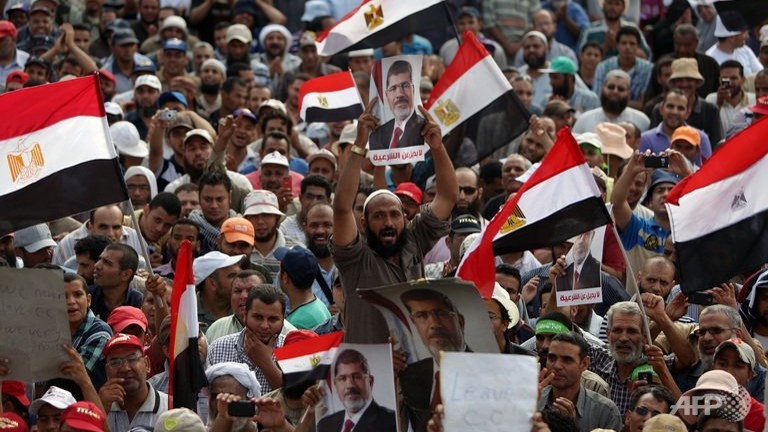
 Cairo – Egypt was on edge yesterday ahead of rival protests by the military and Islamists, as the government declared a “war on terrorism” to end violence convulsing the country since president Mohammed Morsi’s overthrow. Police said they were planning massive reinforcements to secure today’s rallies, which raise the prospect of further bloodshed between Islamists demanding Morsi’s reinstatement and an array of opponents including the military.
The fugitive leader of Morsi’s Muslim Brotherhood Mohamed Badei urged Egyptians to peacefully make a “stand for freedom and legitimacy, and against the bloody coup”, in a statement yesterday.
The United States said on Wednesday it was “very concerned” by military chief Abdel Fattah al-Sisi’s call for a rally to justify a crackdown on what he called “terrorism and violence.”
Washington, which has close ties with Egypt’s military, also announced it had decided to suspend a plan to supply its ally with F-16 warplanes.
The Brotherhood and allied Islamist groups had denounced Sisi’s call as “an announcement of civil war” and said they would press on with their own demonstrations today.
Egyptian newspapers, mostly hostile to the Brotherhood, featured Sisi’s call, made in a Wednesday speech, in their front page headlines.
The state-owned Al-Akhbar ran a banner, partially in large red font, reading: “Sisi’s message has been delivered. And the people respond: We mandate you.”
“Sisi calls. And the people respond,” reported the leading independent daily, Al-Masry al-Youm.
In Qatar, a Muslim organisation headed by the influential Egyptian-born cleric Yusuf al-Qaradawi issued an edict against obeying Sisi’s call, saying it could lead to “civil war”.
The general’s unusual demand – the military insists he is merely a defence minister and deputy premier in the army-installed cabinet – came after calls for a crackdown on Islamists staging sometimes bloody protests since the 3 July coup.
“Next Friday, all honourable Egyptians must take to the street to give me a mandate and command to end terrorism and violence,” the general said, wearing dark sunglasses as he addressed a military graduation ceremony near Alexandria.
A spokesperson for army-installed interim president Adly Mansour later said Egypt “has begun a war on terrorism”.
Hours before Sisi’s speech, a crude time bomb placed outside a police station in the Nile Delta city of Mansura killed a police conscript, the interior ministry said.
In the restive Sinai peninsula, where militants have staged daily attacks on security forces, two soldiers were shot dead in separate ambushes on Wednesday.
More than 170 people have died in political unrest since the end of June, according to an AFP tally, many of them in clashes between Morsi’s supporters and opponents.
Huge crowds of Egyptians protested against Morsi on 30 June, after just one turbulent year of his presidency.
Senior Brotherhood leader Essam al-Erian said Morsi loyalists would not be intimidated by the army chief’s call for mass rallies.
“Your threat will not prevent millions from continuously protesting,” Erian wrote on Facebook.
Tamarod, the movement that spearheaded the mass anti-Morsi rallies that led up to the coup, called on supporters to take to the streets again today to support the army.
“We call on the great Egyptian people to rally on Friday across Egypt to demand . . . Morsi’s trial and to support the military in its upcoming war on terrorism.”
Morsi’s detention, and the subsequent arrests of senior Brotherhood leaders, have hardened his supporters’ stance.
His family said it would sue Sisi and also take legal action outside Egypt.
The United States has joined other Western nations in calling for Morsi’s release, although it has declined to characterise his overthrow as a coup, which would force a suspension of US aid.
Meanwhile, supporters of Morsi continued to rally after an apparent call by Egypt’s army chief to crack down on dissenters.
Thousands of pro-Morsi supporters filled Nasr City yesterday, repeating their weeks-long demand that the deposed president – who was removed by the army on 3 July – is reinstated.
Many are also gathered at the al-Azhar mosque.
“Protesters here are calling for the Grand Imam of this mosque, Ahmed el-Tayeb, to go because he has accepted the roadmap for Egypt under interim President Adly Mansour,” said Al Jazeera’s Nadim Baba, reporting from outside the mosque.
“It’s invevitable that there will be more protests on Thursday,” he said.
Military helicopters circled above Cairo early in the morning following a “state of alert” declaration by the army. The alert was declared on Wednesday after general Abdel Fattah El Sisi called for all Egyptians to rally against what he termed “violence and potential terrorism” today.
In a speech to army graduates, he also denied accusations that he had betrayed the deposed president, Mohamed Morsi.
“I ask . . . that next [upcoming] Friday all honest and trustworthy Egyptians must come out,” Sisi said. “Why come out? They come out to give me the mandate and order that I confront violence and potential terrorism.”
Elsewhere, Sisi vowed to stick to a political roadmap that laid the way for a reform of the constitution and new elections within some six months.
He said his appeal for protests was not a call for violence and expressed support for efforts for national reconciliation.
The military reacted soon after, declaring the “state of alert”.
Ahmed Al-Meslemani, media adviser to the interim leader Mansour, echoed the call, asking people to take to the streets to protect the “revolutionary legitimacy” and support efforts to “fight terrorism”.
The Muslim Brotherhood reacted quickly, with senior member Essam al-Erian issuing a statement directed at Sisi saying: “Your threat will not prevent millions to rally against [the] coup … You have been always in your office conspiring.”
The state of alert includes additional army troops on streets in provinces in greater Cairo and surrounding areas.
Sources confirmed to Al Jazeera that armed forces would work on preventing attempts to “incite violence or terrorism”.
The army chief’s speech came ahead of “national reconciliation” sessions called for by the interim leader Adly Mansour, and followed renewed violence in and outside the capital, in which at least three people died. – Al Jazeera


 Online Reporter
 derick.khumalo