

 Online Reporter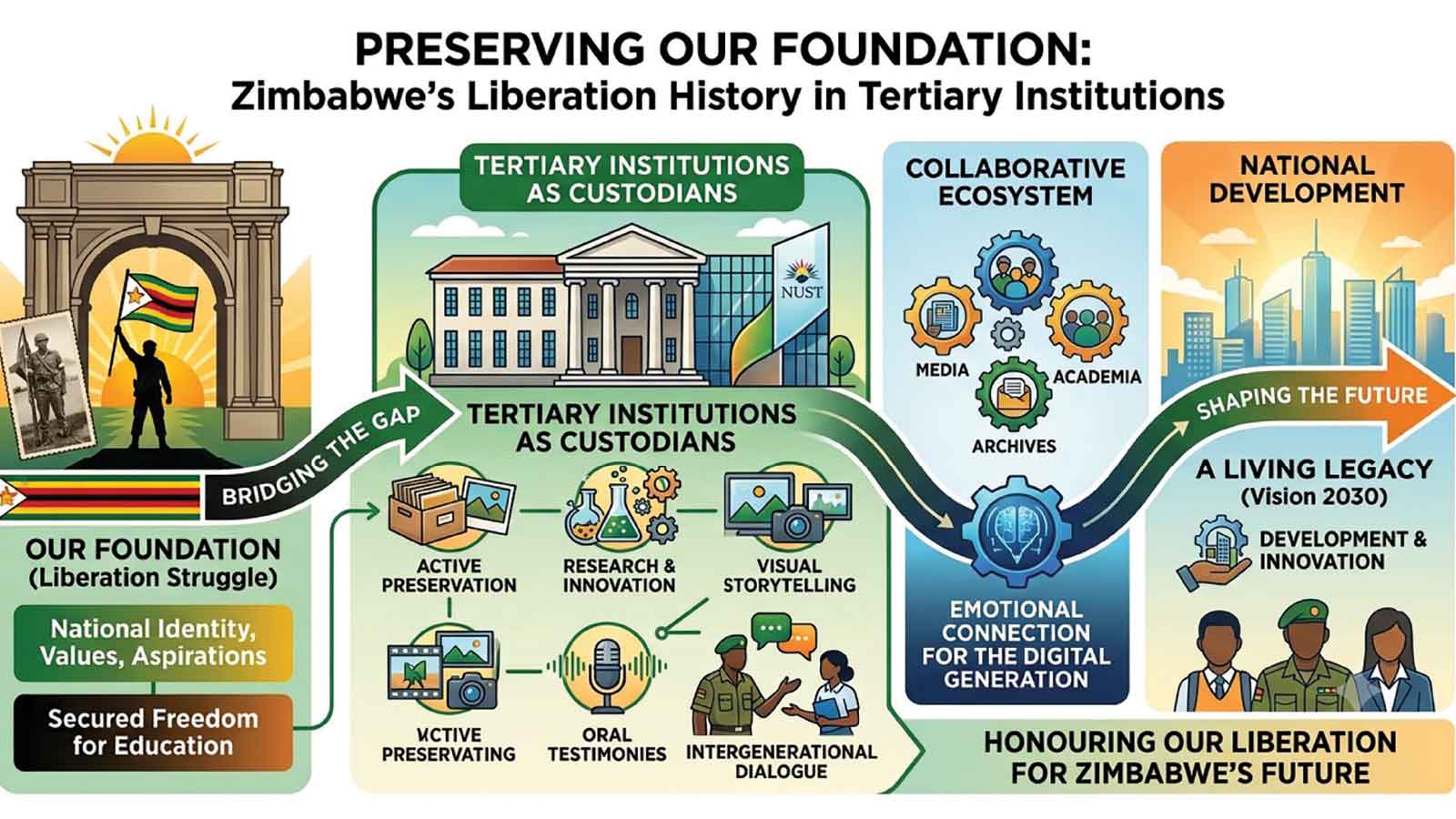
Gibson Mhaka
Zimpapers Politics Hub
HISTORY is never merely a record of the past; it is the foundation upon which a nation builds its identity, values and aspirations.
People who preserve their history are better equipped to shape their future, while those who neglect it risk losing the very ideals that define them.
For decades after Independence, the responsibility of preserving Zimbabwe’s liberation history rested largely with national commemorations, political platforms and public memorials.
While these have played a significant role in honouring the country’s liberation heroes and heroines, they are no longer sufficient on their own to engage a generation growing up in an increasingly digital and knowledge-driven world.
There is now a compelling need to move beyond annual commemorations and integrate liberation history into spaces where young people learn, question, innovate and develop.
The Heroes’ Day photographic exhibition recently hosted by the National University of Science and Technology (Nust) in Bulawayo under the theme, “Lest We Forget: A Visual Journey of Sacrifice and Liberation,” demonstrated why Zimbabwe’s tertiary institutions should become active custodians of the nation’s liberation heritage.
By bringing together authentic archival photographs, oral testimonies, academics, journalists, school pupils and liberation war veterans, the exhibition transformed history from textbooks into a living experience that inspired dialogue across generations.
Taking liberation history beyond commemorations
Universities are centres of knowledge creation, research and innovation. As such, they have a responsibility not only to produce graduates but also to preserve the historical foundations upon which the nation was built.
The liberation struggle secured the freedom that enables Zimbabwe’s universities to flourish today. It is therefore fitting that institutions of higher learning play a leading role in documenting, researching and interpreting that history.
Officially opening the exhibition, ZANU PF Bulawayo provincial chairman Cde Jabulani Sibanda applauded Nust for taking Heroes’ Day commemorations beyond traditional ceremonies by bringing liberation history into an academic environment where students could engage directly with those who participated in the struggle.
“We are excited to see a national institution of this level, a university, recognising the commemoration of the people that gave their lives, their time, their teenage years, their everything for the freedom of the generations that were to come.”
His remarks captured an important reality.
Universities are uniquely positioned to preserve liberation history because they combine research, archival science, journalism, digital technology and education.
Through these disciplines, historical records can be authenticated, preserved and presented in ways that remain relevant to future generations.
Bridging the Generational Gap
One of the greatest challenges facing Zimbabwe today is ensuring that young people appreciate the sacrifices that brought Independence.
Many students know the liberation struggle only through textbooks, examination syllabi or annual Heroes’ Day commemorations.
While these remain important, they cannot fully capture the human experiences, sacrifices and emotions that defined the struggle.
The Nust exhibition demonstrated the power of visual storytelling. Historic photographs, archival documents and first-hand testimonies from liberation war veterans brought history to life, allowing learners to connect emotionally with events that previously seemed distant.
For St Columba’s High School Lower Six learner Ronewa Ndlovu, the exhibition fundamentally changed her understanding of Heroes’ Day.
“Being someone who studies arts, I knew very little about Heroes’ Day and many of our liberation heroes, but this exhibition has given me a greater insight into the liberation struggle.
“It has shown me why it is important for schoolchildren to learn about our history, culture and heritage.
“I believe these exhibitions should be held regularly because they are educational, inspirational and help young people appreciate the sacrifices that brought us our freedom.”
Her sentiments illustrate why universities must become centres of historical engagement.
By opening their doors to schools and communities, tertiary institutions can create opportunities for young Zimbabweans to interact directly with liberation war veterans, historians and archivists.
Joshua Chatindo, the Junior Parliament representative for Bulawayo Central and a learner at Gifford High School, echoed the same sentiments.
“This event is a great initiative because it allows the youth to engage with the heroes of the liberation struggle.
“It enables us to receive first-hand information and understand the critical details of our country’s history.
“I believe such programmes should also be taken to rural and disadvantaged communities so that every young Zimbabwean has an opportunity to learn about our liberation heritage.”
His observations reinforce the need to extend such initiatives beyond university campuses so that every young Zimbabwean has access to authentic accounts of the liberation struggle.
Journalism, archives and academia: A shared responsibility
The exhibition also highlighted the complementary roles of universities, the media and archival institutions in preserving Zimbabwe’s liberation history.
A fitting tribute was paid to the late veteran journalist and liberation war hero Mkhululi Sibanda, whose Lest We Forget column in the Sunday News documented the stories of both renowned and lesser-known liberation fighters.
Sunday News Day Editor Vincent Gono emphasised the enduring importance of documenting liberation history.
“The focus of Lest We Forget is to ensure that Zimbabwe’s liberation struggle and Zimbabwe’s liberation memory are preserved.”
His remarks underscore journalism’s role as the first draft of history. Through accurate reporting, oral history and investigative documentation, journalists preserve narratives that might otherwise disappear with time.
Professor Lungile Tshuma stressed that academia and journalism must work together in safeguarding national memory.
“A nation which wants to grow together should share its memories with the young generation so that they understand where the country is coming from and where the country is going.”
Equally significant was the contribution of the National Archives of Zimbabwe.
Director Ms Brenda Mamvura said preserving archival material was essential in protecting the country’s collective memory.
“By preserving these materials, the National Archives protects the nation’s collective memory, promotes historical research and ensures that future generations understand the sacrifices made to achieve this independence.”
Together, universities, archives and the media form an ecosystem capable of preserving authentic historical records while ensuring that future generations have access to credible sources of information.
From liberation memory to national development
Perhaps the exhibition’s greatest lesson was that preserving history is not an end in itself.
The liberation struggle was fought to secure political freedom, national sovereignty and the opportunity for Zimbabweans to shape their own destiny.
Today’s generation carries the responsibility of translating those gains into scientific advancement, industrialisation and economic transformation.
Nust Vice-Chancellor Professor Mqhele Dlodlo captured this relationship between liberation history and education.
“Heroes’ Day is not simply a date on our national calendar. It is a solemn reminder of the sacrifices made by the sons and daughters of this soil that gave us the freedom to educate and to stand here today as a sovereign people.”
His remarks remind students that the opportunity to study, research and innovate was made possible by those who fought for the country’s freedom.
Cde Sibanda challenged young people to honour that sacrifice not only by remembering the past but by contributing to Zimbabwe’s future through innovation, entrepreneurship, research and industrial development.
In doing so, he reinforced the idea that the liberation struggle laid the foundation upon which future generations must build a prosperous and self-reliant nation.
The Nust Heroes’ Day Photographic Exhibition offers an important blueprint for Zimbabwe’s higher education sector.
It demonstrated that universities should not merely commemorate history; they should actively preserve, interpret and transmit it through research, teaching, archives, journalism and digital innovation.
As Zimbabwe continues pursuing Vision 2030, tertiary institutions have an increasingly important role in ensuring that liberation history remains a living source of national identity, patriotism and inspiration.
By preserving the past while equipping young people to shape the future, universities will not only honour the sacrifices of the liberation heroes and heroines but also help secure the legacy they fought to leave behind.



