malvernmugadzikwa
Russia’s President Vladimir Putin — a grandmaster of international politics — recently invited President ED and Bolivia’s Luis Acre to grace the 27th St Petersburg International Economic Forum (SPIEF), which ran from June 5 to 8.
The two leaders had the happy distinction of being the only Heads of State to be invited to grace the auspicious global event, which is also described as the “Russian Davos”.
Since its inception in 1997, the forum has provided a global platform to discuss critical issues facing the world.
This year, it hosted delegates from more than 139 countries, notwithstanding determined attempts by the West to ostracise Russia.

We might never know what motivated Putin to invite only ED and President Acre to St Petersburg, a city that was founded on May 27, 1703 by Peter the Great, who made Russia a major European power, but what we do know is that both Zimbabwe and Bolivia have one thing in common — they are fabulously rich in mineral resources, particularly lithium, or “white gold”, which is considered the “oil of the 21st century”.
Bolivia, in particular, holds an estimated 23 million tonnes of lithium reserves, the world’s largest, and, together with other South American countries Argentina and Chile, forms the “lithium triangle”, which holds more than half the world’s lithium deposits. However, just like most countries in the Global South, Bolivia might be rich in mineral resources, but it still finds it difficult to deliver prosperity to its people.
Incidentally, it is presently in the throes of a major economic crisis that is threatening political stability.
As recently as June 26 this year, about 10 days ago, there were dramatic scenes in the capital, La Paz, when President Acre had to stare down a rogue army general, Juan José Zúñiga, who led troops in an abortive coup.
It took the determined stand by President Acre and ordinary Bolivians, who poured onto the streets of the capital, to stop the soldiers in their tracks.
But such incidents are all too familiar in Bolivia, which has reportedly had 190 coups since its independence in 1825.
It roughly averages to a coup in each of the 199 years that the country has been independent.
Incredible!
Curiously, in 2019, the country’s first indigenous president, Evo Morales — under whose administration Acre served as finance minister and during whose tenure Bolivia experienced a golden period of sustained economic growth — was forced to resign by the military, led by General Williams Kaliman, after what was described as a “contested vote” that was purportedly marred by allegations of fraud.
It was all a lie. You see, Morales and his party, the Movement for Socialism (MAS), were always targeted, particularly for their push to nationalise Bolivia’s oil and gas, among other critical resources.
It is, however, believed that it is his stance on lithium that proved fatal.
After declaring the mineral as a strategic resource, Morales also founded YLB, a national lithium company, in 2008 and was determined to beneficiate the mineral for the world market.
So, tight regulations made it difficult for multinational companies such as FMC (America), Eramet (France) and Posco (South Korea) to get a share of Bolivia’s lithium market.
Morales insisted that if the companies wanted to develop the resource, they had to partner with YLB. This obviously made him unpopular with the usual suspects who prey on the Global South for critical raw materials.
In an interview from exile on December 24, 2019, Morales blamed the United States for engineering the coup in order to get a slice of Bolivia’s lithium.
“It was a national and international coup d’etat,” Morales told AFP.
“Industrialised countries don’t want competition . . . That’s why I’m absolutely convinced it’s a coup against lithium . . .
“We as a state had begun industrialising lithium . . . As a small country of 10 million inhabitants, we were soon going to set the price of lithium . . . They know we have the greatest lithium reserves in the world of 16 000 square kilometres.”
Morales’ view was later corroborated by socialist Federico Nacif, who researches about lithium in Bolivia, Argentina and Chile.
“Morales conducted hard negotiations with the Germans in order to develop a sovereign and strategic industry that would potentially play a major role in the global market,” he said.
“No one gives up and transfers technology easily, it’s the hardest thing to achieve and develop. Bolivia’s lithium policy has been divergent, instead of convergent policy towards global powers and the role that’s been designated to South American countries as merely raw material providers.”
So, in a nutshell, Bolivia’s rich mineral resources has been its curse.
Thankfully, MAS, under Acre, came back to power in October 2020.
But just like his predecessor, the new leader continues to incense the West by deliberately partnering with Russian and Chinese companies to develop its lithium.
During the first half of last year, Bolivia, for example, signed three lithium deals with two Chinese companies and one Russian firm worth US$2,8 billion.
And this is an unpardonable sin, which helps to explain developments in Bolivia over the past couple of weeks.
Rewriting the rules
In the last instalment, Bishop Lazi wrote about Malawi’s founding president, Kamuzu Banda, a maverick and enigmatic leader who decided to throw in his lot with the West at a time of the great-power rivalry between the US-led Western bloc and Russia-led Eastern bloc.
It did not work out as Banda thought it would, as the ostensible “support” from the West and its economic model failed to deliver prosperity to ordinary Malawians.
This is precisely because, as currently rigged, the obtaining unipolar political, economic, social and cultural global order is meant to benefit and prosper the West and deliver misery and poverty to the rest of the world.
Just like South American countries, the Global South, Zimbabwe included, is also designated as “merely raw material providers”, as observed by Nacif.
So, nothing good will ever come from prescriptions from the West.
Luke 6:43-45 says: “No good tree bears bad fruit, nor does a bad tree bear good fruit. Each tree is recognised by its own fruit. People do not pick figs from thornbushes, or grapes from briers. A good man brings good things out of the good stored up in his heart, and an evil man brings evil things out of the evil stored up in his heart. For the mouth speaks what the heart is full of.”
And, as the Bishop recently observed, we are currently living in another consequential epoch where the great-power rivalry is now defined by the competition — nay, bristling contest — between US and China.
It is widely acknowledged that control of the critical raw materials, which include cobalt, nickel, copper, lithium and rare earths, would most likely shape future global power dynamics and influence.
Cobalt is critical in the defence industry as it powers jet engines, nickel and titanium make powerful alloys, while lithium is important in the manufacture of batteries needed to power electric vehicles and smartphones.
All these are instruments of power in the technologically powered 21st century.
Instructively, on June 20 last year, US legislators introduced the Critical Mineral Independence Act to push the Department of Defence to “achieve critical mineral supply chain independence from China, Russia and other geostrategic competitors and adversaries”.
All this puts Africa at the centre of this epic tussle for critical minerals, which is manifesting in increased overtures to partner the continent through platforms such as the South Korea-Africa Summit and the US-Africa Leaders Summit.
Thank God for sanctions
But thanks to sanctions that have been used to attack Zimbabwe’s economy over the past 23 years, we now know how to navigate the geopolitical terrain and leverage on our fabulous mineral resources to achieve our ambitious targets.
By the way, Zimbabwe boasts over 60 minerals, including rare earths and possibly uranium.
This is why, despite the El Niño-induced drought and sanctions, we have managed to grow our exports, most of which are beginning to be increasingly beneficiated, to average more than half a billion US dollars every month.
In May, for example, our exports topped US$583 million, which is impressive.
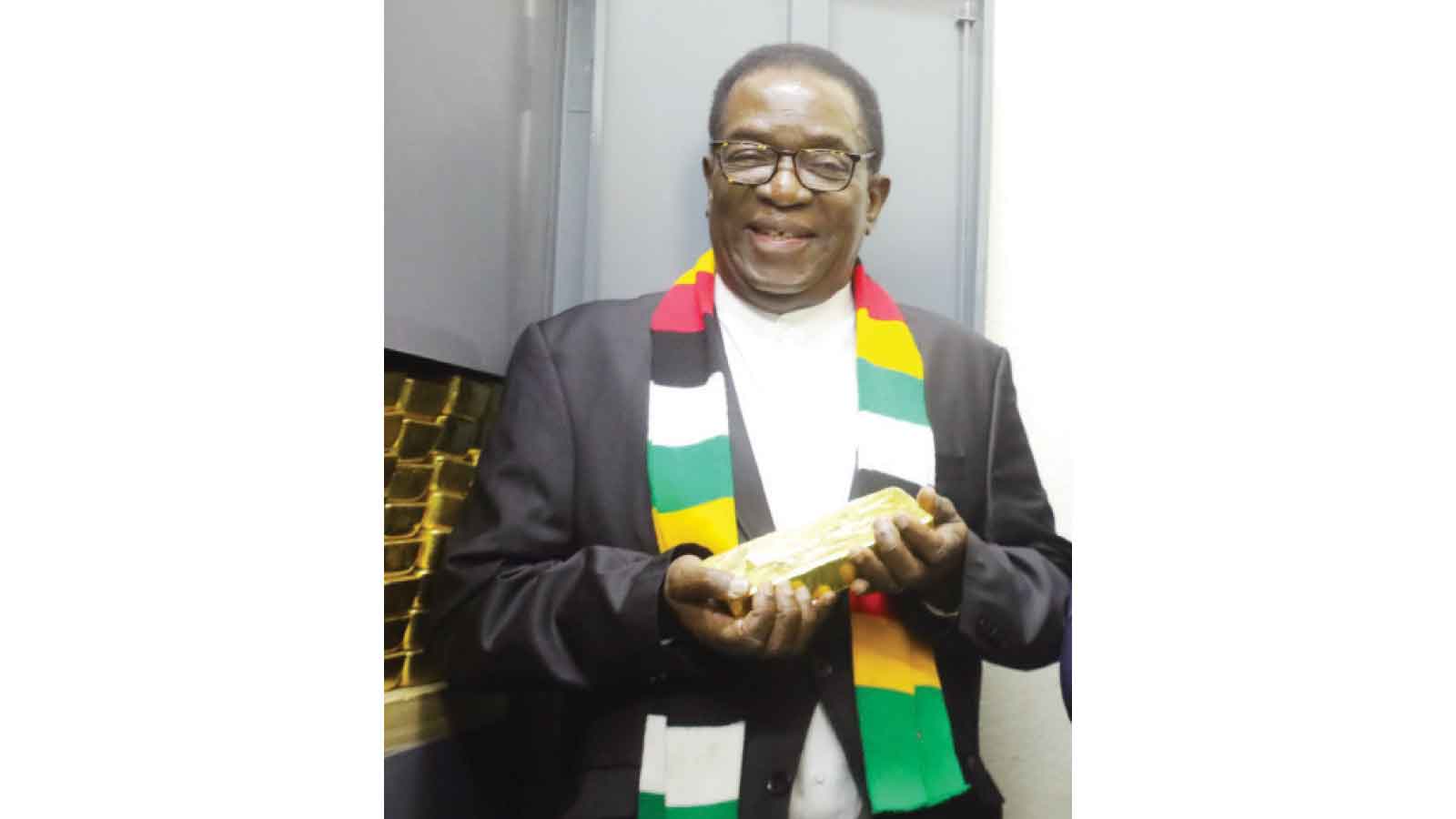
Our gold, among other precious minerals, is now anchoring our new currency, Zimbabwe Gold (ZiG), helping to insulate it against external attacks by our enemies.
By last week, the reserves that anchor the local unit were inching towards US$400 million, which is crucial insofar as it guarantees a stable and sustainable unit of exchange.
ED’s thrust to promote value addition will help to unlock more value from our mineral riches.
The most valuable lesson we have learnt under ED’s Second Republic, however, is that our minerals will never be our curse but the source of our salvation.
We can now see the promised land.
Bishop out!


 Online Reporter