Online Reporter
On Monday last week, the French military, as they have done for the past 145 years, rolled out an ostentatious military parade to commemorate Bastille Day, continuing a tradition that has endured since 1880.
However, the media, as they are wont to do, focused on trifles and trivialities.
Rather than dwell on the significance of this annual grand event, so much was made of the series of bizarre events during Monday’s parade, such as the soldier who was bleeding from the ear, the horse that fell to the ground and another that broke away from the cavalry formation.
Perhaps such oddities are a spark that provides the much-needed break from the banalities of the annual event.
However, the profound meaning of Bastille Day was not lost on folks such as Bishop Lazi, who studied European history, of which the French Revolution that it ushered in was a staple.
A little bit of history will suffice.
You see, when an angry mob, on July 14, 1789, stormed the Bastille — which, as a state prison and military fortress, represented the tyrannical regime of the Bourbon monarch, then under King Louis XVI — it set off a series of events that heralded the beginning of the French Revolution.
The motivation behind this mob was not so much to overrun an institution that was a symbol of the oppressive regime as it was to seize from the fortress muskets and gunpowder needed for the rebellion.
On that fateful day, July 14, the Bastille, which was built around 1300 during the Hundred Years’ War with Britain to protect the eastern entrance of the city of Paris, only had seven prisoners — four, who were detained for forgery; two, who were considered lunatics; and another one who was held at his family’s request.
Forget the pageantry of the modern-day parades, the storming of the Bastille and the revolution it engendered were episodes of unconscionable violence, savagery and barbarism. For instance, when the riled-up mob stormed the fortress, they took the governor of the Bastille, Bernard-René de Launay, prisoner.
They later murdered him, cut off his head, put it on a pike and paraded it around the city.
It foreshadowed the bloodletting that would surely follow.
As the violent uprising grew, power began to slip away from King Louis XVI, who was later convicted of treason and guillotined in the Place de la Révolution in Paris on January 21, 1793.
His wife, the infamous Marie Antoinette, met the same fate on October 16 the same year.
Just a small detail here: A guillotine was literally a killing machine that had a heavy blade to behead condemned victims.
The bloodshed became pronounced when revolutionaries such as Maximilian Robespierre embarked on a crusade, eerily referred to as the Reign of Terror (September 5, 1793 to July 27, 1794), that was targeted at eliminating supposed counter-revolutionaries.
More than 17 000 people were savagely executed as a result.
Ironically, this period of unimaginable terror only ended when Robespierre himself was executed on July 28, 1794. Kikikikiki.
Indeed, Karma has a crude sense of humour.
It proves that violence is a “Frankenstein monster” that can potentially become uncontrollable and turn against its own creator.
However, after the revolution began, France went through several cycles of monarchy, empire and republic before the dust finally settled.
But this seismic political, economic, social and cultural shift was important insofar as it asserted that legitimate power comes from the people.
It also led to the Declaration of the Rights of Man and the Citizen in 1789, which proclaimed that citizens are equal before the law.
In addition to introducing written constitutions and legal protections for individual rights that laid the groundwork for modern civil liberties, the revolution popularised representative democracy, where leaders are chosen by the people.
Merit also became a major consideration over birthright.
Historians say the revolution essentially planted seeds of liberty, equality and fraternity across the world.
Blood and tears
Revolutions are not pretty; they are messy. Since they inherently involve profound changes in the political, social and economic order, they are oftentimes bloody and violent.
Here in our teapot-shaped Republic, we have witnessed this in our key epochs, such as when we overthrew the racist white minority settler regime.
We also saw it during the Land Reform Programme at the turn of the millennium when we took back land that had been appropriated by the colonial regime.
It was a sacred revolution that united the land with its rightful owners.
Since there was no textbook formula to redistribute the land under such circumstances, it was naturally disruptive, which was considered by some to be chaotic.
It was bound to be painful.
EFF president Julius Malema aptly summed it up sometime in July 2013 when he said: “You can say whatever you want to say about Zimbabweans, in the next 10 years, they will be the only Africans in the whole of Africa who own their country. Because why?
They were ready to take the pain. Revolution is about pain; revolution is change, and change is painful. We are ready for that pain; we need that pain.”
Sweet fruits of revolution
It is, however, now close to three decades after the late Chief Svosve (Enock Gahadza Zenda) and his people, armed with hoes and axes, moved from villages such as Magorimbo, Mupazviriho, Chematanda, Kanjiva and Nyabonde, Choto, Mumvuma and Mareverwa in Mashonaland East province, where they had been condemned by colonial administrators, to four sprawling white-owned farms — Bruce Farm, Daskop Farm, Igava and Homepark — in a development that marked the beginning of the Land Reform Programme.
Unfortunately, our Generation Z did not see this tumultuous period, which was so consequential that it rewrote the history of modern-day Zimbabwe.
Not only did it hand back to indigenes their heritage and means of production; it also attracted the wrath of the West, which was determined to protect its kith and kin who were benefitting from the land.
So, this materially reshaped our foreign relations, as the United States, the United Kingdom and their allies worked assiduously to isolate Zimbabwe, both economically and politically.
Although we have bravely endured the pain for the past 27 years, our people have since learnt to work the land and produce more than the white man ever did, putting paid to the racist theory and narrative that the black man is neither intelligent nor capable of producing enough food to feed himself.
By 2010, it was already becoming clear that, contrary to propaganda from the West, Zimbabwe’s Land Reform Programme would deliver results with time.
A 10-year study titled “Zimbabwe’s Land Reform: Myths and Realities”, conducted by Ian Scoones from the UK’s Institute of Development Studies at Sussex University, said:
“What we have observed on the ground does not represent the political and
media stereotypes of abject failure; but nor indeed are we observing universal, roaring success.”
However, 15 years after Scoones’ study, we can now say land reform was a roaring success.
As the Bishop writes this, tobacco deliveries have now reached an all-time record of 346 million kilogrammes, with smallholder farmers who benefitted from the Land Reform Programme contributing about 85 percent of the crop.
Production is expected to rise even further in the coming season as the area put under the crop increases and farmers gain the expertise and resources to reinvest in their ventures.
Another record wheat harvest beckons after farmers planted 122 000 hectares (ha), more than the 120 000ha target.
More than 600 000 tonnes (t) of the cereal are expected, which will naturally better last year’s record of 563 961t.
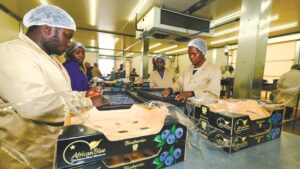
Zimbabwe is also now counted as the biggest producer of blueberry in Africa.
We are now harvesting sweet dividends from our revolution.
Thank God we have lived to see the roaring success of the Land Reform Programme.
This should embolden people who were similarly dispossessed of their land around the globe.
Our heroes, who laid down their lives to reclaim the land, did not die in vain after all.
Bishop out!


 Online Reporter