

 Chronicle Editor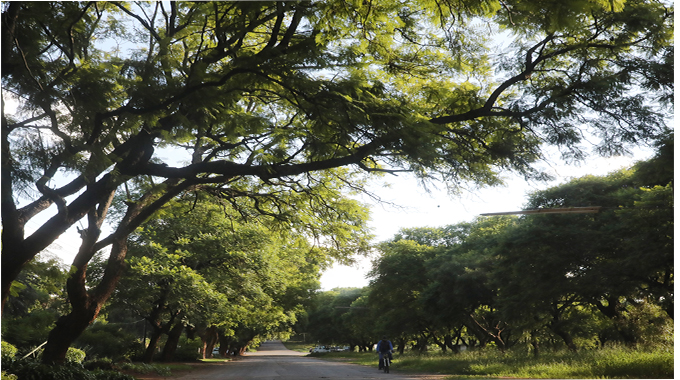
Nkosilathi Sibanda
TREES that align close to highways can either save lives, injure or kill, in the event of an accident. So many road users can testify to this.
Soon after long distance travel was permitted after the long Covid-19-induced lockdown, buses that ply the rural areas route were the first to hit the highways.

People yearned to travel home, the lifting of the ban was a blessing. Excited of his journey after seven months of lockdown, was Mr Kildon Moto, a driver at one of Bulawayo’s well-known companies.
On that Wednesday morning as he hit the ignition of his 75-seater bus, he beamed at the sight of nature by the roadside as he cruised the big engine on the tarmac.
Be it in summer, amid the lush green of the veld or during the trees’ lifeless bristle in winter, drivers are sure to enjoy what nature has to offer as one goes behind the wheel while looking outside the window.
But, that beauty hides what mankind has lived to endure the acknowledgement that roadside trees and objects kill. In fact, road construction engineers say trees that are close to highways are an obstruction. They call them death traps.
Road safety experts say circumstances that lead to vehicles hitting trees are varied. The reasons are an inconclusive outcome.
It is common and unavoidable for drivers to take a look on the outside and lose concentration. Nature that surrounds the roadside is at times tempting for a “looksee”. But, that comes with danger.
Accident investigations by the Zimbabwe Republic Police (ZRP) reveal that in events of avoiding head-on collisions, drivers take the option of moving away from the road. Without control, of which at most times it happens to many, they hit a tree. It is worse when vehicles are not in good condition or if the road is in a bad shape, so say road construction experts.
Such was the occurrence that befell Mr Moto along the Bulawayo-Victoria Falls.
In about an hour-and-a-half after leaving Bulawayo for Lupane, the white bus had budged at some place between Insuza and Mbembesi. The 1960s AVM manufactured bus swayed off course and pulled along for 500 metres in the dense trees lined roadside. It ploughed the vegetation and was eventually forced to stop as its front wheels got stuck in the sandy red soils.
Mr Moto had caught sight of a haulage truck that had encroached his lane. As a defensive licence holder, his first instinct was to save lives, both on board his bus and the truck.
A few passengers were injured and ferried to Mpilo hospital. The lucky ones to escape unscathed told of the tale of how the drivers saved their lives.
The Insuza-Mbembesi stretch along Victoria Falls road is one of a scenery of well lined up trees that form a canopy that is an awe to any driver countrywide. The trees line up just a few metres from the road.
That distance is what engineers call the road servitude and it does not apply to trees only.
Villagers who stay nearby say there have been many accidents in that stretch of the highway, mainly cashed by tree crashes.
Experts in road infrastructure locally say while trees have an important function in having an influence on ecology and the modern transport systems, there has to be caution in creating space alongside roads.
“The road servitudes in most of our highways is 35 metres to 50 metres. As such, while we know how deadly tree crashes can be, drivers have to be cautious and avoid hitting on trees,” said one engineer with a civil works company in Bulawayo.
The trees are just too close and pose great danger to human life, according to Bulawayo-based construction expert Mr Mkhululi Nyathi, the former chairman of the Construction Industry Federation of Zimbabwe.
“Frankly, from what we have witnessed especially on the Bulawayo-Victoria Falls road, the trees are too close to the tarmac. They pose a threat and something has to be done,” said Mr Nyathi.
“A lot of drivers crash their vehicles into trees as they try to navigate the road in avoidance of accidents. While most accidents are due to human error and other unforeseen circumstances, we need to be wary that trees that are close by do not offer any safe chance for highway road users.”
Mr Nyathi said there is a need for road contractors to take note of such pertinent issues.
In interviews with some road engineers, it was revealed that the road servitude varies.
“The road servitude depends on the highway and the nature that surrounds it. In our case in Zimbabwe, the servitude is between 35 to 50 metres. Following outcries of accidents over the year, that servitude has to be increased probably from 50 to 70 metres, where it permits. A close inspection at some portions of the Bulawayo-Victoria Falls highways, that distance is less.
“Many of these accidents are fatal. Vehicles burn out and if there are survivors, the situation would be critical,” said Mr Nyathi.
The police are equally concerned on the high rise of road traffic accidents where vehicles crash into trees close by.
National police spokesperson, Assistant Commissioner Paul Nyathi said it boils down to speeding and failure by drivers to be familiar with road terrains.
“We always, time and again, advise the motoring public to avoid speeding. We can blame the trees but there is no car that veers off the road on its own. Drivers must be constantly reminded to be on the alert,” said Asst Comm Nyathi.
Another engineer who worked on the Plumtree to Mutare highway upgrade said: “Run-off the road collisions are a cause for concern. It is noted with concern that road designs are different from place to place. We have places where there are many run-off-the-road collisions and these are significant contributors to injuries and death.”
Government, through the Ministry of Transport and Infrastructural Development is working to address a number of anomalies on our roads so as to address crash incidence and create safer driving conditions.
The issue of the road servitude was a talking point in the ongoing Beitbridge-Masvingo- Harare highway that is under construction.
Environmentalists raised concerns.
Cutting down the trees is a threat to conservation efforts, they say. Driver alertness and education should be prioritised.
“It is best we train our drivers to try by all means to be alert on the road. In cutting trees, we are messing up the environment,” said Ms Noxolo Sibalo, an environment activist based in the Gwayi-Dete-Hwange Conservancy.
She encouraged road transportation officials, in particular within Government to come up with ways to mitigate the effects of environmental impacts using well thought-out processes.
“I would like to think that those who do road construction and maintenance often take a conservative approach to safety,” she said.
Numerous research on accidents involving roadside trees have shown that deterrence and mitigation have to be at the core of improving roadside safety.
In one study done in the United Kingdom in the 1990s, deterrence emphasises the importance of keeping cars on the roadway, whereas mitigations reduce the severity of consequences when drivers leave the paved area.
The World Health Organisation (WHO)’s report on risk factors for road traffic injuries places the importance of the Haddon Matrix, developed by William Haddon that identifies risk factors before a road accident, during the crash and after the crash, in relation to the person, vehicle and environment.
Roadside trees are placed in the environment matrix. If trees and vegetation obstacles are removed and roads are redesigned to give space for vehicles, accidents might be reduced, as some will view.
Experts argue that in case of highways, there must be “clear zones” that are also referred to as “recovery zones” on the side of the roads.
“The first major benefit of removing or relocating trees that are close to the roadway would be increased motorist safety with the elimination of rigid, discrete hazards. The best way to obtain this benefit is to adopt the clear zone concept. A clear zone is defined as the distance adjacent to the road edge that is free and clear of fixed objects, which could damage a vehicle and harm occupants upon impact. By clearing the area of rigid hazards, a driver can safely return to the road or bring the vehicle to a safe stop before encountering additional harmful consequences,” explains Bradley J. Winkelbauer from the University of Nebraska, in his document titled “The killer tree problem”.
Psychologists explain that drivers that encounter natural roadside views display reduced physiological stress response compared with those viewing built settings.
For Mr Moto, the Insuza-Mbembesi accident was a lesson.
The World Health Organisation estimated that in over 40 years the impact of roadside trees on road accidents have been deadly. The world body says over 30 000 fatalities are recorded every year.


 Online Reporter
 Bongani Ndlovu