admin
admin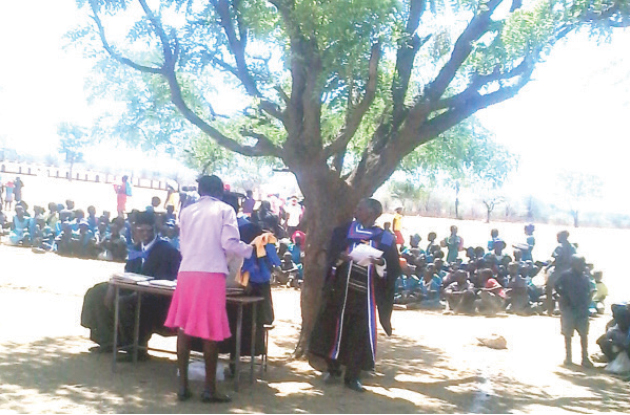

Patient Sibanda Features Reporter
GETRUDE Siwela, 43, a mother of five wakes up every day to do piece jobs for other villagers in order for her to raise money for her children’s school fees. She works very hard only to get a bucket of maize as compensation for her work.
Siwela of Gwitshi Village in Nkayi District worries about the future of her children. Like most mothers, she believes that her children would take care of her in old age if they get an education.
But she always struggles to raise fees for them. Three of her five children dropped out of school after she failed to pay for their school fees. Her 15-year-old son relocated to Tsholotsho District to be a herdboy after he dropped out of school at the age of 11.
Siwela and her husband, Kwanele Hleza, 55, are struggling to raise their children’s tuition fees of $20 per term per child and have not paid it for about two years. The little money raised by Siwela goes towards buying food for the children.
“I’ve five children and three of them dropped out of school after I failed to pay for their school fees. My husband is also unemployed and life is very tough for us. Things once improved slightly when he once did piece jobs at our children’s primary school. He managed to raise fees but since then we’ve struggled to raise money for two years.”
“When my children were enrolled at the school the government was paying for them through Basic Education Assistance Module (Beam). The government stopped paying for them last year. It pains me when I see my children going to school without a uniform and also when I fail to pay their school fees,” said Siwela.
She and her husband are among many villagers in Gwitshi who are struggling to pay fees for their children at Gwitshi Primary School in Nkayi, Matabeleland South province.
Their problem stems from the persistent droughts affecting their district.
Villagers are giving priority to buying food for their families at the expense of paying their children’s school fees.
Most villagers in the area are peasant farmers who are primarily dependent on rain-fed farming but they have experienced two successive droughts. They usually depend on selling maize and livestock in order to raise money for their children’s school fees. Some grow vegetables near Shangani River for sale. To the villagers, however, even the river appears to have conspired with the heavens by running dry at a time when they needed it most.
The villagers only harvested a little, leaving nothing for the market.
More than 6,000 pupils in Matabeleland region dropped out of school in recent months due to drought. Nkayi district was among the worst affected.
Villagers’ tested rescue package whenever there is drought — livestock — is either dying or already dead.
Gwitshi Primary School Headmistress, Kunyalala Malumo, is worried over the high number of pupils at her school who have not paid school fees. She said out of 381 pupils only 111 have paid their fees this year.
“Only 30 percent of the pupils in the school have paid their fees. This is posing a big challenge to us as the school can’t develop without the financial support of the parents. We usually give parents piece jobs at the school to help them raise fees for their children. Some of last year’s grade seven pupils have not yet cleared their fees and we’ve a number of this year’s grade seven pupils who haven’t paid fees since the beginning of this year,” said Malumo.
She said the school usually holds on to the grade seven exam results as a way of forcing parents to pay their children’s outstanding fees.
Gwitshi Primary’s School Development Committee chairperson, Steven Ngamo, said recurrent droughts have caused untold suffering among villagers.
“Parents struggle to pay fees. We encourage them to plan by all means and give education first priority because education is a right for every child,” said Ngamo.
Headman Nhlanganiso Msiza said most villagers were unemployed.
Local councillor, Sicelo Mpofu, said failure by parents to pay fees was worrying.
He said parents needed to devise new ways of raising money for their children outside the traditional ways of farming or selling farm produce.
“In the past years we had donors who usually paid for pupils but they had stopped doing so and this has become a challenge to parents. We don’t have organisations that are assisting parents in anyway,” said Clr Mpofu
He said the high dropout rate due to failure by parents to pay fees were affecting both primary and high schools in the area.
“The school is facing a number of challenges due to limited finances. We’ve a shortage of furniture and textbooks. Parents are struggling to get money after they recorded poor harvests last year,” he said.
Despite the challenges, Gwitshi Primary School authorities remain committed to creating a conducive learning environment for the children.
The school recently held a Speech and Prize Giving Day to honour primary pupils who excelled in their studies. The event was also held concurrently with the Early Childhood Development (ECD) graduation ceremony.
Clr Mpofu, who was standing in for Nkayi South Member of Parliament Abednico Bhebhe, gave $120 to three grade six pupils for attaining position one, two and three.
Mthokozisi Moyo, a former pupil at Gwitshi primary school who was the guest of honour, urged villagers to resist the temptation of turning the girl child into housemaids.
“I urge you to take the education of the girl child seriously. Our daughters are our future teachers, nurses and ministers. It’s sad that some parents send their children to work as maids in order for them to get money. You should plan for the future of your children,” said Moyo.
Moyo, who is the Education and Training Officer for the Rural Associations for Progress (ORAP), urged pupils to take education seriously in order for them to succeed.
He said education had the power to end poverty.
The guest of honour handed over stationery, school kits, soccer balls and textbooks to the school.


 Online Reporter