Chronicle Editor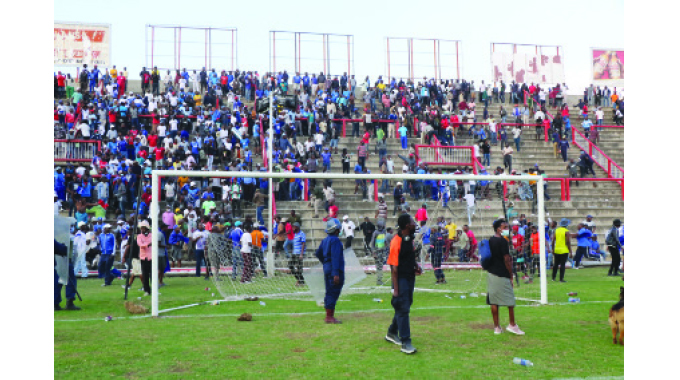
Stanford Chiwanga, Online News Editor
THE groundsmen, who maintain Barbourfields Stadium, must be worried because Dynamos are back in the city of Bulawayo to face Chicken Inn today, a team they struggle to beat.
The caretakers are not worried about which team will win, no.
They are worried about repairing the stadium in the event that DeMbare fans turn violent and vandalise the football arena if a decision, they feel is unfair, goes against their team.
The last time they were at Barbourfields Stadium, the Dynamos fans watched in disbelief and horror as Washington Navaya jumped and Taimon Mvula, the DeMbare goalkeeper, reacted.
Only it was too late – the ball hit the back of the net off the head of Navaya and the lid to Pandora’s box was hacked off.
Horror, because a defeat to Highlanders is unpalatable. Disbelief, because they felt the goal should not have stood as Shadreck Nyahwa had been fouled in the build-up to the goal.
It had been 0-0 and Navaya thought he had won it for Highlanders. Only it was not a winning goal.
There was one more drama to come: conspiracy, accusations, missiles and terror.
In the middle of it all, a man, a man in the wrong place and at the wrong time.
Jimmy Makwanda, the referee, would feel the vandals closing in.
When he allowed the goal to stand, the match should have continued.
Instead it was stopped. Suddenly he was surrounded by furious Dynamos’ players and fans, only it was temporary – the players accepted the decision – but only after Dynamos defender Frank Makarati had held the referee by the neck. Only it was too late, the fans took matters into their own hands.
When assistant referee Melody Ncube appeared to kick at a Dynamos fan who had approached him, things fell apart.
The fans voiced and showed their displeasure. The red card to Bill Antonio and then the goal were an incitement to them.
A series of interlocking stories came to a head, building to a violent climax late. One hooligan threw a bottle; it was a cue of what was to come. More fans turned hooligan – stones and bottles flew into the field of play like confetti at a wedding.
The DeMbare fans invaded the pitch in their numbers.
They tried to remove the goalposts, but it was an abortive attempt. So, they turned on the nets, which they removed and took away after damaging the goalposts.
Maybe they are trawler fishermen who needed a new trawl and used violence as a disguise to steal from the Bulawayo City Council.
The groundsmen brought on new nets, but they failed to put them up as the fans rained missiles on them.
Police and marshals came across and, sheltering the players, ushered them to the sanctuary which was the touchline near the VIP stand.
Navaya’s controversial goal had been scored close to the death of the match – meaning the match was the referee’s whistle away from being ended – maybe not enough time for Dynamos to equalise.
Dynamos coach Tonderai Ndiraya was the only one who seemed to think the match could be salvaged, he hugged the touchline trying to psych his players to be ready for the resumption of the match.
His team, though, had become deadweight on his back, victims of their own fury, paralysed by the injustice of it all and they transferred it to the fans.
Virtually nothing had happened before Navaya’s goal, except the red card, just fouls, stray passes, poor shots on goal and faking, and virtually nothing would happen after it either.
Whether the protests against the goal were justified, the scale of the protest was not justified. Nothing can explain such a fallout, quite so nuclear.
Hooliganism grabbed the headlines. Hooligans were at the heart of it all. The only thing that the violence did was spare Highlanders and Dynamos from being criticised by the media for a poor game of football.
The fleeting moments of good football aside, the two teams looked off-colour, heavy-legged and as if their minds were somewhere else and credit to Ndiraya for admitting that his team was the worst of the bad.
In a nutshell, Dynamos’ fans lost their discipline and Dynamos ended up losing the match 3-0 – via a boardroom decision.
It is not only Dynamos, in April, Highlanders’ fans caused the match against FC Platinum to be abandoned after they invaded the Mandava Stadium pitch, protesting a ‘ghost’ penalty that had been awarded to the platinum miners. Police were forced to use teargas in a bid to disperse the marauding crowd.
At Barbourfields Stadium against Dynamos, Highlanders were not innocent as they also invaded the pitch, threw missiles and fought with DeMbare fans.
The two violent-marred matches surely prove that football in this country is a long way from turning professional, for it is such behaviour that chases away sponsors and advertisers who have a desire to pour their money into the game, but have no wish to be associated with violence and controversy.
Though no life was lost in the two hooligan tarnished matches, the violence shows that Zimbabwe did not learn from the tragic events of year 2000, at the National Sports Stadium, where 13 people died because of a stampede, at a World Cup qualifying match between Zimbabwe and South Africa.
Such incidents have made the beautiful game ugly. No wonder some spectators now prefer not to watch a match in the stadium again, no matter how important the game is. A certain degree of fear has crept in and continues to creep in and that has seen fans staying away from matches.
It can be safely said that for all its entertainment value, football in Zimbabwe is not just a game anymore. It embodies local culture and local pride.
Wherever football is played, emotions will always be at a high and anything that can be of controversy to some, can spark and fan the flames of hooliganism.
As much as we do not excuse the fans for being violent, we must also point fingers at the administrators who lack the flair for organisation to reorient the supporters to accept that bad decisions, premeditated or not, do happen in football.
Wining is in the DNA of Highlanders and Dynamos, and fans are so used to it that losing is unbearable, but that is not an excuse to turn violent.
Psychologists, who specialise in crowd behaviour and who have made a special study of football fans’ behaviour, disagree with the notion that only a few trouble makers are responsible.
They believe that many caught up in riots have no previous history of violence, and instead are galvanised into action by a sense of solidarity which emerges suddenly and powerfully, as a direct result of the way their team is treated.
The PSL, predictably, descended on Dynamos and Highlanders with a heavy hand, but that will not make the cancer of hooliganism disappear.
Eradicating hooliganism would need a culture of change.
The minute we think we have it under control there will be trouble. Do not think for a moment that Highlanders and Dynamos fans have changed because their teams lost points and were fined; they have not changed at all. If you poke the animal in them well enough it will bite again.
An improvement in crowd control, appropriate policing, state-of-the-art CCTV systems and the efforts of clubs and the PSL are needed to make football a fan-friendly environment, but that would require money, lots of money.
Currently Zifa is broke, the PSL is broke, the clubs are broke and the business community is sitting on the fence, fearing to invest in a game whose image has taken a lot of battering over the years. With such depleted resources it will be difficult to stop hooliganism, but that does not mean attempts should not be made.
The media can also play a role. The coverage of hooliganism betrays a curious paradox. While every fragment of aggression between Dynamos and Highlanders fans gets the full back-page treatment, intra-violence between fans of the same teams goes virtually unreported.
Every season fans turn on each other, but you won’t see much evidence of this in the media as the press plays down such incidents and dismisses them as trivial. The clubs are generally unmoved by such small-scale skirmishes.
Over the years, it has also become increasingly clear that the police cannot and should not deal with hooliganism alone and that an integrated approach is needed.
In practice, measures tend to focus on ways to prevent rival fans from having a go at each other. This one-sided focus on security is detrimental to an atmosphere of friendliness.
Well-trained marshals can contribute significantly to hospitality and the uprooting of trouble causers inside stadiums.
The behaviour of players, coaches and club-officials also influences fan behaviour. Supporters’ clubs can also play a role.
Security forces deal with public order and the arrest of offenders.
Public prosecutors and judges deal with apprehended offenders.
To prevent hooliganism, all these parties have to develop policies and co-operate with one another. If the different policies are not made explicit, if they are not integrated and if arrangements are not binding, they will not work as expected.
And as long as football hooliganism continues to be presented as a preserve of Dynamos and Highlanders fans, rather than as an endemic part of the national game, there will be few serious attempts to understand why a significant number of football fanatics choose to spend their football Sundays fighting, throwing missiles and stealing nets.



 Online Reporter