Tongai Mashonga, [email protected]
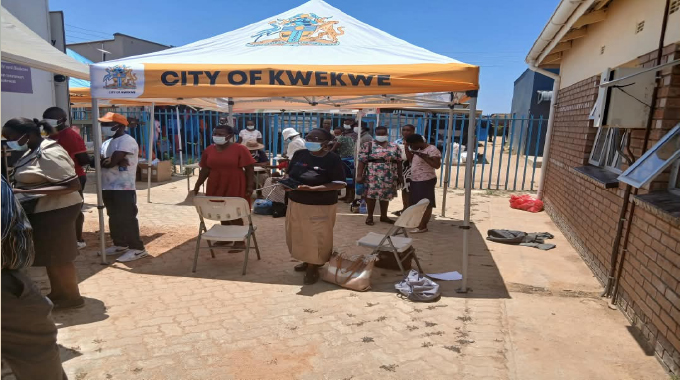
THE mobile X-ray truck is parked unobtrusively at Mbizo 15 shops, but its presence has drawn a crowd that tells a deeper story of this mining city.
Artisanal miners with faces grey from underground dust, young mothers carrying babies on their backs and mature men who have spent years crushing stone are seen. They have all come for one thing – a free picture of their lungs.
In Kwekwe, gold has built houses, paid school fees and kept families alive. It has also been quietly destroying lungs. Silicosis, the irreversible, incurable lung disease caused by inhaling fine silica dust, has become the city’s most stubborn occupational health crisis, often masquerading as TB and only diagnosed when it is too late.
According to the Kwekwe General Hospital, at least 15 patients succumbed to silicosis-related complications at the hospital alone since the beginning of last year. Dozens more are admitted at any given time. But for the first time, the response is matching the scale of the problem.
Leading the response is a joint programme by the Ministry of Health and Child Care, Kwekwe General Hospital and Kwekwe City Council, initiated by Kwekwe Mayor’s Office supported by partners such as ZHI and the National Aids Council. It has taken screening out of hospital walls and into the community.
Kwekwe General Hospital Medical Superintendent, Dr Tinashe Gunda, says the shift is the biggest improvement the district has seen in years.
“We have got serious improvements that are occurring in our district and the province in general in terms of silicosis. The major change that we’re receiving is the screenings that are being done.
“There are so many screenings that are actually taking place now. Screening both silicosis as well as TB as we know that silicosis predisposes to TB,” said Dr Gunda.
The uptake, he says, has been overwhelming.
“As I speak there’s actually a programme that is going on in terms of screening and next week again there’s a lined up programme of screening and also we’re so happy because the community of miners is responding very well,” he said.
“They are coming in their numbers for the screening and I also want to just encourage the others who have not come to come for screening so that we can get these as early as possible and also the education that is going on that educates the miners in terms of safe practices to prevent silicosis.”
It is still too early to see the curve bend inside the wards, but Dr Gunda is confident it will.
“We have not yet seen the changes in terms of the numbers of patients who are being admitted because this is a programme that is just starting but I’m sure and confident that in a few months’ time we may see the change coming up,” he said.
The hospital’s own pain point remains infrastructure. Most silicosis patients are male, and they share a single male ward with all other medical and surgical cases. Their long stays choke the system.
“The biggest challenge is space. We don’t have space in terms of the males. You know most of the silicosis patients are male patients and we only have one ward for the male patients both medical and surgical patients.
“So, silicosis patients usually stay long in the wards. Therefore, we run out of space so we actually would want a construction of a new ward altogether that is a male ward,” said Dr Gunda.
If the hospital is the referral point, the street is the frontline.
At Mbizo 15, Kwekwe City Environmental Health Officer and City TB Coordinator Mrs Zvichauya Muvango is leading the community interface. Her team is not just screening for silicosis, they are offering HIV testing, diabetes and hypertension checks and health education in one stop.
“We’re here at Mbizo 15 shops where we’re doing TB and silicosis screening. This is a very important activity within our mining community as Kwekwe. Our community has a high number of silicosis cases that go undiagnosed.
“So, the Ministry of Health has come up with a programme that has deployed a vehicle that’s conducting X-rays for free to the community members,” she said.
“This programme is being done by Kwekwe City Council, Ministry of Health supported by other partners such as ZHI, National Aids Council. There are many activities happening here. There’s HIV testing, there’s diabetes testing, there’s also high blood pressure checks and TB and silicosis screening. Health education is ongoing and most of the people that we’re seeing here are miners from the artisanal mining community.”
What has surprised her team is who else is showing up.
“There are also a lot of ladies that are coming up because they’ve heard the message, they’ve learned, they’ve understood the importance of early screening and diagnosis, prevention and control measures.
“Since silicosis is a disease that cannot be treated but can be prevented and also controlled by measures such as protective clothing, wet drilling and other measures that we’ve been educating people about here in Kwekwe.”
The awareness did not happen by accident. A month ago, Kwekwe City marched, literally. Led by Mayor Cllr Albert Zinhanga, council, health officials, miners and students marched through the central business district, culminating in the inaugural Kwekwe City Silicosis Awareness Conference at Kwekwe Polytechnic College.
“So, this one comes from the march that was done a month ago we came up with an awareness campaign that we did in conjunction with our mayor who was heading the programme in the city where we marched in Kwekwe city raising awareness and we ended up having a silicosis conference at Kwekwe Polytechnic College,” said Mrs Muvango.
The claim that built its own clinic
About 15 kilometres out of town, in the Jojo mining area, the message is being tested where it matters most, at the mine face.
Gransharp Enterprises, which has operated in Jojo since around 2008 and employs between 200 and 250 workers, has set up its own first aid facility. For a company far from town, it is a pragmatic investment in survival.
Human resources and administration manager at Gransharp Enterprises, Mr Edwin Giyani said the mine clinic serves its workforce and their immediate families but applauded the awareness being done by the Government in mitigating on silicosis.
“So, with regards to this first aid facility, for now it’s still a first aid facility that we’re using to assist our employees for immediate help because of the distance that’s there between where we are operating and town,” he said.
“If someone gets injured depending on the level of injury the transporting time might be too much. Maybe someone needs oxygen or whatever. We just had to gather the resources that we had to build this so that we can assist them in that way.”
The clinic, for now, serves employees and their immediate families.
“So, currently we have been assisting our direct employees and their close relatives. Some of them they’ll be staying with their wives, their kids. So we do assist,” said Mr Giyani.
“For their well-being in terms of performance at work, it’s also important for the close relatives of our employees to be in good health.”
Gransharp has recorded one silicosis case so far, no TB, but Mr Giyani says the Government’s mobile screening, which the company is now hosting on site, will reveal the true burden.
“Currently we have not had any TB. We had just one silicosis. And I think with the awareness that’s been going on around Kwekwe and the screening that’s provided by the Ministry of Health it might also review any other employees that might be at risk so that they get help while the silicosis is still at early stages, which is actually a good thing. We greatly commend the government for assisting us with that.”
“We have been encouraging our employees to use their PPEs properly and to take their health very important because in some cases you might offer PPEs to employees but if they don’t really take that seriously people might just be working two minutes and they remove their masks and with the exposure they need to be really strict on that.”
It is that culture of casual exposure that Government now wants to end. At that same conference at Kwekwe Polytechnic College, the Minister of State for Midlands Provincial Affairs and Devolution, Cde Owen Ncube, put mining companies on notice, warning that compliance with occupational health would be closely monitored in Kwekwe, Zvishavane, Shurugwi and Mberengwa.
Responsible mining, he said, must extend beyond production and investment to protecting workers from hazardous silica dust.
“I made a firm commitment to monitor their compliance not only to the Mining and Minerals Act but to other supportive legislation,” Cde Ncube told delegates, adding that regulations governing safety, health and sanitation, including clean water, decent ablution facilities and health promotion, were non-negotiable.
“It’s unacceptable for workers to stay under deplorable conditions that include overcrowding, limited access to decent housing, ablution and medical facilities. Workers have their rights at work which should be respected.”
Kwekwe’s paradox has always been that the dust that feeds it is the same dust that kills it. What is changing is the city’s refusal to treat silicosis as inevitable.
From a queue at Mbizo 15 shops, to a first aid room in Jojo, to a conference hall at Kwekwe Poly, the message is converging – silicosis cannot be cured, but it can be prevented. Wet drilling, ventilation, masks that stay on longer than two minutes and an X-ray taken in time.
For a town that has buried too many miners too young, learning to breathe again may be its most important gold strike yet.