Online Reporter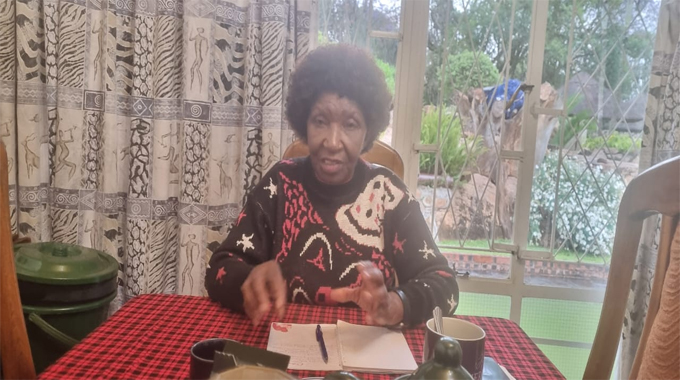
IN this week’s Lest We Forget, our Day Editor Vincent Gono spoke to Cde Sithembiso Moyo, whose pseudonym was Cde Sylvia Moyo, who was born on 23 July 1958 in the communal areas of Bango, where her father’s homestead was located.
She attended Bango Primary School and Hope Fountain Secondary School, now Tennyson Hlabangana High School. Her father was a nurse at Ingutsheni Hospital in Bulawayo.
Her family was politically conscious. A relative, Gideon Moyo, had been detained at Gonakudzingwa after it was established around 1965.
After secondary school, she enrolled in a typing course and worked at Lutheran House, opposite Tredgold. Special Branch officers would often visit, looking for her uncle, Gideon Moyo.
She found herself in the crosshairs of the Special Branch after lying to protect her uncle from the torturous colonial regime. This was part of how she developed her political consciousness.
She was then introduced to Cde Thenjiwe Lesabe. She would visit Cde Lesabe at her home in Barbourfields, near Mpilo Hospital. At the time, racial segregation was widespread.
She spoke about the segregation of the time: “If you were a black person, for example, I remember that, as far as banks were concerned, blacks were not allowed on Main Street. There used to be Barclays Bank, but its clients were normally Europeans.
“Africans were pushed down to the corner along Sixth Avenue, near Sixth Avenue Extension. That was where most black people banked. There was another branch along Sixth Avenue Extension. The banks around what used to be the former Founders were—what’s the name of the new bank next to CBZ?
“The people you would find there were mainly coloured people and whites. If there was a black person, they would be a janitor. Any clerical work was given to either coloured people or Europeans.”
She said it had nothing to do with qualifications, but everything to do with race.
“It was on the basis of colour and race. There was so much racial discrimination at that time.
“Let’s say there were positions for accountants. One applicant was white, another was coloured or Indian, and another was black. You would find that the white person got the highest salary, perhaps followed by an Indian, then a coloured person. The black person would get the least.”
The same applied in factories.
“It used to be like that in factories. I remember I once had a stint at Supersonic before I left for Zambia.
“At that time, you know, sometimes as teenagers we used to be naughty. Sometimes we would go into public telephone booths and look through the directory. One time, I said, ‘Let me just find a company and ask if there’s any employment there.’
“I found one and introduced myself. I asked to be put through to the personnel department. I had that bravery in me. I phoned and introduced myself. They asked about my level of education.
“I told them. They asked how old I was and said, ‘But you’re too young. We can’t hire you.’
“I think I was 17. They finally said, ‘Okay, what type of work are you looking for?’ I said, ‘Well, any that is available.”
“They said, ‘Okay, do you mind coming the day after tomorrow at nine o’clock? Come and ask for Mr Trump.’ That is how I got employed at Supersonic,” she said.
In 1976, she left the country by train for Botswana, en route to Zambia.
“I got off the train before we reached Francistown. There was a family I knew who had left a long time ago, so I had seen them before. I went to their home and slept there. I was advised to surrender myself at the police station. When I got there, I rejoined my group, and the police called the ZAPU people. The late Cde John Nkomo and Cde Cephas Cele came, together with a man called Umnyamana.”
Some of the girls she met at the ZAPU representative’s house were Nomathemba Ndiweni, Prisca Bhozongwani and the late Soneni Ngwenya.
“In September 1976, we left for Zambia. Cde Cele, who was in charge of personnel, came and collected us. Before we got to Zambia, however, we were told only about the good things. Nothing was said about how rigorous the training would be, so we were simply imagining things.
“We thought it was a lovely place because a man had told us that where we were going was very nice and that we would enjoy ourselves.”
When they arrived at Nampundu in Zambia, they were given plain, military-green training gear, and the girls had their own tent.
“We were organised into sections, platoons and companies, each with its own leader,” she said.
They were then moved to Mwembeshi Training Camp.
“There were eight of us girls, and we did our training. That was when I got injured during a judo session. I fractured my shoulder. I was thrown up and landed awkwardly. My partner was a man,” she said.
After she was injured, she was taken to Lusaka in a car that had brought supplies to Zimbabwe House. She slept there before being taken to the University Teaching Hospital.
After being discharged, she was taken to a house in a township called Mtendere in Lusaka. On the day Cde Jason Ziyaphapha Moyo died, she had gone for a review and passed his office, where she saw him. She said that after they left, a bomb exploded and killed Cde JZ Moyo.
Cde Moyo said she was taken to Victory Camp two months later. The girls there were mainly from Manama High School. The camp was also used by Angolans.
“It was at Victory Camp that Cde Cele came and collected me. The ZAPU offices wanted me, and the ZPRA offices wanted me too, to work in the administration department. However, I started working as a secretary at the ZAPU offices in mid-1977, at Zimbabwe House. I kept records and managed documents.
“I was later taken to President Cde Nkomo’s office in 1978 as part of his secretariat team. I used to keep highly confidential information, and the selection process was quite rigorous. I worked with de Simon Khaya Moyo at the ZAPU administration office.
“Whenever Cde Nkomo could not find a document, he would say, ‘The girl has taken it to Smith,’ and it would send shivers down my spine. Sometimes I would cry and Cde SK Moyo would comfort me. My office was there, then SK’s office, and then his office.”
“One day, he asked me where I came from. When I told him, he was surprised that we lived so close to each other back home.
“He also told me about my uncle, with whom he had been incarcerated at Gonakudzingwa, and his confidence in me grew.”
In September 1978, after passing the selection tests, she was sent to study court reporting in America.
The country gained independence in 1980. After returning in 1981, she joined the Parliament of Zimbabwe as a Hansard reporter.
She later joined the High Court of Zimbabwe in 1987 and in 1998, the International Criminal Tribunal for Rwanda, where she worked until 2013.