Online Reporter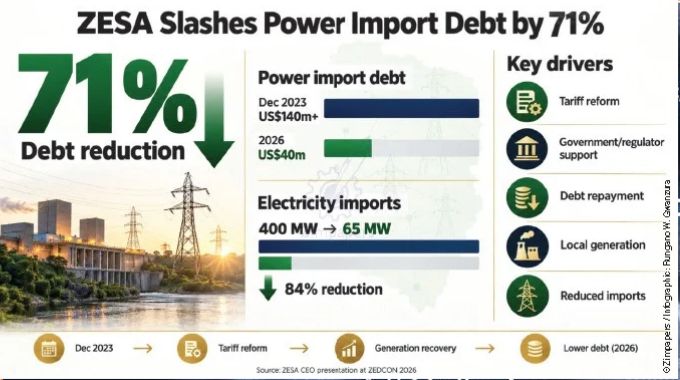
Nqobile Bhebhe, [email protected]
THE Zimbabwe Electricity Supply Authority (Zesa) has reduced its power import debt from more than US$140 million to about US$40 million, signalling a major improvement in the utility’s ability to meet its external power obligations as domestic generation recovers.
Zesa chief executive officer Engineer Cletus Nyachowe said the turnaround followed the introduction of a cost-reflective tariff in December 2023, which enabled the power utility to improve its capacity to settle debts arising from electricity imports.
Speaking at the ongoing Zimbabwe Economic Development Conference (ZEDCON) 2026 in Bulawayo on Thursday, Eng Nyachowe said improved local generation had also sharply reduced Zimbabwe’s dependence on imported electricity.
“I just want to share a few figures to debunk the notion that we still have got debt, substantial debt on imports.
“Since the regulator, with the support of the government, gave us a cost reflective tariff in December 2023, we have been able to pay back most of the power import debt. We were over US$140 million in terms of power import debt and now we are left with about US$40 million.
“So that debt is going down in terms of power imports through bilateral PPAs.”
The development comes as Zesa has reduced its reliance on imported electricity from as much as 400 megawatts (MW) to about 65MW, following the restoration of domestic generation capacity.
“We used to import up to 400 megawatts but now with the restoration of local generation we are only importing 65 megawatts.
“That is from EDM of Mozambique and from HCB so we no longer have pressure on power import bills,” he said.
Eng Nyachowe said Zesa was also increasingly participating in the Southern African regional electricity market, allowing the utility to optimise procurement costs by buying electricity when prices are lower and selling when market conditions are favourable.
“I would like however to say that we are now very active on the Southern African energy market.
“We look at opportunities, buy when the price is low, and we also sell at high prices,” he said.
The regional trading strategy is also providing Zesa with an alternative to relying exclusively on longer-term bilateral power purchase agreements (PPAs), which can carry higher prices.
“Where we would sign bilateral PPAs now, the price would be about 13 cents, but trading on the short-term energy market, we are trading around 8, 8.5 cents.
“So you can see the advantages,” Eng Nyachowe said.
He said the improvement in electricity availability had also eliminated load shedding, although Zesa was treating the current position as a foundation for further expansion rather than an end point.
“Now, going on to the supply side, right now there is no load shedding.
“We are able to supply all the capacity that is required, but that to us is only a baseline from which we should work.
“We need to expand aggressively, and we’ve got a pipeline.”
The expansion drive is expected to remain central to Zimbabwe’s economic growth ambitions, as increased and reliable electricity supply is critical for mining, manufacturing, agriculture and other productive sectors.
Eng Nyachowe’s remarks come as Government seeks to strengthen domestic generation while reducing exposure to costly power imports and positioning Zimbabwe to participate more actively in the regional electricity market.