admin
admin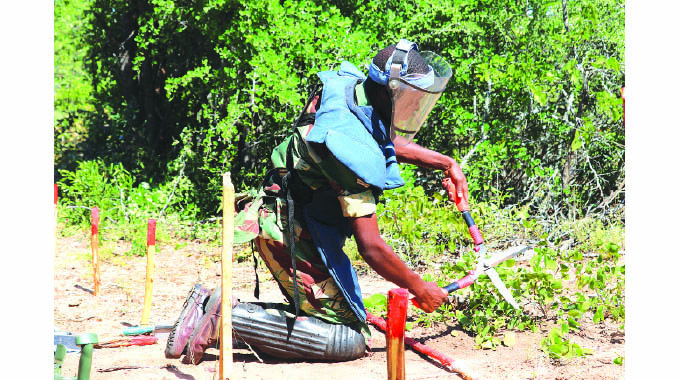
Yemurai Nyarugwe
Zimbabwe continues to bear the long lasting impact of mine contamination stemming from the country’s liberation war of the 1970s.
Thousands of landmines were laid along the country’s borders with Mozambique and Zambia during the liberation war.
The effects of landmines are long-lasting and go beyond just physical injuries but affect mental health, social and economic well-being of individuals living within the affected communities.
Communities risk their lives when crossing through these minefields on improvised paths to schools, dip tanks and farmlands.
These mine contaminations pose severe threats in and around the border communities that heavily rely on subsistence farming and animal grazing.
The deadly explosive ordinances have maimed and killed a number of people and livestock since independence.
Affected communities struggle to derive economic value from what would ordinarily constitute productive land. The cost of mine clearance, victim assistance, and mine risk education weigh heavily on nation-building efforts saddled with other competing priorities.
The Zimbabwe Defence Forces (ZDF) in conjunction with the Government and other demining partners like Anti-Personnel Product Detection Organisation (APOPO), Hazardous Area Life Support Organisation (HALO) Trust, Mines Advisory Group (MAG) and Norwegians Peoples’ Aid (NPA) are tirelessly working together to achieve a mine-free environment.
The Government is working on mobilising funding and resources for demining operations around the country to achieve a mine free Zimbabwe.
Director Zimbabwe Mine Action Centre (ZIMAC), Colonel Mkhululi Bhika Ncube highlighted that the Government has made strides to achieve a mine-free environment.
“The Government of Zimbabwe has placed demining on high priority to ensure the country makes strides to fulfil its Article 5 obligation which states that, ‘Every state party shall make every effort to destroy or ensure the destruction of all anti-personnel mines in mined areas under its jurisdiction or control.’ The Government has been funding mine action activities by National Mine Clearance Unit (NMCU) alongside funding from other international stakeholders to allow for speedy clearance and residual risk management,” said Colonel Ncube.
Currently, awareness campaigns are being conducted to educate communities living in mine-infested areas on how to identify and avoid these deadly ordnances.
In as much as the Government is making frantic efforts to eradicate the landmine problem, the ZNA has deployed its de-miners who are currently conducting operations in Dumisa Minefields, Masvingo and Lusulu Minefields in Matabeleland North.
Colonel Ncube said, “So far we have cleared about 295,21 square kilometres (95 percent) area out of the 310 65 square kilometres area initially discovered as contaminated. The remaining area of 15,44 square kilometres area (5 percent) is yet to be cleared.”
The Zimbabwe Demining initiatives demonstrate the importance of collaborative international efforts in achieving a mine-free world. With continued support and funding, the eradication of landmines in Zimbabwe and elsewhere is not only possible but a necessary step towards creating safe and secure communities for all.



 Online Reporter