admin
admin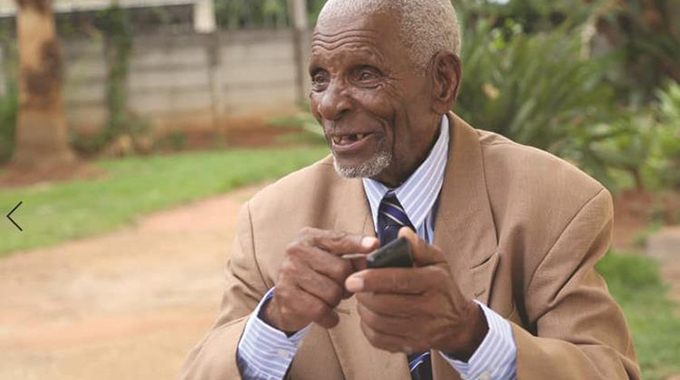
Leroy Dzenga Features Writer
The year is 1942 in Nyasaland, a small British colony in Southern Africa. Among its citizens is 24-year-old Simon Matora, a young ambitious man in search of greener pastures. He weighs his options. Rhodesia attracts him more and the natural decision is to migrate.
The official paperwork is taking a long time to be processed and Matora cannot wait any longer. He joins four friends, three contemporaries and an elder who is familiar with the way to the country now identified as Zimbabwe.
They begin their journey to the Promised Land, in what becomes a colourful tale. A tale he tells in Harare 77 years later. At 105, Sekuru Matora still has a firm handshake. His neat beige double-breasted suit stood out as he welcomed us to their Hillside family home.
“You are on time, rare to see these days. The young ones no longer have time for us elders,” he said with a chuckle.
One of his grandchildren attempted to pull the chair for him before he sat down, a prank he frowned upon.
“Why are you aiding me? I do these things by myself all the time, the presence of our guests changes nothing,” Sekuru Matora retorted, dragging his chair.
After taking a seat, he offered us tea, a gesture known to signify courtesy. The narration could commence, the scene had been set for a session of reminiscence.
“I do not remember how long it took us to walk from Malawi, but we passed through Mozambique. It took us a while.”
With no identification documents, the quartet had to utilise unorthodox routes.
“We walked through bushes and villages in Mozambique. We did all we could to avoid law enforcement. They would deport us back to Malawi,” he said.
At the time, in 1942, wild animals still dominated the spaces they occupied in their voyage. A classic case of indigenous knowledge in full application.
“The elder we were with had means to evade law enforcement. They used their knowledge of herbs and performed rites for our safe passage. Police officers followed tracks, and there were herbs which were sprinkled to confuse them.”
“Lions would usually come to where we were resting. The fires we lit drew them to us. The elder kept castor beans and threw them in the fire whenever there was a threat, the smoke would drive away the beasts,” Sekuru Matora said.
They walked for days, sleeping in makeshift mud huts and villages.
“We arrived at Penhalonga Mine first. Stayed there for days, until a farmer decided to employ us. That is when we got our Rhodesian identification cards,” he said.
Sekuru Matora worked at a number of farms and in the process gained tailoring skills.
“In 1947 I moved to Marandellas (now Marondera) and became a tailor. I then teamed up with a friend and moved to Murehwa. The intention was to open up a grocery store.”
The idea did not have the intended results, as the shop flopped, but his reach for the moon left him with a star.
“It was in Murehwa in 1949 where I met my wife, Violet,” he recalled, taking a moment to stare at the overcast sky. Marriage is well received ordinarily, but he was perceived as a foreigner at the time, and that ruined the script for him.
“My wife’s parents did not want to let a man from another country marry their daughter. They were afraid I would take her away with me. I was taken to the chief a number of times until we found common ground.”
He was to bear nine children with his wife. His skills would take care of him, being employed by clothing stores to the point of becoming a storekeeper.
“I never received any formal education, and I could not speak English. The white employers had devised a language called Chilapalapa. It was a funny, but effective language. I am still fluent in it,” Sekuru Matora said. His journey was not without tears, like many Zimbabweans he had his unfortunate encounter with colonialism. “During the liberation war I lost my son John. He just disappeared. He was around 17. We never heard what happened to him.”
After Zimbabwe got its Independence, Sekuru Matora bought a house in Dombotombo, Marondera, through a rent to buy scheme. He stopped working in stores and began sewing clothes for sale at farms.
“After Independence I did not want to continue working for white people, so I began doing my own thing striving to send my children to school. All my children had a good education.”
With age, the workload reduced to garment alterations only. In 2002, his wife died, a day he described as one of his most painful.
“It was after a long illness. I saw her go through a lot of pain. Those were hard times. I miss her every day.” At 105 he has since retired from his work as a tailor; a man who walked to the pot of gold and managed to raise a generation with no formal education.
“I now spend my days relaxed. Up until recently, I used to take walks around the neighbourhood every morning. My grandchildren stopped me from walking around. They fear I may fall and fail to get help,” he said of his daily routine. Many of his contemporaries died, but he still goes strong. In a way that makes it hard to believe he has lived beyond a century.
“I think it is God’s will that I have lived this long, seeing my grandchildren raising their own families. It could be because I have never tasted alcohol or smoked a cigarette,” he said.
After raising nine children (six boys and three girls), 19 grandchildren and 22 great-grandchildren, Sekuru Matora now identifies as a Zimbabwean and his papers corroborate.
“I went to Malawi once in 1995 at the insistence of my daughter. When I got there everyone I knew had died. I stayed there for a month and came back to Zimbabwe. I have not been there since,” he said shyly.
Most of his documents were destroyed during Operation Murambatsvina, which consumed a cabin he used as an archive. Despite his old age, Sekuru Matora remains attuned to technology. During the interview, he had his black feature phone (kambudzi) firmly in his hand.
“I use this phone to call my grandchildren when I miss them. I can use it without assistance. Even though I am not formally educated I have mastered my phone.”
His eldest grandchild, Tendai (51), said Sekuru Matora is still alert, save for his left eye which has begun failing him. “I was shocked last week to hear that Sekuru had gone to my house unaccompanied. He even comes to my workplace when he is troubled or misses me,” Tendai said.
As the conversation neared its end, Sekuru Matora explained a long-standing legend on how migrant workers from Malawi used rail lines as their compass to Zimbabwe.
“There is no way any sane person would have taken the long rail line route when there were shortcuts. It was a joke thrown in jest by our friends, but I guess I have to wear the tag with pride. I am part of a generation that followed the rail line to Rhodesia.”
A few cup refills later, a tale of brave dream chasing was capped with a firm handshake.
Feedback: [email protected]



 Online Reporter