Online Reporter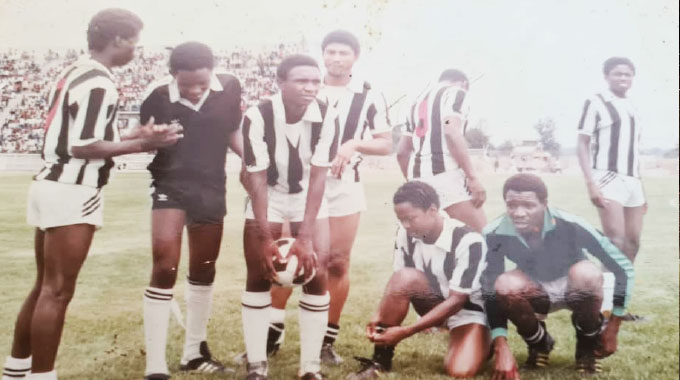
Yesteryear greats with, Lovemore Dube
BEFORE Saul Ndlovu’s dreams were shattered by a cruel ankle injury, he was part of one of the most exciting junior teams to ever emerge from the Highlanders Football Club.
A golden generation so talented, they earned the nickname Liverpool, not by accident, but because of how they dazzled, dominated, and grew together from the dusty fields of Makokoba to the grand stage of Barbourfields Stadium.
Ndlovu was among a band of gifted boys who began their journey in 1976 in the Under-12s. For the next six to seven years, they advanced through the Highlanders’ ranks, mentored by the legendary Ali Dube, whose influence Ndlovu describes as “the icing on the cake” for a group already bursting with potential.
“The foundation was laid early,” recalls Ndlovu.
“We had played street football together, school games in Makokoba and Mzilikazi, and tournaments that helped us understand each other’s game. It all made the transition into the Highlanders system smoother.”
At Lotshe Primary School, he played alongside Agayi and Netsai Moyo. Later, at Helemu, he teamed up with Max Makanza-Lunga and Joshua Mhizha in Njube, facing tough opposition like Mtshede, which featured Rahman Gumbo.
“Football was life back then,” Ndlovu says.
“We trained for hours and played even more, a privilege kids don’t enjoy these days.” His family’s move to New Lobengula meant leaving Makokoba, but his talent had already caught Ali Dube’s eye. “Coach Dube would give me money to get home and return the next day for training,” he remembers.
In the Under-12s, he joined familiar faces from Makokoba’s junior project, like Mafoti FC’s Tanny Banda, often battling the likes of Agayi and Netsai Moyo.
That team went on to include names such as Willard Khumalo, Sam Sibanda, Summer Ncube, Oliver Ncube, Abraham Senda, David “CB” Mahlangu, Barbs Ncube, Harold “Screamer” Tshabalala, Francis Muringayi, Mercedes Sibanda, Mpumelelo Dzowa, and Lovejoy Mugadza.
As some graduated early, others seamlessly stepped in to fill the void. They dominated junior football but had fierce rivals in Zimbabwe Saints, whose own gems included Godfrey Paradza (who later joined Bosso), Abisha Mugadza, and Jethro Hunidzarira.
Ndlovu says the bond within the Highlanders juniors was their secret weapon.
“We had a telepathic understanding on the pitch,” he says.
“Ali Dube wove us into a close knit, motivated unit.”
When the Coca-Cola Under 18 inter-provincial tournament launched, Bosso contributed seven players to the Matabeleland North squad, including Khumalo, Ndlovu, Summer, Muringayi, Paradza, and the Moyo brothers. Though Francis Muringayi was a talented goalkeeper, he sometimes froze under pressure, making way for Pernell McKop from Cosmos Juniors.
Ndlovu’s big break came in late 1982, when Paradza returned to Saints, prompting his promotion to the first team at just 17.
“Our coaches were shocked to see Paradza warming up with Saints,” Ndlovu recalls.
“So they promoted me and Willard Khumalo. In 1983, we played several games under Bobby Clark, who brought even more youngsters into the fold.”
He made his debut at Luveve Stadium, replacing Tymon Mabaleka.
“He told me he was proud of us and was retiring to make way,” Ndlovu says.
As a midfielder, Ndlovu’s touch, intelligence, and presence made him one of Bosso’s great hopes during a transition period that saw veterans like Lawrence Phiri, Majuta Mpofu, and Josiah Nxumalo bowing out.
In the first team, he rubbed shoulders with stars like Roy Phiri, Peter Nkomo, Douglas Mloyi, Madinda Ndlovu, Ernest Sibanda, Phineas Mabaleka, Macdonald Silongwe, Richard Ndlovu, and Shakespeare Mabika. “Tymon was already called SaZwe as the elder statesman,” Ndlovu says.
He credits Mloyi and Titus Majola for helping him adjust. “Majola used to tell me he’d do the donkey work so I could play my natural game. We were welcomed with golden hands.”
Unlike today, juniors back then curtain-raised for senior teams and got to watch their heroes for free, a connection that deepened their passion. However, a promising career was soon derailed.
An early ankle injury in 1983 after a clash with Ziscosteel’s Benedict “Grinder” Moyo kept him sidelined. Though he returned in 1984, a freak injury during a strike affected match against Gweru United ended his Bosso career.
“I twisted my ankle just as I stepped onto the Barbourfields pitch,” he recalls.
When he came back, it was for Ingwebu Breweries, where he worked with teammate Sam Sibanda.
“It was a blessing. No one knew I was injured, unlike in the Super League where I was targeted.”
Training was gruelling.
“I’d run from Lobengula to Barbourfields. Barry Daka, from the same neighbourhood, always got there before me!
After training, I jogged home with Alexander Maseko. He’d go to Luveve, and I’d turn off at Emakhandeni.”
He credits that fitness for his energy in extra time. In 1989, former teammate Sam Sibanda invited him to join Eagles in Division Two.
“After my first session, Majuta Mpofu said I was in the team. I scored against Gweru United in my debut,” Ndlovu says.
He attributes the strength of his generation to township youth clubs and informal games using plastic balls and “fridos”.
“That’s how we learned playing anywhere, anytime.” Now back in Zimbabwe after more than a decade working in South Africa, Ndlovu is eyeing farming on his family’s land in Insuza, Matabeleland North Province.
He remains grateful to legends like Joel Shambo, Mabaleka, Madinda Ndlovu, Majuta Mpofu, and David Mandigora.
“They were my heroes,” he says of the players who inspired him to dream, a dream cut short too soon.
Saul Ndlovu’s name is now etched alongside a long list of prodigies Zimbabwean football lost to injury, including Alexander Maseko like centre back Nqobani Ncube and the charismatic Basil “Bash” Chisopo of Caps United.