Moffat Mungazi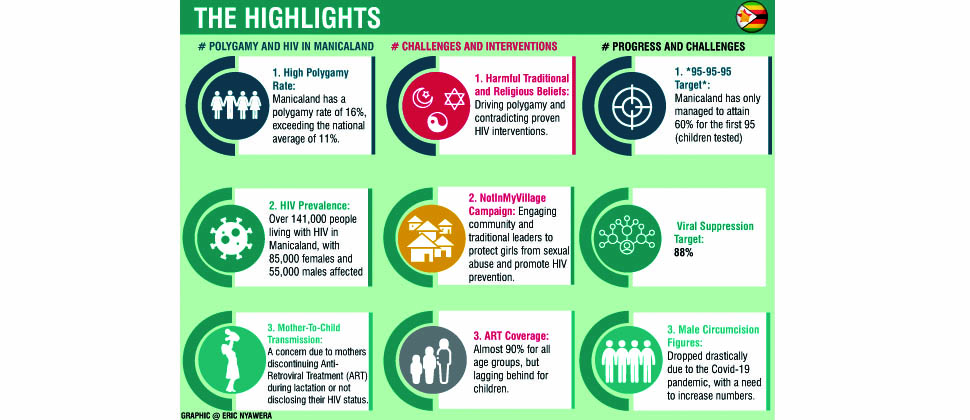
Ray Bande
Senior Reporter
MANICALAND has a high polygamy rate of 16 percent, exceeding the national average of 11 percent — a trend that is militating against efforts to combat HIV and AIDS among adolescent girls and young women.
This was revealed during the Manicaland edition for the NotInMyVillage campaign, attended by stakeholders from diverse professional backgrounds, in Mutare recently.
The campaign seeks to enlist the services of traditional and community leaders in protecting girls from sexual abuse.
National Aids Council Manicaland provincial monitoring and evaluation officer, Sibert Hlatywayo said the province’s high polygamy rates stem from harmful traditional and religious beliefs that contradict proven HIV interventions.
“For child marriages, we have identified Mutare Rural and Chipinge as problematic areas, with a polygamy rate of 16 percent, surpassing the national average of 11 percent. We are actually doing worse off than other provinces.
“These areas are plagued by harmful cultural practices and barriers to HIV interventions, resulting in young girls becoming second or third wives and increasing their risk of contracting HIV. This necessitates comprehensive interventions, such as the NotInMyVillage campaign, which engages community and traditional leaders,” said Hlatywayo.
Hlatywayo said the HIV burden in Manicaland disproportionately affects females, adolescent girls, and young women.
“Regarding HIV trends in the province, we have examined the latest HIV estimates for Manicaland, which are for 2024. Overall, it is estimated that over 141 000 people of all ages are living with HIV in Manicaland.
“More females are living with HIV than their male counterparts, with 85 000 females and 55 000 males affected across all age groups. The majority of these cases are found in the adult age group, comprising individuals aged 15 and above. Additionally, young people are also affected, accounting for approximately nine percent of the total population living with HIV,” he said.
Hlatywayo also confirmed that Mother-To-Child Transmission (MTCT) is a concern, particularly when mothers discontinue Anti-Retroviral Treatment (ART) during lactation or are reluctant to disclose their HIV status.
This trend has also complicated the administration of ART to children between zero and four-years-old.
“When we look at our progress towards the 95-95-95 target as a province, when we look at the first 95, where we want to have our children tested, we have only managed to attain 60 percent.
“In terms of viral suppression target, we are at 88 percent, and for the provision of ART to the affected, we are almost at 100 percent. This is where we also hope that the NotInMyVillage campaign will help us in making sure that our parents get the HIV services that they require.
“For ART coverage for all age groups we are almost at 90 percent, but for children we are lagging behind in all the districts. It remains a challenge to ensure that all children who require ART have access to the medication.
“Key drivers of this trend include Mother-To-Child Transmission because the mothers are either dropping out of ART or deliberately do not want to disclose their status in families,” said Hlatywayo, further chronicling the benefits of diverse interventions in saving lives of people living with HIV.
“In 2023, for example, we had 7 936 lives saved because of ART. With ART, these people managed to live on because they adhered to it judiciously.
Owing to the PMTCT, we managed to avert 1 081 deaths in 2023 alone. In terms of life years gained, this is a cumulative summation of the years that people continued to live because they have been on ART or got PMTCT services — 148 535, he said, adding that male circumcision figures have dropped drastically in the province.
“Up to 2019, we were on the right track. We had an increasing number of men who were coming in for male circumcision. But from 2019, we had a drastic drop because that is the year we faced the Covid-19 pandemic. We need to go back to the old statistics.
“In 2023, we were almost on 18 000 males that were circumcised. We want to bring them back to 40 000. One of the challenges that we have as Manicaland is that we are not doing well on male circumcision,” he said.



 Online Reporter