Chronicle Editor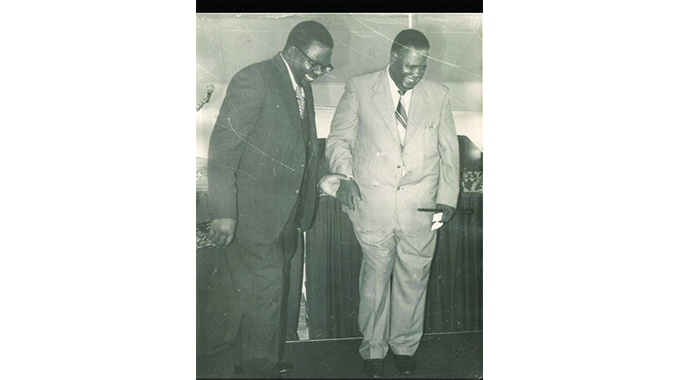
Mashudu Netsianda, Senior Reporter
THE late Vice-President Dr Joshua Mqabuko Nkomo, who died 22 years ago, was christened “Father Zimbabwe” for a reason.
He was a man of the people, father to everyone irrespective of their tribe, religion, creed or race. Although Nkomo’s true calling was the politics of African nationalism, he was a religious person who firmly believed in God. He knew that steering Zimbabwe from colonial subjugation to independence required something more than just a gun. In as much as Dr Nkomo put up a persistent resistance to white minority rule, he knew that without God’s intervention, an independent Zimbabwe would remain a dream.
It was through this realisation, that Dr Nkomo forged a long-lasting friendship with the founder of the Apostolic Faith Mission (AFM) of Southern and Central Africa, the late Reverend Morgan Sengwayo way back in the 1960s during the church’s formative years.
As the nation commemorates Dr Nkomo’s death this month Chronicle spoke to the Sengwayo family and the church’s veteran pastors about the strong relationship that existed between Rev Sengwayo and Dr Nkomo.
Rev Sengwayo’s daughter, Mrs Seldom Tshiwilowilo said Dr Nkomo would visit his father both at their family home and church in Pelandaba suburb in Bulawayo.
“We really cherished those lovely moments when Dr Joshua Mqabuko Nkomo and his entourage would visit us on several occasions at our home in Pelandaba. Dr Nkomo would also grace our services on Sundays and whenever he was around Bulawayo, he would not miss our annual December camp meetings,” she said.
Mrs Tshiwilowilo said her father and Dr Nkomo shared a common vision of seeing an independent Zimbabwe.
“My father and Dr Nkomo both shared a common goal and vision albeit in different spheres of life. Rev Sengwayo had a spiritual calling while Dr Nkomo’s calling was to liberate people from colonialism and they both dedicated their lives towards achieving that goal,” she said.
Mrs Tshiwilowilo said on many occasions her father would be detained by Rhodesian police for openly supporting and feeding freedom fighters.
“I remember one day as we were preparing to go to church, police came to our home in a truck and they took away our father. His crime was that he supported and fed those who were fighting for our freedom in the bush,” she said.
“Police detained him on many occasions because young men would come to our home hungry and we would give them food and water to drink among other needs.”
Mrs Tshiwilowilo said each time, Dr Nkomo visited them, he would jokingly say to Rev Sengwayo ‘mfundisi, you are in a wrong profession, you make a great politician.’

“My father would respond by saying, ‘Baba Nkomo you too should also be preaching the Gospel’ and the two men would eventually burst into laughter. They were very close to each other and we cherished those moments,” she said.
Mrs Tshiwilowilo said each time Dr Nkomo attended church services, Rev Sengwayo would ask the choir to sing his favourite song Iziphithiphithi, which he had personally composed in light of the political instability that prevailed at the time.
“Dr Nkomo also loved the song, Thula Sizwe, which was composed by my late brother Evangelist Freedom Sengwayo in 1977,” she said.
When Rev Sengwayo died in March 1982, Dr Nkomo was the main speaker at his funeral.
Rev Sengwayo’s driver, Mr Pastor Nhlanhla Sithole also relived the memories, describing Dr Nkomo and Rev Sengwayo as “more than just friends.”
“To me, Dr Nkomo was an ordinary and humble man but very loving and brave. One thing I liked about him is that he feared God. In fact he knew there was God hence he was close to Rev Sengwayo and they became more like brothers,” he said.
“As Rev Sengwayo’s driver, I spent most of the time with him such that I would have an opportunity to see the two men talking to each other for long hours.”
Mr Sithole said Dr Nkomo would visit Rev Sengwayo at the church house in Pelandaba to ask for prayers, especially when the war was beginning to heat up.
“Each time, Dr Nkomo had problems that required prayer, he would visit Rev Sengwayo even at night and he would lay his hand on him. Rev Sengwayo and Dr Nkomo developed a strong bond to an extent that Rev Sengwayo acted like his (Dr Nkomo’s) spiritual advisor,” he said.
“Dr Nkomo was a unifier. He was not a regional leader but a national leader who never condoned tribalism. Sadly, tribalism has crept into churches resulting in divisions and Dr Nkomo never condoned tribalism.”
One of the church’s veteran and pioneer pastors, Rev Lot Mateza said Dr Nkomo and Rev Sengwayo were very close to each other since the early 1960s.
“During the liberation struggle, the church under the leadership of Rev Sengwayo played a critical role in terms of supporting the Zipra freedom fighters. As a church we had a great relationship with Dr Nkomo,” he said.
“I remember at the funeral of Rev Sengwayo, Dr Nkomo spoke highly of Rev Sengwayo and urged the church to remain united even after his death.”
Rev Mateza said during his graveside eulogy at Rev Sengwayo’s burial, Dr Nkomo struggled to hold back his tears as he narrated the life of the clergyman.
“You could see that Dr Nkomo had lost a true and special friend. As church leaders, we had a torrid time as we tried to console him. Dr Nkomo was a great man who stood by his words,” he said.
Dr Nkomo’s daughter, Ms Thandiwe Nkomo said her father interacted with many people who openly supported the liberation struggle.
“Rev Sengwayo was one of the people who were supportive of the struggle. In fact, most people didn’t want to come out in the open for fear of being tortured by the Rhodesian police who were very vicious but Rev Sengwayo was one of those few people who openly supported the liberation and interacted with my father,” she said
Dr Nkomo will continue to be remembered as the man who contributed immensely to the liberation of Zimbabwe.
Nkomo’s true calling was the politics of African nationalism and that career began in 1951 when he became secretary of the Railway African Workers’’ Union.
With a commanding presence, eloquent in both Ndebele and English, he quickly made his mark. He was soon elected president of the Southern Rhodesian African National Congress (ANC).
He came to international attention when he stormed out of a London conference in protest at its endorsement of the Central African Federation, a fanciful piece of map manipulation designed by Britain to bring together the colonies of Northern and Southern Rhodesia and Nyasaland (now Zambia, Zimbabwe and Malawi).
Back home in Rhodesia, Nkomo put up a spirited and unflinching resistance to white minority rule.
When the ANC was banned, he formed the National Democratic Party (NDP) — and became its president. When the NDP was banned in 1961, he founded the Zimbabwe African Peoples’ Union (Zapu) and was elected president. — @mashnets


 Online Reporter