Online Reporter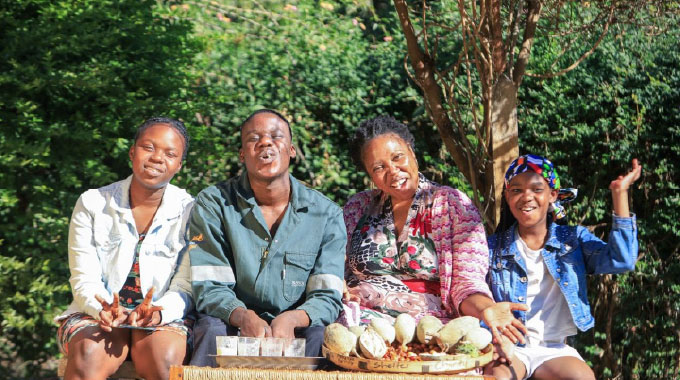
Tafadzwa Zimoyo
Arts Editor
While the healthy eating movement gathers momentum, with indigenous foods and organic foods being its major ingredients, for most people, it has remained more of an occasional outing and a treat, not a lifestyle.
However, the puzzle is being resolved, just maybe, in Mutare where the Chieza family is on a mission to spread traditional cuisine, not only in Zimbabwe, but beyond the borders.
Nestled in Florida, in Mutare’s leafy suburbs, is the Chieza family, who have not only made organic and indigenous foods, juices, pesticides and cosmetics their lifestyle, but also are on a mission to get all of Zimbabwe and Africa to adopt this healthy lifestyle.
The mother, Mrs Nomagugu Cheza, started Impilo Organics, a social enterprise that promotes healthy lifestyles through nutritious organic and indigenous foods, juices, cosmetics and pesticides.
This fire has caught on to her children: Jesse (15), Tandiwe (12) and Nnandi (10).
Nnandi, the fashionista, is a bundle of confidence and passion as she narrates her story in organic beauty products.
“I had a passion, a girl’s passion. And then my mom told me, why don’t I just make it into organic, because she had an organic business. So, she said, make it into organic.
“So I make beetroot lipstick, baobab oil and I also make essential oils and do massages,” Nnandi said.
But the 10-year-old gushes when she speaks of her joy when she combined beetroot with other ingredients (withheld for intellectual property reasons) to make lipstick.
“When I combined them (ingredients), I saw something wonderful, something unique, something I’ve never seen before.
“I saw a natural cosmetic product which is helping a lot of people right now, because people are using industrial cosmetics, which are damaging the skin of a lot of people. So I am coming up with an idea of making a natural product that helps the skin instead of damaging it,” Nnandi says with a smile.
A recent study in the US by the Environmental Working Group found that 80 percent of more than 4,000 beauty products that are marketed toward black women have at least one moderately hazardous ingredient or multiple.
In Zimbabwe and other African countries, there are illicit skin-lightening creams that contain harmful substances such as mercury and hydroquinone, which, according to the World Health Organisation, cause skin cancers, nervous system, digestive and immune system damage.
Government has come up with several interventions to take these products off the streets.
“My organic beauty products are not only for me to look pretty and stuff, but also to protect my skin to make me more prettier, to make me glow up into the world and show the world who I truly am,” Nnandi says.
And her goal?
“I see a future of changing the world. I see everyone wearing Nnandi’s products that are organic, instead of walking around with the ones that are damaging the skin,” says the visionary 10-year-old.
Nnandi’s elder sister, Tandiwe, is into baobab juice, coffee and pulp. She is also into dried vegetables and the on-demand indigenous grains meal such as rapoko and sorghum.
And as calls for adoption of organic fertilisers and pesticides grow louder, Jesse Chieza (17), the two young girls’ brother, is producing organic fertilisers and pesticides.
“I am environmentally-conscious, so I have come up with a homemade pesticide which uses everyday garden crops like garlic and onions (other ingredients withheld) to get rid of garden pests such as aphids and locusts,” he says.
He also runs a rabbit project, and cuniculture is the source of his fertilisers and pesticides.
“Rabbit urine is a natural pesticide, and is an ingredient of one of my pesticides.
I am also formulating a liquid organic fertiliser from rabbit droppings and rabbit urine. Seriously, there is no need to choke the environment with chemicals in the name of fertilisers and pesticides, yet Mother Nature has provided us with organic products,” the teenager says, with a reverent gesture of his hands.
Harmony between humans and the environment is emphasised by Mrs Chieza, under whose watch Impilo Organics, as a brand, and her children’s organic ventures, are thriving.
“Impilo Organics focuses on organic farming and processing of our local indigenous products. We tap into nature in our farming processes without using any synthetic pesticides or fertilisers,” she says.
Mrs Chieza emphasises that her love for nature derives from the Ubuntu philosophy.
“Impilo means life, and to me, life is how we collaborate, how we connect with each other. It’s about relationships, it’s about biodiversity. It’s about working together and linking together, and everybody or every aspect of our life benefits from that. In our culture, we have the Ubuntu philosophy, you are because of somebody else,” she says.
And again, she lays out global ambitions.
“I just want to say that I’m proudly Zimbabwean and would like to share the Zimbabwe story through our food with the whole world,” Mrs Chieza says.
Therefore, Impilo Organics has become a sprawling organic venture that not only provides fresh vegetables and indigenous grain mealie-meal, but also value adds them, with, for instance, baobab morphing into juices, oils, powder, coffee and porridge, while organic pesticides and fertilisers complete the circle of life in its natural state.
However, organic products are still trying to gain momentum, hence Impilo Organics has been getting help from the Hivos-funded Urban Futures Project.
Hivos’ Urban Futures project Regional Manager, Runyararo Chibota, speaks highly of Impilo Organics and the organisation’s role in promoting Zimbabwe’s healthy, indigenous foods heritage, which dovetails with her project’s objectives.
“Under the Urban Futures project, we have been working with an amazing organisation, Impilo Organics, here in Mutare. It’s so great how they make juices from baobab using natural ingredients without using preservatives or sugar.
“We have been walking this journey with Impilo Organics since last year. We first met them during the Urban Cities Conference last year, which is under the Urban Futures Project, where people were showcasing innovations in our country.
“We support them by creating platforms where they can showcase their products and also educating other young people on how to promote and create natural products from indigenous fruits and vegetables,” Chibota says.
With their partners Green Governance Zimbabwe Trust, National Association of Youth Organisations (NAYO) and Manicaland Youth Assembly, the Hivos’ Urban Futures Project held a six-week Business Masterclass, where Jesse and Tandiwe were participants.
“We enrolled some of their children in the masterclass that we held this year, which empowered Impilo Organics for them to understand business models to grow their business. It covered skills from proposal writing, how to get more prominence as a business, marketing strategies, pitching and key business principles, among others. “The masterclass also taught the children how to grow the family business,” Chibota said.
She also said that the Urban Futures Project’s support for Impilo Organics and other young entrepreneurs in the urban food value chain is ongoing and spans borders.
“We not only provide a platform, but also training, mentorship opportunities, networking and we continue to provide knowledge of policies that can help Government and business, and interlinkages with our other cities in Bulawayo, markets in Harare and our partners in Zambia,” Chibota said.
The Urban Futures Project is a youth movement across three continents, five countries and 10 cities that supports young people to build more inclusive, climate-resilient urban food systems while voicing their priorities, influencing decisions, and seizing opportunities in the food sector.
And the parting shot from a 10-year-old?
“Always eat healthy, because healthiness it’s like your wealth. Health is more than anything else, it’s more than money, it’s more than joy. How can you have all of that if you are not even healthy?” says Nnandi Chieza, with wisdom that belies her age.