

 Online Reporter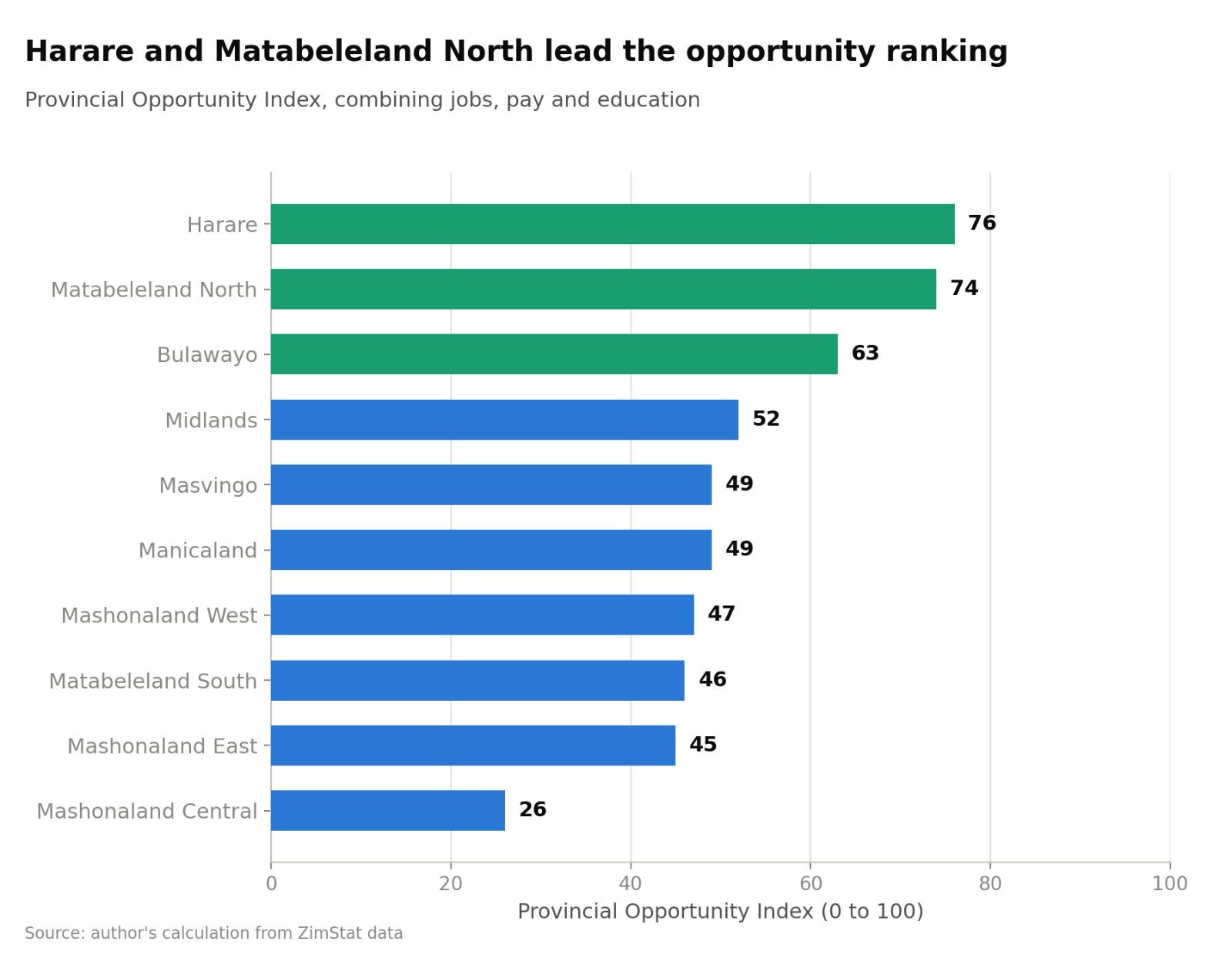
Tawanda Musarurwa
Checkpoint Desk
ASK which province best educates its people for the labour market, and most Zimbabweans would assume Harare.
But that honour belongs to Matabeleland North, built on coal, hydropower and Victoria Falls tourism, where 36,9 percent of employed people hold post-secondary qualifications, nearly double Harare’s 20 percent. Bulawayo, better known for its factories than its classrooms, follows at 31,6 percent.
Earnings tell a different story. In the fourth quarter of 2025, the average formal-sector worker in Mashonaland Central, where just 6,1 percent of the employed have any higher education, the lowest share nationally, took home ZiG72 500 a quarter, the best pay packet of any province, ahead even of Harare’s ZiG54 060.
Education is not the whole story of who prospers here; geology, geography and proximity to the state matter just as much.
That is the puzzle between the two latest Zimbabwe National Statistics Agency (ZimStat) datasets: the fourth-quarter 2025 Employment Index, from formal payrolls, and a Quarterly Labour Force Survey (QLFS) thematic report on education.
Separately, each confirms a familiar story: education pays, and Harare dominates. Together, they show provinces converting human capital into prosperity at wildly different rates.
The jobs and pay divide
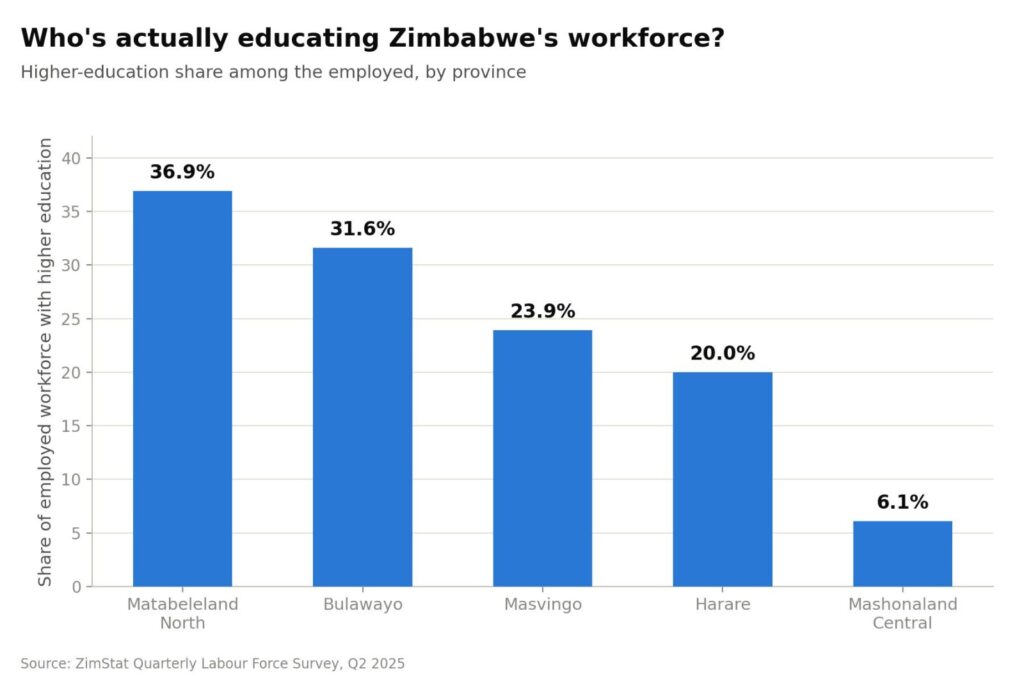
The Employment Volume Index, which measures formal jobs against a third-quarter-2024 baseline, stood at 99.10 nationally in the final quarter of 2025, down 1,1 percent quarter-on-quarter and 1,3 percent year-on-year.
Provincial fortunes diverged sharply. Harare climbed to 102.73, the only province with a net jobs gain since base, large enough given its 30,5 percent weight in national employment to prop up the whole country’s figure.
Masvingo followed at 101.71, on gold mining and irrigation agriculture near Lake Mutirikwi. Mashonaland East was weakest at 92.36, down nearly 8 percent from base, then Midlands (95.72) and Bulawayo (95.88).
Earnings ran almost in reverse. Mashonaland East, shedding the most jobs, posted the highest Earnings Index nationally at 196.72: nominal pay nearly doubled since the third quarter of 2024. Harare (169.86) and Midlands (167.60) also grew strongly.
Masvingo and Mashonaland Central collapsed to 41.92 and 57.09, below their own base level, as inflation ate into what remained.
The Real Earnings Index, which deflates nominal pay by the CPI, fell nationally from 90.19 in the third quarter of 2025 to 79.14 in the fourth, a 12 percent quarterly decline.
Harare alone is creating jobs and raising pay at once, a genuine, if narrow, engine of opportunity.
A province can also look like a wage “winner” for reasons unrelated to a thriving economy, since a small, volatile base makes a modest rise look like triple-digit growth.
Mashonaland East’s figure reflects a shrinking, more concentrated workforce paid more per head, not a boom.
The industry data bear this out. Financial and insurance activities recorded an earnings index of 660.74 in the fourth quarter, pay more than six times the base period and the standout among the white-collar, often public-sector-adjacent industries concentrated in Harare. Mining and Quarrying pays the highest absolute wages of any sector but posted an earnings index of just 92.34, below base, a volatility signature of commodity-price swings rather than steady growth.
Manufacturing’s earnings index, at 69.16, was among the weakest of eighteen sectors tracked, quiet confirmation of the deindustrialisation that has hollowed out Bulawayo and Midlands over three decades.
Education does not guarantee a paycheck
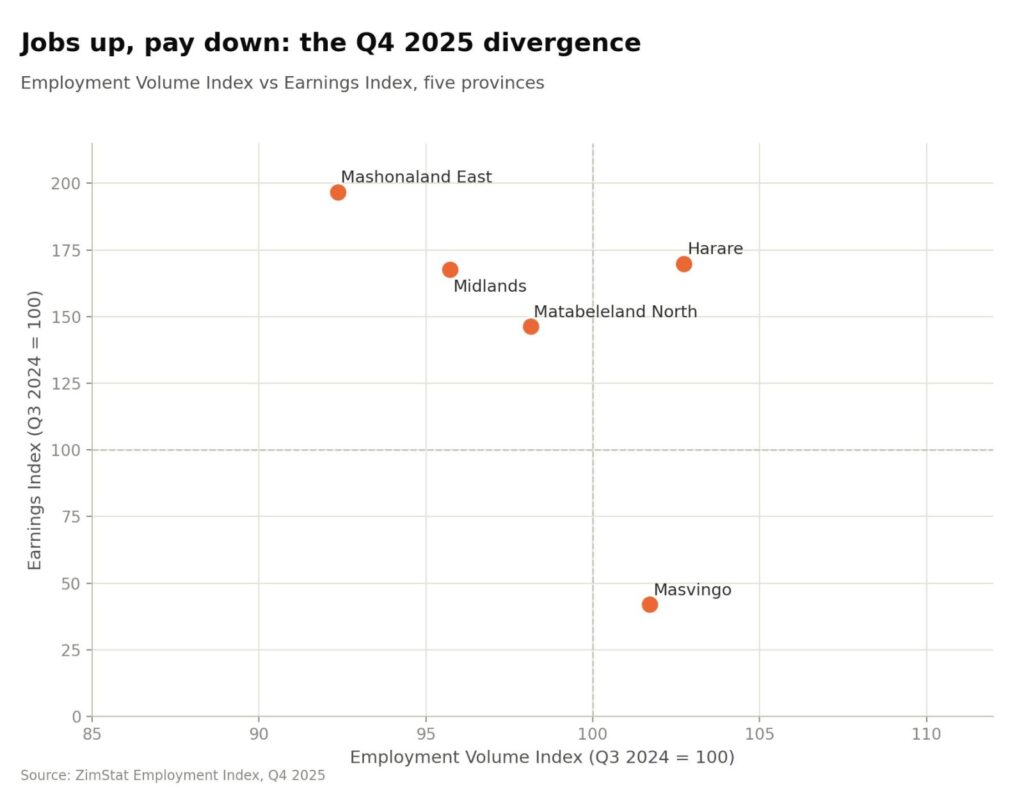
The QLFS thematic report, from the second-quarter 2025 survey, isolates who holds qualifications. Nationally, 9,5 percent of working-age adults have higher education, 63,1 percent secondary, and 3,1 percent none, with a stark urban-rural split: 18,4 percent of urban adults hold higher education against 4 percent in rural areas.
Harare has the largest share of secondary-school leavers among its workers (73,6 percent) but only a middling higher-education share (20 percent), behind Matabeleland North (36,9 percent), Bulawayo (31,6 percent) and Masvingo (23,9 percent).
Mashonaland Central sits opposite: 33,8 percent of its employed have only primary schooling, the highest of any province, with just 6,1 percent tertiary-qualified. The surprise is less Harare’s strength than its lack of exceptionalism.
The capital has Zimbabwe’s largest, most secondary-heavy workforce, not its most educated one. Matabeleland North and Bulawayo, long associated with decline, quietly out-educate it per worker.
Nationally the QLFS is unambiguous that education pays. Employment-to-population rises from 12 percent among those with no schooling to 70 percent among the highly educated. Formal-sector absorption rises from 1,9 to 56,2 percent.
Average monthly earnings climb from US$126,21 for the unschooled to US$634,40 for the tertiary-educated, a five-fold premium.
Unemployment, though, peaks among those with secondary schooling, at 23,6 percent nationally and 39,7 percent among secondary-educated youth aged 16 to 25.
The market rewards the credentialed extremes while punishing the secondary-school middle most workers occupy.
Provincially, this plays out unevenly. Bulawayo is the clearest case of high education meeting weak absorption: a 31,6 percent higher-education share, an employment index still below base (95.88), and a declining manufacturing base.
Mashonaland Central is the inverse anomaly, with low education and high pay, almost certainly a mining effect given its gold and, more recently, lithium deposits.
That is inference, not something either report states directly, but it aligns with industry data: Mining and Quarrying carried among the highest absolute wages of any sector (ZiG121 570 in the fourth quarter) even as its earnings index (92.34) sat below base, high pay but volatile. Matabeleland North threads a rarer needle: high education (36,9 percent) matched with respectable employment (98.14) and earnings (146.28) indices, tentative evidence that a smaller province can convert schooling into opportunity given an anchor industry, coal at Hwange and tourism at Victoria Falls, to employ its graduates locally.
To rank provinces on how well they convert education into reward, this analysis builds a Provincial Opportunity Index, combining three ZimStat-derived indicators available provincially: the Employment Volume Index, the Earnings Index, and the higher-education share of the employed workforce, rescaled to 0–100 and averaged equally.
It is narrow, since labour-force participation and formal-employment absorption exist only nationally in the current QLFS, but it is the clearest ranking the data allow. Harare tops the list at 76, followed by Matabeleland North at 74 and Bulawayo at 63.
The rest trail well behind: Midlands, Masvingo and Manicaland cluster around 49 to 52, Mashonaland West and Matabeleland South around 46 to 47, Mashonaland East sits at 45 with its best-in-country pay growth undone by the worst jobs growth, and Mashonaland Central finishes last at 26.
Harare tops the table not because it is Zimbabwe’s most educated province, since it is not, but because it combines a large, expanding jobs base with solid earnings, from concentrating public administration, financial services and higher education in one market.
Matabeleland North’s second place is the most counter-intuitive result: a remote province out-performing the second city. Mashonaland Central’s last-place finish, despite its startling wage level, reflects an index built to reward momentum and human capital together; a mining-driven pay spike on the least-educated workforce fails two of its three legs.
Geography, not just schooling, decides who prospers
Neither report tracks where a worker studied versus where they work, so an internal “brain drain” cannot be confirmed outright.
But the circumstantial evidence points that way. Harare absorbs 30,5 percent of all formally employed Zimbabweans while producing only a middling share of the country’s graduates, and the Bulawayo literature suggests the missing flow is skilled young people relocating to the capital rather than staying to be underemployed at home.
The divergence traces back to familiar forces. Harare’s edge is concentration: head offices, banks and the largest universities cluster there, driving the white-collar demand that pays best.
Matabeleland North and Mashonaland Central owe their numbers to extractive geology, coal and hydropower in one, gold and lithium in the other, which can pay well without a broad tertiary pipeline.
Bulawayo and Midlands carry the scars of deindustrialisation: factory-era human capital with no factories left to employ it.
The National Development Strategy 2, 2026 to 2030 (NDS2), launched in late 2025, lists “regional development and inclusivity through devolution and decentralisation” among its 10 priorities, an implicit admission that growth concentrated in Harare and a few mining belts is not national development.
The pattern of a dominant capital, a declining second city and volatile resource peripheries echoes similar divides in South Africa and Zambia.
It is not a simple “Harare wins, everyone else loses” story. Prosperity depends on three things that do not always align: whether a province has an economy that can absorb qualified people (Harare, and strikingly Matabeleland North), whether it sits on resources that pay well regardless of schooling (Mashonaland Central, more precariously than its headline wage suggests), and whether industrial decline has stranded an educated population without local demand for its skills (Bulawayo, most visibly).
The current structure is reflective of the old colonial state’s decisions about where it chose to locate its jobs.
Fixing that would mean building formal, tradeable-sector jobs in the provinces that already have the graduates, rather than waiting for graduates to come to the jobs, which is what NDS2 points towards.



