Online Reporter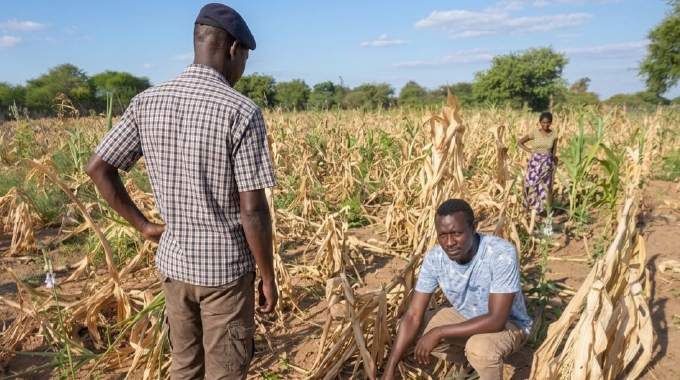
Theseus Shambare, [email protected]
THE rains arrived like a long deferred blessing, falling from the sky with all the weight of a promise finally being kept. Then they lingered, day after day, until that promise soured and turned into a curse.
In Bulilima District, in Zimbabwe’s Matabeleland South Province, a landscape more accustomed to cracked earth than pooled water, the 2025/2026 farming season began with a rare and cautious optimism.
This is a region straddling agro ecological zones IV and V, where rainfall is famously fickle and often absent altogether. For generations, life here has been shaped by what is missing — dependable water, predictable harvests, the quiet assurance that tomorrow will resemble today.
Even during routine monitoring between October 2024 and January 2025, the imbalance was stark: Ward 2 received 396mm of rain, while Wards 15 and 5 managed just over 200mm. Such unevenness has long forced communities to adapt, turning to hardy goats and donkeys while fields, more often than not, yielded little beyond survival.
So when the clouds finally opened in earnest, many believed fate had shifted.
“This year, we thought God had finally remembered us,” said 67 year old widow Ms Lucia Dube of Malopa Village.
But hope, like the rain, became overwhelming. Instead of nourishing crops, the relentless downpours stripped nutrients from the soil, drowned seedlings and swept away entire fields. Rivers burst their banks, crossings vanished under rushing water and whole communities found themselves cut off from schools, clinics and markets. Then, just as the waters began to recede, another menace appeared from the edges of the land.
Elephants
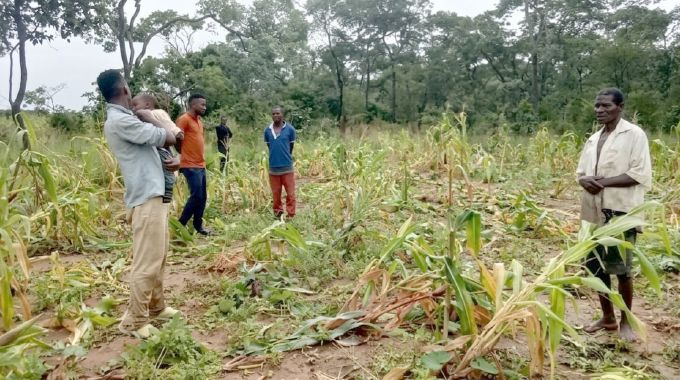
In Tjakuda Village, the damage reads like a silent testimony etched into the earth. Maize stalks lie snapped and scattered like abandoned matchsticks, while deep, circular footprints pockmark the softened ground — unmistakable signs of a nocturnal invasion.
“They were here,” said Mr Stewart Sibanda, surveying what remains. “And they will come again.”
For villagers, the season has become a cruel stacking of disasters — too much rain followed by devastating loss.
“We are now left with nothing. The rains destroyed some of our crops and what remained has been eaten by elephants,” Mr Sibanda said.
Across wards including Dupute, Sihoma, Nswazi and Makhulela in Bulilima West constituency, the refrain is the same: fields once glowing with promise now stripped bare and silent. For 70 year old Ms Jane Ndlovu, nights have stretched into long hours of anxiety.
“The elephants come at night. They destroy everything — especially watermelons and maize. We try to chase them away, but we are old. We cannot fight them.”
Ms Sukoluhle Moyo, 60, has watched entire fields vanish between dusk and dawn.
“They move as a group. By morning, there is nothing left,” she said.
In Bulilima today, the irony is painful and unmistakable — a season of abundance has delivered hunger. The heavy rains that battered Matabeleland South left scars far beyond the fields.
In neighbouring Gwanda District, floods washed away vital infrastructure, crippling water supplies and isolating entire communities.
In parts of Bulilima, swollen rivers and broken crossings have turned access to basic services into an exhausting daily challenge. For many households, the lean season — usually a brief wait before harvest — has arrived early and with unforgiving force.
Against this backdrop, the Government, working with the World Food Programme (WFP) and supported by the Russian Federation, has stepped in with emergency assistance.
At Malalume, villagers gather beneath thin patches of shade, forming quiet, patient lines as they wait for aid — modest, yet life saving. Each household receives a food basket of 7,5kg of cereals, 1,6kg of pulses and 0,6kg of vegetable oil, enough to carry families through the hardest weeks. For Ms Dube, it is nothing short of survival.
“This will help us a lot,” she said, clutching her allocation. “We had nothing left. At least now we can eat.”
The programme is expected to reach more than 63 000 people across Bulilima and Kariba districts, focusing on the most vulnerable — the elderly, child headed households and people living with disabilities.
Speaking during the distribution, WFP Head of External Relations Ms Ifeoma Garba said the intervention could not have come at a more critical moment.
“This assistance has been made possible through strong partnerships, helping households cope at a time when food is most scarce and many families struggle to meet their daily needs. The Government of the Russian Federation has provided pulses and vegetable oil worth US$1,5 million, which has been twinned with cereals provided by the Government of Zimbabwe.”
Deputy Russian Ambassador to Zimbabwe Mr Sergey Kuzin described the support as part of a broader commitment to tackling climate driven hunger.
“This donation is part of Russia’s contribution to the United Nations World Food Programme, aimed at helping communities overcome the impacts of climate change,” he said.
Government officials echoed the sentiment, emphasising the importance of collaboration.
“This timely support is essential in ensuring that no one is left behind during this lean season,” said Acting Chief Director of Social Development and Disability Affairs Mr Tawanda Zimhunga.
Yet even as food aid offers temporary respite, a deeper and more complex crisis continues to unfold — one that pits survival against survival. Encounters between people and wildlife are no longer rare or isolated. According to ZimParks, reported cases of human wildlife conflict rose sharply from 1 654 in 2024 to 2 090 in 2025, a 26 percent increase, with elephants among the most commonly involved animals.
“Climate change has fundamentally impacted the dynamics of our ecosystems. Our responsibility is to adapt our management approaches while working closely with communities and partners to reduce risk and build resilience,” said ZimParks Director General Professor Edson Gandiwa.
Shifting weather patterns are reshaping wildlife behaviour, pushing animals beyond traditional habitats in search of food and water. In places like Bulilima, elephants are no longer distant silhouettes confined to protected parks — they are uninvited visitors trampling through communal fields. Conservationists caution against seeing the animals as villains alone. With shrinking water sources and altered grazing routes, elephants too are navigating a landscape in flux. Here, people and wildlife are increasingly competing for the same fragile resources.
Efforts to ease this tension are beginning to surface. ZimParks, alongside communities and partners, is promoting chilli based deterrents to keep elephants at bay, while supporting stronger livestock enclosures to protect household assets.
Community based conservation initiatives are also being encouraged, enabling villagers to benefit from wildlife while taking an active role in managing it. For now, however, these solutions remain works in progress.
As the sun sinks low over Malalume, villagers begin the slow journey home — sacks of grain balanced on heads, wheelbarrows rattling over dust, donkey drawn carts creaking along narrow paths. Children trail behind, their laughter briefly piercing the heaviness of the day. For now, there is food. For tomorrow, there are questions.
In Bulilima, the climate crisis is no longer an abstract theory debated in distant rooms. It is lived daily — in saturated soil, empty granaries and the heavy tread of elephants in the night. For Ms Dube, hope persists, quiet and unyielding.
“We have seen bad years before. We will survive this one too,” she said.
But as seasons grow less predictable and the boundary between people and wildlife continues to blur, survival is no longer just about endurance. It is about relearning how to live with a land that is changing beneath one’s feet. And in Bulilima, that lesson is still being written — in mud, in footprints and in the fragile promise carried by the next rain.