Online Reporter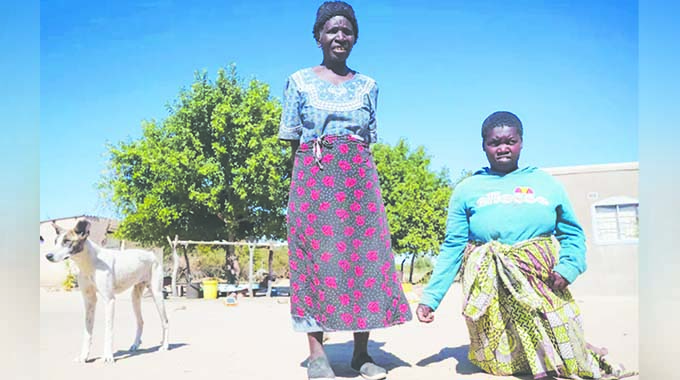
Stanford Chiwanga, Quality Editor
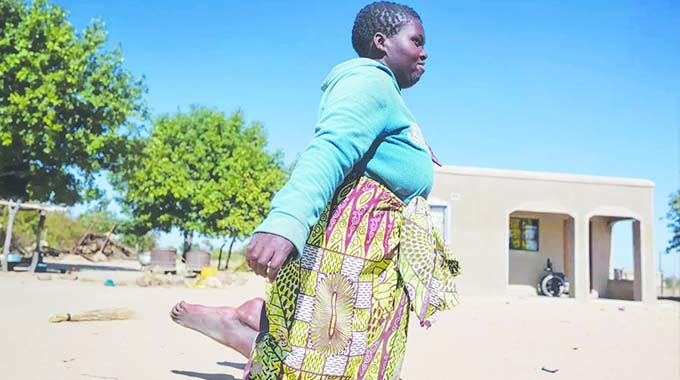
MILLICENT Tshabalala’s journey is not measured in steps but in purpose. In a quiet corner of Matabeleland South’s Mangwe District, the 24-year-old from Empandeni East Village moves with a grace that has always been uniquely her own. Born with underdeveloped feet and limited use of her left hand, she has defied conventional expectations, forging a path forward with remarkable determination and strength.
“I may use my knees, but I go where I need to. I can wash myself. I don’t feel like I can’t do things,” she says. Millicent lives with her 77-year-old grandmother, Mrs Maria Tshabalala, who has cared for her since childhood.
Theirs is a household built on resilience. They survive through love and willpower, despite the challenges of poverty, limited mobility, and Millicent’s epilepsy, all without access to reliable healthcare.
“She’s never seen herself as helpless. She even wants to start a little business selling groceries in the village. She just needs a bit of help to get there,” Maria says with pride.
That help has finally arrived through a transformative initiative launched by the Ministry of Public Service, Labour, and Social Welfare with support from Unicef. Funded by Sida through the Child Protection Fund (CPF) and the Unicef Child Protection Global Thematic Pool, the programme aims to pilot harmonised protocols and tools for Disability Identification, Screening, Assessment, and Determination, thereby bringing vital services directly to the doorsteps of communities and reducing barriers to care.
Previously, individuals like Millicent would have had to endure long, exhausting journeys to Plumtree town, navigating multiple Government offices just to be assessed — an impossible task for many. Now, thanks to an outreach-based model, these services are brought directly into communities like Millicent’s.
The project, being field-tested in Mangwe District, represents a whole-of-government approach, coordinated by the Ministry of Public Service, Labour and Social Welfare, and involving the Ministries of Health and Child Care, Primary and Secondary Education, the National Social Security Authority (Nssa), Organisations of Persons with Disabilities, and various Civil Society Organisations.
Through this initiative, families are not only assessed but also connected to healthcare, mobility support, inclusive education, psychosocial services, and social protection programmes — all in one place.
For Millicent, this could mean access to epilepsy treatment, a wheelchair to ease the strain on her knees, and menstrual products to manage her cycle with dignity. Until now, period poverty has been an unspoken burden.
“Sometimes we choose between mealie-meal and pads. That’s not a real choice. But this programme — it’s changing things,” said Mrs Tshabalala.
The transformation is not only practical but perceptual. Families once silenced by stigma now feel seen. For them the pilot exercise is more than a framework for services — it is a declaration of worth.
And for Millicent, that worth is finally being recognised.
“With a wheelchair,” she says, eyes shining, “I’d go even faster.”
That is what this initiative represents: not just the ability to move, but the right to. On knees or on wheels, with pride and promise, Millicent is living proof that when systems shift, lives do too.
Mangwe Community Childcare Worker Mrs Madel Ngwenya (62), who has supported vulnerable families in the area for over two decades, described Millicent’s story as both inspiring and emblematic of the silent struggles many endure.
“I’ve watched Millicent grow up crawling through this village, never asking for pity — just for a chance. This programme has brought that chance right to her doorstep, and I can tell you, it is already changing how our community views disability.”
Reflecting on the broader impact, she added: “For too long, services happened ‘out there’ — in towns, in offices we could hardly reach. Now, the system is coming to our homes, asking us what we need, not telling us what we’re worth. That shift is huge. It is restoring dignity, especially for young women like Millicent who have been invisible for too long.”
Mrs Ngwenya also highlighted the importance of addressing period poverty and mobility alongside healthcare and education.
“When you give a girl a wheelchair, knee pads, and sanitary pads, you’re not just meeting her physical needs — you’re saying, ‘You belong in this world as much as anyone else.’ That’s powerful.”
Her words echoed across the assessment site, where — for the first time in memory — inclusion didn’t feel like a favour. It felt like a right.