


 tawandamusarurwa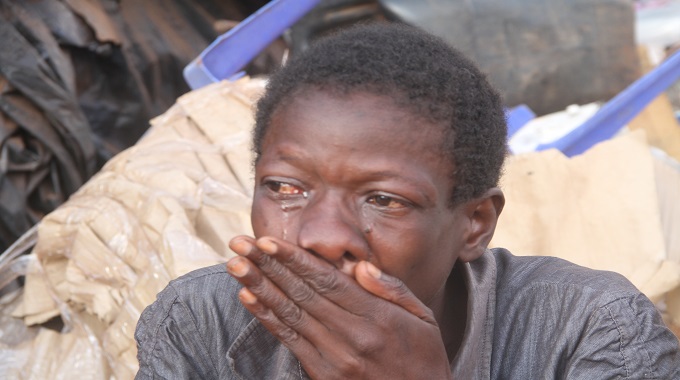
Veronica Gwaze
CLOSE to the National Sports Stadium, several adults sit under the sun, sorting out heaps of plastic waste for sale.
It is late afternoon, a time when ordinary families should be preparing supper, yet there are no pots or fires being attended to in this area.
The “dumpsite” now hosts more than 50 plastic shacks, which have been erected over the years. The number of these illegal structures keeps swelling with each passing day.
Families that were illegally settled in a nearby area, have turned the place close to the sports facility into their new home.

Others simply invade the dumpsite after being evicted from lodgings. There are yet others who find themselves at the site after running away from their matrimonial homes for one reason or the other.
The squatters mostly come from surrounding areas like Warren Park, Westlea, Kuwadzana and Dzivaresekwa.
As the elders toil, trying to eke out a living, their children occupy themselves with something else.
A bunch of shabbily dressed youngsters of school-going age are busy playing social football, while the older ones sit under a tree, listening to loud music from a Bluetooth speaker.

Lyrics from one of the songs that are played repeatedly capture this writer’s attention.
“Nhamo haiurayi asi inoondesa,” sings the late Tedious Matsito in the song.
The songs aptly capture the state of affairs at the squatter camp.
There are neither proper ablution facilities in sight nor clean water sources. The place is actually a ticking health time bomb, especially considering the cholera and typhoid outbreak.

Also, the plastic shacks are not secure and could collapse any moment.
Similarly, the occupants are at risk as the structures can easily catch fire, while harsh weather conditions also make them improper for habitation.
Origin
The Sunday Mail Society recently interviewed some members of the community to get an insight into their background.
Wadzanai Mutowo moved to the dumpsite in 2016 from Chitungwiza after separating with George Kamonera, her husband of six years.
“We had four children together, but our union was based on endurance rather than happiness,” she said as she broke down.
“I endured years of verbal, emotional and physical abuse until I felt it was better to leave, even though I had no fallback plan.”
For days, Mutowo and her children slept in an open space, enduring harsh weather conditions.
She then met a friend, a former squatter, who directed her to the dumpsite near the National Sports Stadium.
In 2017, she and her children moved there, and they currently live in a tiny shack.
The family neither has a bed nor enough blankets.
“All my children are not in school because I cannot afford tuition fees. To feed them, I used to do menial jobs, but things have become tough of late, hence I have now resorted to scavenging in bins,” said Mutowo.
Her colleague, Nokuthula (18), stays with her three siblings.
Nokuthula’s mother remarried, after separating with their father. She now stays in Highlands, where her current husband is employed as a gardener.
“I have to take care of my siblings because our mother cannot stay with us at her new home,” she said, as tears rolled down her cheeks.
“She sometimes visits us but life is tough here. I cry myself to sleep every night. I wish I was in school, but it is not possible because I have to provide for my siblings.”
Her normal day starts around 4am, as she goes around collecting plastic waste in communities and later sells it.
The money, she said, is barely enough to meet their needs, but it has enabled them to survive.
Manipulation
Most of the dwellers are vulnerable single mothers, who are struggling to provide for their kids. Sadly, some men now consider them easy prey.
The wolves in sheep’s clothing befriend these women using fake identities and make false promises of a better life.
However, they quickly vanish after impregnating the women or stealing from them.
Thirty-four-year-old Wadzanai, a mother of five, is a bitter woman.
She shared her sad tale that dates back to 2003, when she came to Harare from Nyanga in search of greener pastures.
Upon arrival, Wadzanai secured a job in one of the affluent suburbs, where she served as a domestic worker for a few months, before meeting the man who then became her husband for close to a decade.
However, her marriage was not rosy as she was the sole breadwinner, with little income.
The husband would violently demand the few dollars she earned to satisfy his wayward drinking behaviour. This forced Wadzanai to abandon her matrimonial home and employment in 2016.
By that time, she already had four children.
She could not find a place to rent due to financial constraints and eventually found herself at the squatter camp, where she later on met another man.
One thing led to another and the two had a child before the man vanished into thin air.
“When I tried to track him down, I realised that he had lied to me about his identity and roots. I am heartbroken, but there is nothing I can do. I have to look at the bigger picture.
“I wish my children could go back to school and for the authorities to assist us with proper housing,” pleaded Wadzanai.
Addy Cheza, a mother of three, is equally dejected.
She used to stay in Hatcliffe with her husband. However, their union collapsed due to the husband’s alleged abusive behaviour.
The man, recalls Cheza, would come home drunk, verbally abuse her, calling her all sorts of names, and sometimes get physical.
Interventions by relatives only worked briefly.
The situation almost turned fatal in 2019, when he nearly missed Cheza with a kitchen knife.
“I fled for dear life that night, and that was the end of our union. My relatives had to collect the children on my behalf, before we moved here. My parents are late, so I have no one to assist me and the children with even a place to stay,” said Cheza.
Last year, she met another man, who identified himself as Trust, from Mt Darwin.
He impregnated her and disappeared without a trace.
Cheza tried in vain to locate him.
“I later discovered that he infected me with HIV after I stumbled upon some of his antiretroviral drugs, which he forgot to take with him,” she said as she wept bitterly.
“Life has never been easy for me. In the first days, I could not even eat. The living conditions are just bad. Even now, when I look at my children, I feel heartbroken. I feel I have failed them.”
Support
Ministry of Public Service, Labour and Social Welfare Harare provincial social welfare officer Mrs Susan Ngani said they are addressing the situation.
She said they are working closely with the Ministry of Primary and Secondary Education to ensure more than 40 children staying at the dumpsite are enrolled in school.
“Our plan is to have these children in school under the Basic Education Assistance Module (BEAM) and then handle other issues afterwards,” explained Mrs Ngani.
“We will also take some of these people to various shelters that we have across the country and give them the necessary assistance. Their living conditions are not conducive. This is a ticking health bomb, so we need to act hastily.”
Ministry of Local Government and Public Works communications advocacy director Mr Gabriel Masvora said the Social Welfare Department is mandated to move in and document the squatters and the circumstances that have led to the situation.
“It is only after the report and recommendations from the department that Local Government and other entities move in to offer relevant support or intervention.
“Also, it must be noted that areas in towns fall under respective urban local authorities, so we deal with such matters in a holistic manner. Local authorities will ensure that land uses in their jurisdictions conform to their masterplans,” said Mr Masvora.
Director of communications and advocacy in the Ministry of Primary and Secondary Education Mr Taungana Ndoro called for collaboration between schools and parents to enrol the affected children.
“Parents should approach local schools and register their children under the BEAM programme so that they do not violate these children’s right to education,” he said.
Psychologist and University of Johannesburg post-doctoral researcher Dr John Ringson notes that children who grow up in such environments often develop behavioural and emotional complications.
He said a squatter camp type of life is often associated with wayward behaviours such as use of foul language; loose morals; and drug and substance abuse.
“Such children are at a high risk of having no interest in their academics or struggle with them in future. They may also be prone to depression, and drug and substance abuse, so there is a need for psychological therapy when they are enrolled back in school,” said Dr Ringson.



 Online Reporter
 Bongani Ndlovu