admin
admin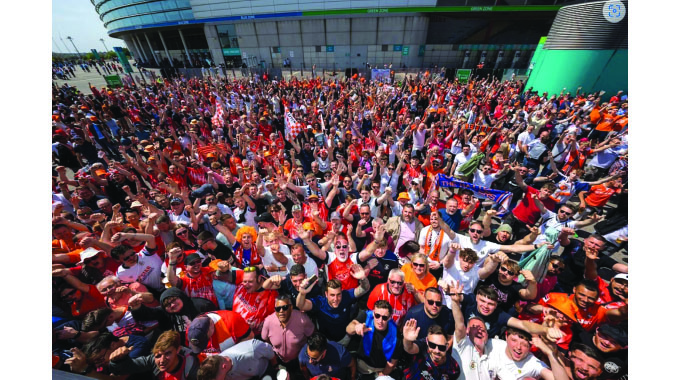
Sharuko On Saturday
HE strode like a true Warrior, seemingly unfazed by the punishing weight of the massive assignment and the dire consequences, which failure could trigger.
For four months he had experienced nothing but an outpouring of undiluted love from those in the brighter colours of this historic English town of about 240 000 residents, which they collectively represented.
But, he knew things could change quickly, in the event he failed them when they really needed him the most.
Marvelous Nakamba lives in the real world.
And, he saw how they came up with a sickening image of Bukayo Saka, in what was a disturbing racist attack, after the Arsenal star missed a crucial penalty.
That this boy, with Nigerian roots, had been the Gunners’ best player, all season, didn’t matter at all to those racists.
After all, as far as they are concerned, black people can only be tolerated for convenience’s sake, when they are delivering a certain service, for the satisfaction of the ‘master.’
And, on the occasions they come short, in the world of these racists, these black sports stars should be treated as monkeys, instead of humans.
In the pressure cooker of a Wembley shootout drama, where the difference between who pockets a cool £100 million pay cheque, and who gets absolutely nothing, is determined by who converts the penalties better, boys are separated from men.
It’s a cruel way to decide matches but even World Cup finals have been won this way, including the last one, when Lionel Messi and his lieutenants found a way to hold their nerves better.
Aurelien Tchoameni and Kingsley Coman missed their penalty kicks and that they are black athletes didn’t help their cause, in terms of the inevitable backlash, from racists scrambling to find scapegoats.
It’s a sensitive subject we should confront and discuss, some other time, about why our black football stars seemingly don’t handle the relentless pressure, which comes with such do-or-die situations, like penalty shootouts, better than their white counterparts.
Two years ago, three black footballers — Saka, Jadon Sancho and Marcus Rashford — missed penalties at Wembley in the Euro final as England lost to Italy and the Cup, instead of coming HOME, ended up going to ROME.
Eleven years earlier, in the most important kick, from 12 yards ever taken by an African footballer, Asamoah Gyan fluffed his lines and Ghana missed their chance to make history as the first country, from the continent, to play in the World Cup semis.
On Saturday night, the spotlight fell on Nakamba as a gruelling duel between Luton Town and Coventry City came down to the penalty shootout drama.
We had a reason to expect the best and fear the worst.
In 252 matches on the European football fields, Nakamba had scored just FOUR times, two in the Dutch top-flight league, one in the Dutch Cup and one in Beloften.
On average, that’s one goal every 66 matches.
His last goal in a league match had come six years ago, in a 5-0 romp over Sparta Rotterdam, on October 3, 2017.
For the first time, during his European adventure, he was taking a penalty, not an ordinary spot kick but one of the most important spot kicks, in the 138-year history of Luton Town.
He was wearing the vibrant tangerine kit.
It was introduced when a club director, Eric Morecambe, suggested the need for a more vibrant kit to help the players to pick each other out because the floodlighting at Kenilworth Road was not up to standard.
The boy from the coalfields of Hwange, appeared to be an island of composure, in a rough ocean of emotional chaos, as he strode to take the most important kick, from 12 yards, of his career.
We held our breath, as Zimbabwe, because his nationality had long sucked us into this showdown, praying for him to score, pleading with the football gods, to help him find the target.
Of course, he did, with the calmness of a regular penalty taker, fooling the ‘keeper, as his shot nestled in the far corner.
To suggest that we breathed a sigh of relief will be an understatement.
MARVE THE THIRD, IT’S BEEN AN ADVENTURE
I was at Alex Sports Club when this whole drama unfolded on Saturday night.
And, the explosion of joy, which greeted his successful conversion of the spot kick was huge, in what was a beautiful illustration of the power of patriotism.
Of course, like Luton Town’s nickname, the Hatters, which is derived from the city’s history as a hat-making centre, there will always be haters.
Those, among us, who don’t want to hear or read a success story coming from this country or associated with this nation.
They are already dismissing it as a non-event, arguing that there is no reason to celebrate a success story from a second-tier English league.
They were telling us, a few weeks ago, that real football nations, like Zambia, have players in the English Premiership.
Now, with Leicester City’s relegation, and Patrick Daka facing the possibility of playing where Nakamba and Luton Town have just come from, they have all gone quiet.
They don’t want us to tell you that, as of now, there are just two Southern African players registered with Premier League teams and Nakamba is one of them.
The other is Bafana Bafana forward, Lyle Foster, who has just arrived in the Premiership with Burnley.
They don’t want us to tell you that Nakamba’s Wembley adventure was a milestone moment for football in this part of the world.
Why?
Because it was only the third time, in 55 years, that a black footballer from Southern Africa featured at the home of English football in a match, in which a piece of silverware would be handed out, at the end of the showdown.
The first time this happened was on May 1, 1965, when Albert Johanneson, a South African footballer, featured for Leeds United in the FA Cup final against Liverpool before 100 000 fans.
It was an historic occasion for football on this continent as Johanneson became the first footballer, of African heritage, to play in the FA Cup final.
To illustrate why it was such a monumental moment for this continent, one should note that it took 93 years for the FA Cup final, which was first played in March 1872, to have its first footballer of African descent.
Johanneson had to deal with unacceptable levels of racial abuse during his playing days, which all took a significant toll on him.
And, to escape from it all, he turned into someone who became a slave of alcohol and was a sorry figure of the trailblazing star by the time he died, at the age of 55, in Leeds, on September 28, 1995.
His lifeless body was not noticed by anyone for several days in the tiny council flat, in a tower block, which was his home.
A single seashell was listed among his possessions in a graphic illustration of the levels of destitution, which the man they called ‘Black Flash,’ in his hey days, had fallen into.
The last time this had happened was on May 30, 2009, when Steven Pienaar, another South African footballer, featured for Everton in the FA Cup final against Chelsea.
Pienaar, just like his countryman Johanneson, could not celebrate winning a trophy, at the end of the showdown, after Everton were beaten 1-2 in the final by Chelsea.
THE THIRD PLAYER, THE THIRD PENALTY
Bruce Grobbelaar won a number of trophies at Wembley with Liverpool but it was easier for him to be accommodated in the game, because he looked like most of the players and the fans.
Of course, he was good, very good, and there is no doubt about that.
Somehow, Nakamba, the third black Southern African footballer to feature in a Wembley showcase, where a piece of silverware would be presented at the end of the showdown, chose to take the third spot-kick last Saturday.
Maybe, he was praying and, if you are a Christian like him, you will understand why.
After all, our Lord and Saviour, Jesus Christ, prayed THREE times in the Garden of Gethsemane before His arrest.
There were THREE hours of darkness which covered the land while Jesus was suffering on the cross and Christ was dead for THREE full days and nights before His resurrection.
Only THREE individuals witnessed Jesus’ transfiguration on Mount Hermon – John, Peter and James.
The Bible only mentions the names of THREE angels – Michael, Gabriel and Lucifer.
Nakamba must have read Exodus 23:14, just before the match on Saturday, or remembered it, just before the penalty shootout:
“THREE times a year, you are to celebrate a festival for Me.”
For a club which was relegated in 1992, just before the big bucks of the Premiership started flowing, with a stadium which has the same capacity as Gwanzura (10 000), Saturday’s success provided them with a grand festival of joy.
This is a club, and a people, who have been to hell and back.
They have taken it all in their stride — a points deduction, a bankruptcy scare and plummeting down the table to end up in the non-league community of football clubs.
Luton is unique, the distance between it and London, where the big boys like Arsenal and Chelsea reside, is roughly like the one between Harare and Norton.
It’s a city which, since the 2011 census, has had a white British population which is less than 50% of the residents who call it home.
There are only two other towns in the United Kingdom with a similar make-up — Leicester and Slough.
I first arrived in Luton at the turn of the millennium and was fascinated by how much it felt like just another town, back home, in terms of the significant number of its black residents.
Temba Mliswa still lived there.
That’s where I also met Mordecai “Bhuru” Mwerenga, a former Sables star, who had relocated to stay in the United Kingdom.
Sadly, we lost Bhuru last year, in a car accident in the UK.
One day, I went to a musical show whose headline act was legendary South African star, Brenda Fassie.
The organisers had targeted the large Southern African community in Luton and they were right — the venue was packed to the rafters. Boy, oh boy, we were so happy that night.
Little did we know that, two decades later, a boy from the coalfields of Hwange would be one of the toasts of this English town for local club Luton Town.
Boy, oh boy, they were so happy on Saturday night.
To God Be The Glory!
Peace to the GEPA Chief, the Big Fish, George Norton, Daily Service, Sitting Bull, Crazy Horse and all the Chakariboys still in the struggle.
Come on United!!!!!!!!!!!!!!!!!!!!!!!!!
Brunoooooooooooooooooooooooo!
Text Feedback 0772545199
WhatsApp 0772545199
Email – [email protected]
You can also interact with me on Twitter (@Chakariboy), Facebook, Instagram (sharukor) and Skype (sharuko58)


 Online Reporter