Online Reporter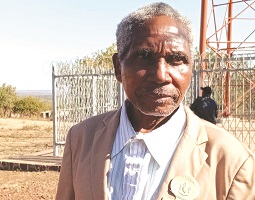
Sharon Chigeza
IN the forgotten southern reaches of Zimbabwe, where the red earth of Chipinge district meets the Mozambican border, just seven kilometres away, the people of Garahwa had grown accustomed to silence.
For generations, this remote community, baked by a relentless semi-arid climate and battered by seasonal floods, existed in peculiar isolation — physically within Zimbabwe’s borders yet functionally removed from the nation’s pulse.
The cruel irony was not lost on villagers, who, when they needed to make urgent calls, relied on Mozambican mobile networks, their voices literally travelling through foreign infrastructure before reaching their own countrymen.
This communication blackout created a parallel existence where national news arrived weeks late, farmers sold their crops at whatever price visiting traders offered — relying mostly on barter trade with neighbouring Mozambique — and impending disasters like Cyclone Idai in 2019 descended on them without warning.
Village head Mr Edson Danga still carries the trauma of those desperate hours when floodwaters rose without alert, swallowing homes and livelihoods while Garahwa’s cries for help went unheard.
“We were shouting into the wind. The world moved on while we buried our dead and rebuilt with bare hands,” he recalls, his voice thick with emotion.
Hope springs eternal
All that changed when the steel skeleton of hope rose against Garahwa’s skies — a multipurpose transmission tower that would become the community’s lifeline to the world.
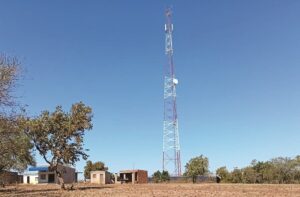
The project, spearheaded by Transmedia Corporation with crucial support from UNDP and UNESCO, faced immediate technical challenges.
Located far from the national power grid, the solution came in the form of gleaming solar panels beside the tower, which harness power from the same sun that had long scorched Garahwa’s fields.
The transformation has been nothing short of miraculous.
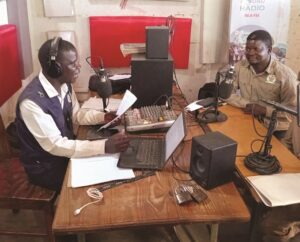
Where once there was radio silence, the airwaves now carry the vibrant programming of Ndau FM, a community radio station that has become Garahwa’s central nervous system.
The station’s early warning weather system, installed at its studio, represents more than technology — it is a promise that no family will again face nature’s fury unprepared.
“Now, when storms gather, our phones buzz with alerts, our radios crackle with informative messages,” explains Mr Danga, demonstrating how the system covers a 70-kilometre radius.
Radio remains a vital tool in promoting agriculture and rural development, as it is the most effective medium in rural areas.
Community participation is essential for radio to succeed as a communication channel.
Speaking during a tour of Ndau Community Radio Station in Garahwa, chief director in the Ministry of Information, Publicity and Broadcasting Services Mr Jonathan Gandari applauded the efficient use of renewable energy to power the facility.
Access to radio, he said, promotes inclusivity for underserved communities within the national development agenda.
“Radio is an important communication tool and essential in driving President Mnangagwa’s vision of an upper middle-income economy by 2030. Now that such communities are connected, they can contribute effectively to the development and rural industrialisation agenda,” he said.
For Ms Esther Makuyana, a mother who once relied on handwritten letters carried by unpredictable means of transport to communicate with her sister in Checheche, the tower has rewritten the rules of relationships.
“I remember watching trucks get stuck in the mud during the rains, our letters being washed away in their cabins,” she says, cradling a smartphone that now connects her instantly to family across the country.
“Now, I communicate with my granddaughter in Harare every Sunday through local calls.”
The economic ripples spread daily.
At the bustling new marketplace, farmers cluster around smartphones, checking commodity prices before negotiating with buyers.
Mobile money agents, once a two-day journey away, now operate from zinc-roofed stalls where transactions ping instantly across digital networks.
A half-built business centre stands as testament to growing ambitions, its concrete blocks waiting to house the entrepreneurs emerging from Garahwa’s connected renaissance.
Transmedia Corporation’s chief executive officer Engineer Adonia Mushosho views the Garahwa project as more than infrastructure.
“This tower did not just bridge a communication gap,” he reflects, watching villagers gather under its shadow for a community meeting broadcast live on Ndau FM.
“It restored dignity. These people no longer need to beg for signals from neighbouring countries. Their Zimbabwean SIM cards work in their Zimbabwean homes,” he said.
Zimbabwe is steadily marching towards its Vision 2030 goal, which is premised on an empowered, modern and highly industrialised country, where living standards are high.
Central to this vision is ensuring that every Zimbabwean has access to the tools and opportunities needed to thrive in an increasingly digital world.
In this regard, rural digitisation is not just a dream, but a necessity.
It is against this background that the Government is doing everything possible to make sure that anyone in rural areas who has an enterprise requiring investment gets adequate assistance to expand business opportunities — communication technology being key to this.
The Government, through its various initiatives, has laid the groundwork for transforming rural communities by distributing digital gadgets and improving access to technology.
It has also focused on infrastructure development to support rural digitisation.
Thus, in collaboration with telecommunications companies, efforts have been made to expand network coverage to remote areas.
The ongoing rollout of 5G technology and construction of base stations in underserved regions are steps in the right direction.
These developments are crucial for ensuring that rural communities can access the internet reliably, enabling them to benefit from e-learning platforms, telemedicine services and e-commerce.
The Government is promoting rural digitisation as part of a broader strategy to ensure no one and no place is left behind in Zimbabwe’s development trajectory.
By prioritising rural areas, the Government is addressing historical inequalities and empowering communities to contribute to the country’s economic growth.
By bringing remote areas into the digital world, Zimbabwe can unlock the full potential of its human capital, driving innovation, entrepreneurship and economic growth.
As twilight paints the sky in hues of orange and purple, the tower’s blinking lights pulse like a heartbeat across the landscape.
In its glow, children do homework by solar lamps while their parents check weather forecasts on mobile phones.
The elderly listen as Ndau FM broadcasts news in their native language, their faces illuminated by something beyond
the physical light — the radiance of inclusion.
Garahwa’s story no longer begins
with “once isolated” but with “now connected”.
The tower stands not just as steel and wire, but as a monument to what happens when a nation decides that no community is too remote, no citizen too far and no voice too small to be heard. In this once-forgotten corner of Zimbabwe, silence has been replaced by the beautiful noise of belonging. — New Ziana



 Online Reporter