Online Reporter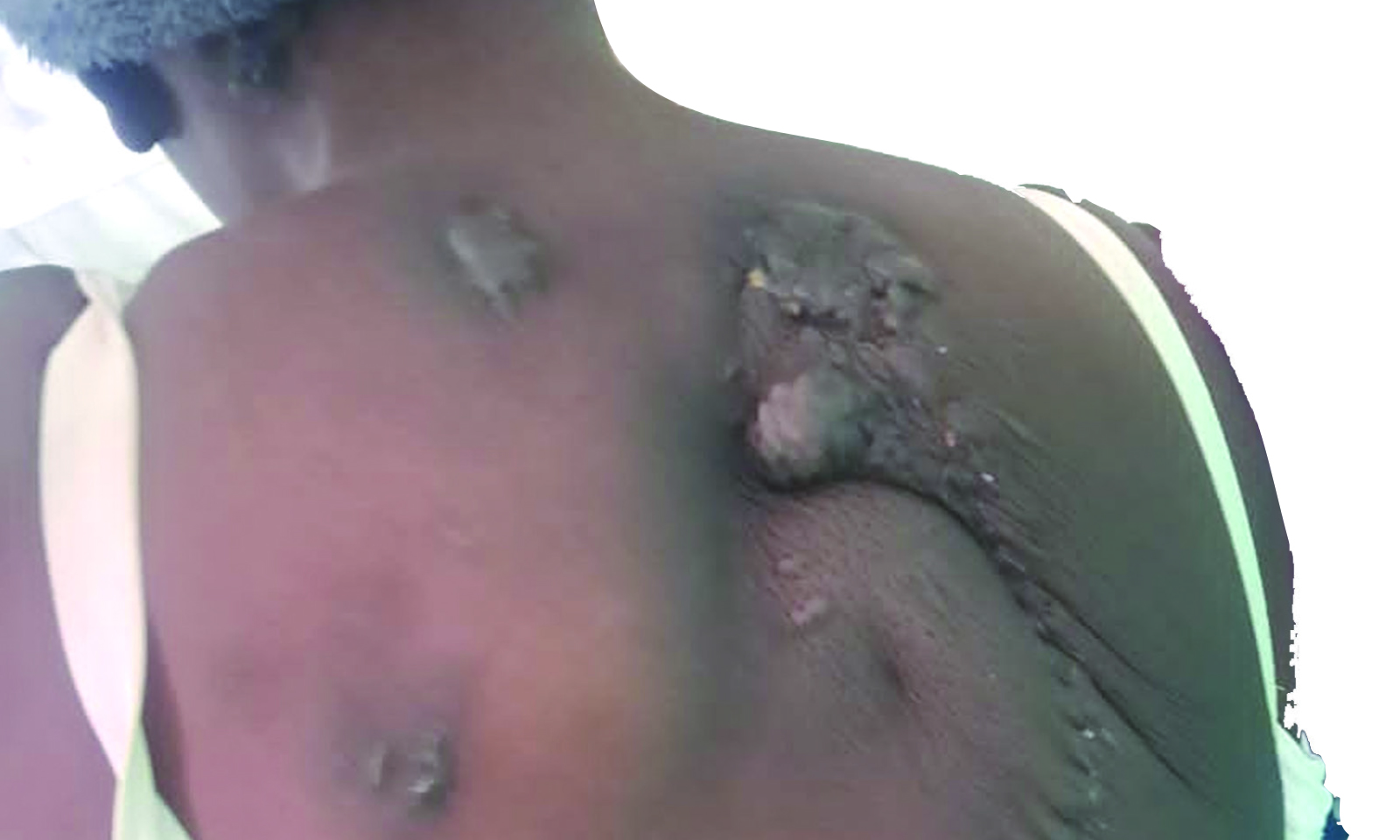
Fungai Lupande
Mashonaland Central Bureau
What began as a small pimple on Batsirai Muzeziwa’s right shoulder evolved into a significant tumour that drastically altered her life over eight years.
Living in a resettlement area in Mberengwa, Muzeziwa (54) faced financial constraints that left her without hope for medical assistance, forcing her to watch helplessly as the tumour affected her life.
Her situation took a turn when she visited her ailing mother, Dzisai Chihora, in Bindura, where she was cared for by her younger sister, Nyembesi Muzeziwa.
During her visit, Muzeziwa recounted her ordeal, explaining that the pimple was initially painless, leading her to dismiss it.
“I did not think much of it because I thought it would disappear with time,” she said.
Unfortunately, the pimple grew rapidly, invading her throat and making life unbearable.
“I could not sleep or work in the field like I used to. My temperature was always high, and it was very painful,” she recalled.
Muzeziwa’s struggle began at Gaha Clinic in Mberengwa, where she received pills and was advised to seek help at a general hospital.
However, financial constraints pushed her to return home instead.
Later, unable to endure her pain, she went to Mberengwa Hospital, where she received injections and was prescribed medication.
“The pain eased for a while. I attended a medical outreach in our area offering free services, where doctors examined my tumour and advised that they could not operate, suggesting I go to a larger hospital,” she said.
Days turned into weeks as she remained without action due to lack of money.
Then, late last year, when her mother fell ill, Muzeziwa decided to visit her in Bindura. Her sister was shocked to see her condition and immediately took her to Bindura Provincial Hospital for further examination.
After various procedures, including a scan, Muzeziwa was surprised when the specialist doctors asked when she wanted to schedule the tumour removal.
“I said immediately because, at this point, I would do anything to reclaim my life,” she expressed. The operation was scheduled for two days later and proved to be successful, with a 6.2-kilogramme tumour removed.
Now recovering at her sister’s home, Muzeziwa is attending follow-up medical check-ups.
“The doctor informed me that the tumour had invaded my trachea. This posed challenges during surgery as the doctors worked around my throat,” she said.
“I am feeling better and can do light duties. I am grateful to God for this breakthrough and extend my gratitude to the medical team at Bindura Provincial Hospital for a job well done.”
Nyembesi expressed disbelief upon seeing her sister’s condition.
“I had no idea about the tumour. My sister was living far away in Mberengwa, and I’m glad she visited,” she said.
Initially, the family considered taking Muzeziwa to Karanda Mission Hospital, known for its medical care, but her son suggested they try Bindura Provincial Hospital first.
“I was unsure if they could handle it,” Nyembesi admitted. “We followed the procedures, and she was taken to the theatre.”
Overwhelmed with emotions, she found comfort from the nurses during her sister’s surgery. They had approached a private doctor, who was shocked by the tumour and referred them to Bindura Provincial Hospital.
Neurosurgeon Dr Lawrence Hlatswayo applauded the dedication of the medical team at Bindura Provincial Hospital for ensuring successful surgeries.
During Muzeziwa’s operation, the team faced significant challenges, spending two hours to intubate her due to the deviation of her trachea caused by the tumor.
“The doctors almost gave up, but they succeeded on the last attempt,” Dr Hlatswayo recounted.
The surgery lasted nearly six hours, and the tumour was identified as a giant lipoma, a slow-growing fatty lump typically found between the skin and underlying muscle.
Part of the tumour was sent to the laboratory to determine whether it was a liposarcoma, a cancerous tumour in fatty tissues.
Bindura Provincial Hospital has been performing numerous life-saving surgeries and now boasts 10 specialist surgeons, addressing conditions such as head, neck, and spine injuries, tumours, and congenital issues in infants.
However, challenges persist. The hospital lacks a CT scan, forcing patients to travel to Harare for these essential services. The absence of an Intensive Care Unit (ICU) limits the number of operations the surgeons can perform.
Dr Hlatswayo stressed, “We need a CT scan as soon as possible because all our emergency operations depend on it.”
He also highlighted the need for an MRI (magnetic resonance imaging) scan. Despite having 10 specialists, the hospital must share two operating theatres, also utilised by gynaecologists for delivery emergencies.
“The theatres lack adequate specialised surgical sets and X-ray machines during operations,” he noted.
In terms of specialists, the hospital has a urologist, two general surgeons, two gynaecologists, an ophthalmologist, a paediatrician, a physician, an ENT (Ear, Nose, and Throat) surgeon, and an orthopaedic surgeon.
Dr Hlatswayo elaborated on tumours, explaining that soft tissue tumours can develop in any part of the body and generally grow slowly.
However, benign tumours can become aggressive, impacting other organs in advanced stages.
“In advanced stages, these tumours can affect other organs. Other types of tumours include fibroids and are often named after the organs they originate from, such as chondromas and keloids,” he said.
He warned that most benign tumours are genetic and advised individuals to seek medical attention promptly upon noticing any lumps.
“Any mass has the potential to turn cancerous. People should not ignore lumps, as they can develop into something serious,” he said. Muzeziwa’s story serves as a poignant reminder of the importance of seeking medical assistance at the first sign of trouble.