

 Online Reporter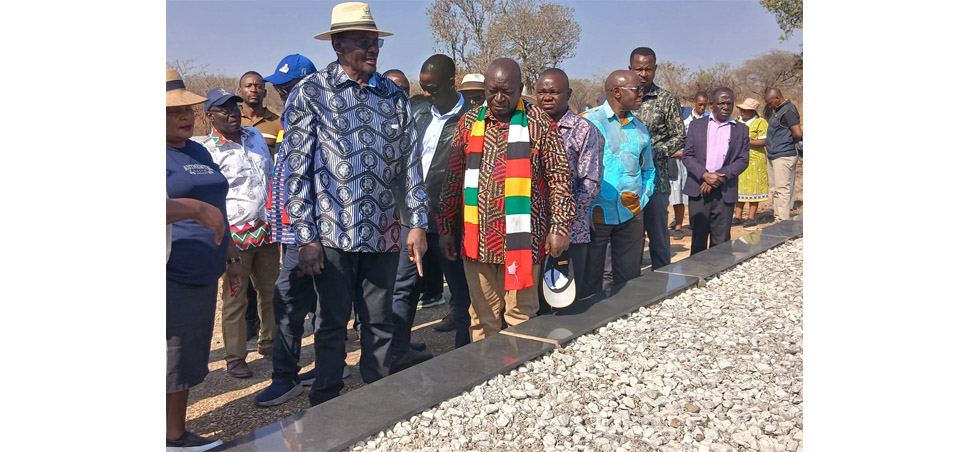
Ray Bande
Senior Reporter
IT has been nearly five decades since the tragic massacre of young men and women at the former ZANLA Armed Forces Chimoio Training Camp in Mozambique on November 23, 1977.
Despite the passage of time, the memory of the departed young comrades continues to resonate.
As the saying goes — those we love do not go away; they walk beside us every day. Their legacy lives on, serving as a poignant reminder of the ultimate sacrifice they made in the fight for independence.
Chimoio Liberation War Shrine was the training headquarters for ZANLA Forces during the liberation struggle — the biggest of Liberation War Shrines in the Frontline States, in the border lying Manica Province in Mozambique.
It had various camps within it.
A conversation with groundskeepers at the shrine, held on the sidelines of Vice President Cde Kembo Mohadi’s recent tour of Liberation War Shrines in Angola, Zambia, Tanzania, and Mozambique, revealed the poignant reality that the spirits of fallen liberation war fighters remain with the living.
Mr Augusto Marutenyu, who has tended to the shrine since 2004, shared that the deceased cadres continue to manifest in various forms to this day.
“We encounter numerous inexplicable phenomena here. One peculiar issue is with the flags. We would hoist them in the morning and remove them around 6pm. However, this routine posed problems. Each time we removed the flags, took them home, and went to bed, I would be kept awake by eerie voices. They would beckon me to join in festivities or return their belongings. My colleague experienced similar disturbances when he took the flags home. We sought guidance from Zimbabwean authorities, who advised us to leave the flags in place permanently. Since then, peace has been restored, and the strange occurrences have ceased,” recounted Mr Marutenyu, adding that not even the shrine gates can be closed or locked.
“At the entrance, we had gates that we would close at the end of each workday. However, when we returned the next morning, we would find them wide open, with the keys still intact and undamaged. This phenomenon left us perplexed. I recall a disagreement with my colleague, who I thought might have forgotten to lock the gates properly. Nevertheless, we soon discovered that the cause was spiritual. We consulted with authorities at the Consulate in Beira, who advised us to leave the gates open at all times. They explained that the fallen heroes buried here desired unrestricted freedom,” he said, adding that sounds of guns blazing are still audible throughout the night.
“The house we are using as a museum once stored guns, some of which we collected from nearby agricultural fields and piled up inside. However, we began to hear strange noises — the sound of gunfire in the dead of night. After reporting the incident, most of the guns were collected and taken to Harare. Nevertheless, we still hear occasional gunfire at night, although it is not as frequent as it used to be,” said Mr Marutenyu.
His colleague, Mr Francisco Ferinando, shared another peculiar experience. “One of the mass graves, where we are told the remains of young boys and girls who perished in the Chimoio bombing are buried, intermittently develops cracks or appears to curve inward. These young recruits had completed their training, but died before receiving their weapons to join the struggle.
“We have experienced problems around this grave, including vicious bees that would swarm the area. We sought guidance and were informed that when there is unrest in Zimbabwe, similar disturbances occur here. However, following a visit from a senior Zimbabwean Government official, who offered prayers on behalf of the nation, the strange occurrences have subsided, and the bees have disappeared,” said Mr Ferinando.
Mr Ferinando shared another account of paranormal activity in the area.
“Charcoal traders who use the nearby road at night often encounter young comrades along the way. We have received numerous calls from local travellers who would have been confronted by these apparitions, especially at night. Some even requested overnight accommodation due to fear,” he said.
Mr Ferinando also recounted an incident where the fallen comrades seemingly defended their honour.
“A Zimbabwean pastor once visited, and parked his car near the gate. He asked if we were the ones maintaining the shrine, and we affirmed. He responded by calling us mad, saying it was insane for people of our age to tend to this place.”
He continued: “We were disturbed by his words. We told him that although the comrades are physically gone, their spirits still remain with us. We performed a ritual under the tree, informing the departed comrades about the pastor’s disrespect. The pastor drove away, but returned within two hours, parking on the same spot. Suddenly, his wife cried out for help, saying the vehicle was on fire. The couple sought our assistance, but we replied, ‘You can’t ask for help from insane people.’”
The camps at the shrine included Parirenyatwa (camp clinic), Chindunduma (school complex), Zvidozvevanhu (transport section), Mbuya Nehanda (female quarters), Chitepo (intensive political orientation), Percy Ntini (rehabilitation centre for injured cadres), Chaminuka (security), Takawira I (male quarters), Takawira II (training) and Mudzingadzi (agricultural production).
The shrine is situated about 21 kilometres from the City of Chimoio to the north.
The camp is said to have housed between 9 000 and 11 000 during the attack of November 23, 1977.
Information from Selous Scouts and captured guerillas and subsequent surveillance carried out led to the Rhodesians to know about this camp.
The Attack:
On November 23, 1977, Chimoio Camp was attacked at 8am when most inmates were on parade. The attacking force was made up of eight Hawker Hunters, six Vampire ground attack aircraft, three Canberra bombers, six Dakota troop carrying aircraft, 185 ground troops parachuted and heli-landed with an unknown number of helicopters.
Casualties at Chimoio were mainly at Parirenyatwa, where the sick and wounded were about to be transported to the main hospital in Chimoio, were caught up in the attack. School children were mostly killed in a river-line where they had taken cover.
The transport section was totally decimated, and paratroopers in stop groups around the perimeter of the camp killed those that were fleeing. Most casualties were a result of bombing by Canberra bombers, heavy machine-gun fire from helicopter gunships and fighter ground from Hawker — Hunters, Vampire and Lynx aircraft. Extensive use of chemicals was responsible for the majority of burns.
Chimoio had a limited number of trained personnel and the majority of casualties were the untrained women and children as well as the wounded.
Out of about plus or minus 10000 people who were within the camp on the morning of the raid, those estimated to have died are plus or minus 1200 of which two thirds were women. More than 1000 comrades were injured. Rhodesian casualties are not known.



Those who led the attacks are well known and some of them are still alive and usually boast on social media about their acts.