Online Reporter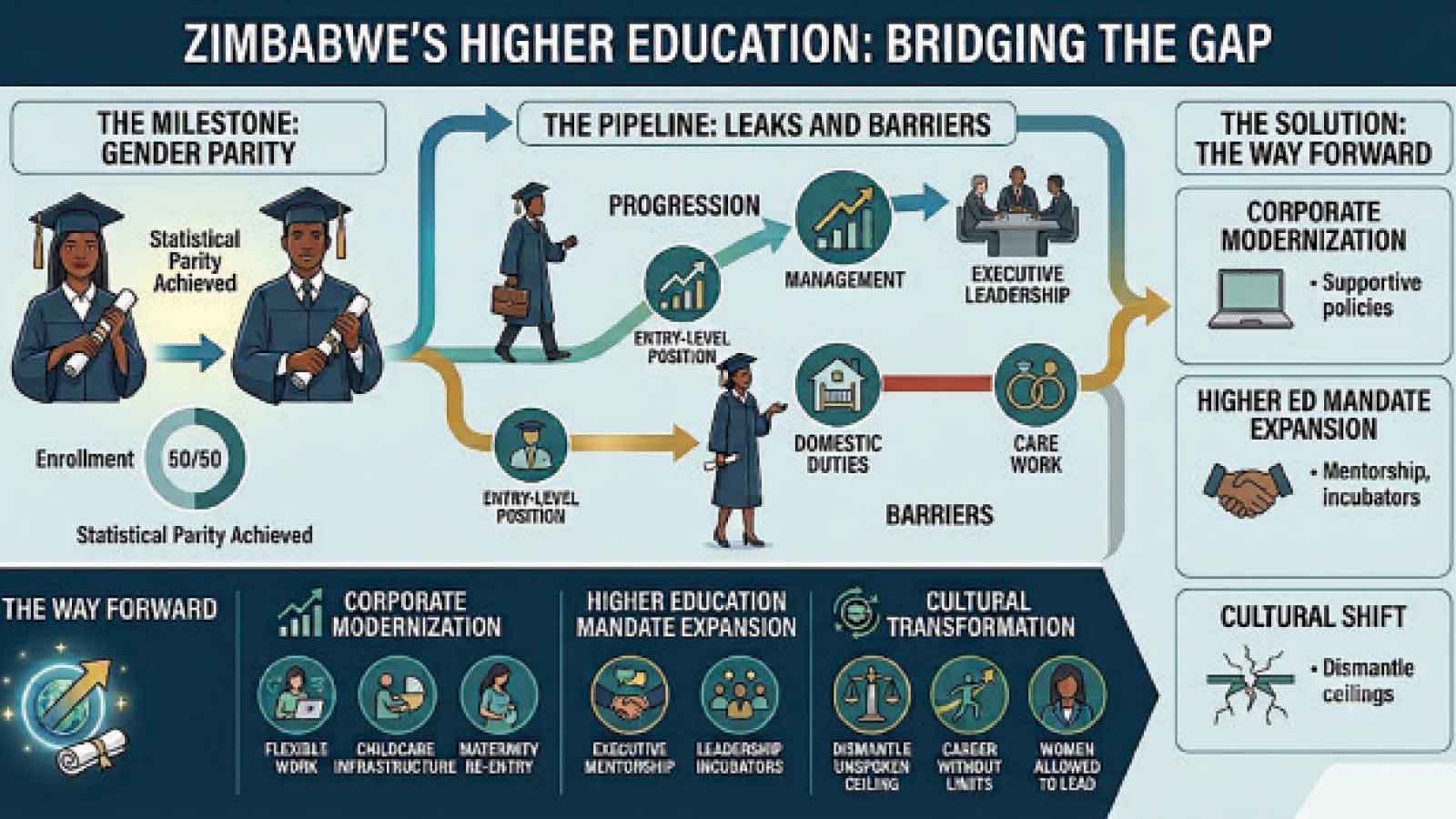
Alice Tagwira
Beyond the Boundaries
Across Zimbabwe’s higher education landscape, a quiet milestone unfolds every graduation season.
Inside the ceremonial halls of the University of Zimbabwe, Great Zimbabwe University, and Midlands State University, women routinely clear the academic hurdles with distinction.
They walk across the stage, caps pinned securely, scrolls held firm, amidst the triumphant ululations of proud families.
Statistically, the nation has achieved something genuinely worth celebrating: near-gender parity in tertiary enrolment. Yet, as the echoes of applause fade into the Harare afternoon, a subtle, unspoken scripts begins to dictate what follows. For a startling number of highly qualified women, the degree was never intended to be the destination. It was designed as an ornament.
Zimbabwe presents a fascinating sociopolitical paradox. On paper, the legal and constitutional architecture protecting women’s right to economic participation is robust. The 2013 Constitution explicitly mandates gender balance across all spheres of society. The National Gender Policy aligns seamlessly with the Sustainable Development Goals (SDG 5) and the African Union’s Agenda 2063. Furthermore, public data indicates that female literacy in Zimbabwe remains among the highest on the continent, oscillating above 88 percent.
However, beneath these progressive policy frameworks lies a deeply entrenched socio-cultural dynamic: the unspoken mandate that women should be educated, but not necessarily ambitious.
Education for women is increasingly commodified—not as leverage for workforce equity or executive leadership, but as social currency.
In many middle- and upper-class circles, a university degree elevates a young woman’s standing on the marriage market. It signals sophistication, moral discipline, and the capacity to nurture future generations of successful children.
Yet, the moment that same qualification is deployed toward demanding corporate careers, political office, or late-night boardroom negotiations, the cultural mandate shifts abruptly. The educated woman is praised; the career-driven woman is quietly framed as a liability to traditional family structures.
This tension produces a structural bottleneck in the national economy. According to data from the Zimbabwe National Statistics Agency , while women represent over half of the national population and graduate from higher learning institutions in numbers nearly equal to men, their representation in formal, high-level employment plummets precipitously.
Female labour force participation is heavily skewed toward the informal sector—informal cross-border trade, small-scale agriculture, and micro-enterprises. While these avenues showcase immense resilience, they rarely offer the structural capital, intellectual leverage, or financial autonomy commensurate with tertiary qualifications.
The leak in the professional pipeline occurs precisely at the intersection of education and career execution. When a young male graduate secures an entry-level position at a commercial bank, a mining conglomerate, or a diplomatic mission, his career path is viewed as an escalating trajectory.
When his female counterpart takes the same role, her employment is frequently treated as a temporary interlude—a holding pattern until marriage and motherhood require her to “balance” priorities.
This “balance” is rarely a shared burden. Unpaid care work in Zimbabwean households remains overwhelmingly feminized. A female corporate accountant or medical officer is still expected to manage domestic operations with uninterrupted traditional grace, while her professional male peer experiences no such dual workload.
When the friction between corporate demand and domestic expectation reaches a boiling point, it is almost invariably the woman’s career that is sacrificed or scaled back into less demanding, lower-paying roles.
The economic cost of this silent compromise is staggering. Zimbabwe is currently navigating a complex economic landscape framed by Vision 2030, which aims to transform the nation into an Upper Middle-Income Economy. Achieving this target requires the total optimisation of human capital. To train thousands of female doctors, engineers, economists, and legal scholars—expending state subsidies, family savings, and institutional resources—only to relegate a substantial portion of them to domestic inactivity or underemployment is an economic inefficiency the nation can ill afford.
Consider the corporate boardrooms along Samora Machel Avenue or the diplomatic corps representing the nation abroad. While female representation has improved in civil service appointments, executive suites in the private sector remain overwhelmingly male.
The issue is rarely a lack of qualified women; it is the drop-out rate forced by an unwritten cultural contract that views female career longevity as optional, or worse, aggressive.
For international diplomats and policy planners observing Zimbabwe, this dynamic highlights a critical lesson in development economics: policy alignment does not guarantee cultural transformation. You can legislate equal opportunity, grant scholarship equity, and build universities in every province, but if the foundational socio-cultural perception of a woman’s primary purpose remains strictly anchored in domestic stewardship, the return on educational investment will remain capped.
Addressing this paradox requires a honest national conversation that transcends simple legislative fixes. First, corporate Zimbabwe must modernize its structural architecture. Flexible working arrangements, accessible childcare infrastructure within business districts, and transparent maternity re-entry programs must transition from peripheral perks to core operational standards.
Second, higher education institutions must expand their mandate beyond conferring degrees. Career guidance, executive mentorship networks, and leadership incubators specifically designed to help young women navigate corporate retention are vital to ensuring that female graduates remain in the workforce long enough to reach executive decision-making positions.
Ultimately, education must cease to be viewed as a gilded certificate of readiness for marriage. A degree is an instrument of economic production, an engine of intellectual innovation, and a tool for national development. If Zimbabwe is to realise its full economic potential under Vision 2030, society must dismantle the unspoken ceiling that permits women to study, but forbids them to lead. The degree must finally be allowed to become what it was always meant to be: not a decorative end point, but the launching pad for a career without limits.