

 admin
admin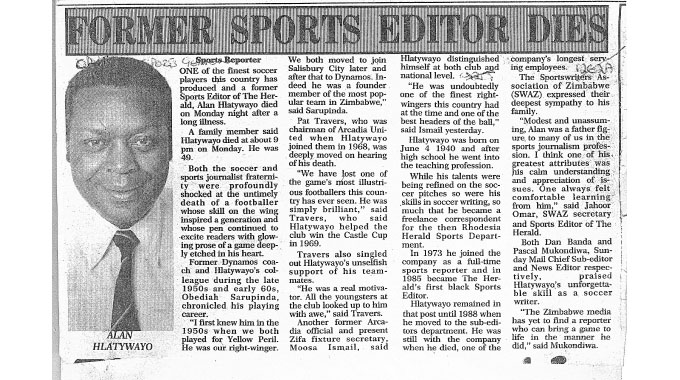
Sharuko On Saturday
IF he had lived to this day he would have been 80 and, just like the immortal Pele, having an eye on his 81st birthday anniversary, later this year.
They were both born in 1940, into a world being battered by a Great War, where football had become something of a luxury.
That’s why the FIFA World Cup wasn’t played in 1942, and it wasn’t played again in 1946 because, with the globe in turmoil, and in ruins, football had to take a back seat.
But, it was this game which would define them, in more ways than they could have imagined, as they started their journey into life, back in those days.
Pele lives to this day, the only man to win the World Cup three times, an iconic figure in the beautiful game, and around the globe.
Alan died, along the way, in June 1989, at the relatively young age of 49.
He never made it, as big as Pele, and some will rightly say his name should never be mentioned, alongside the name of the great Brazilian.
Fair and fine but their year of birth, in a way, unites them and, so does their game, the one they played, with a measure of success, at different levels of its structures.
That the other one still lives, and the other died, 32 years ago, puts into context that, indeed, Alan died relatively young.
Of course, no one really talks about him now, even though, by local standards, he was a very good footballer.
His name now occasionally pops up, as an afterthought, when history is recalled, and when eulogies are penned in newspapers, when his former teammates, and opponents, join him, in the other world.
He has become a figure, whose identity only features among the dead, the stars of the ’60s and early ’70s of our national game, on the occasions we lose them, along the way.
As if he was just like most of them when, in fact, he was far much more, a trailblazer, a luminary of his game, a giant of his profession, which records football’s past, present and even looks into the future.
They mentioned his name again, when we lost Tendai Ndemera in December because, at some point in their playing careers, they both had an attachment with Dynamos.
Alan was one of the pioneers of this giant club, which is trying to find its way back into the light, after years of both neglect, and gradual decay.
Today, the remnants of what used to be Glamour Boys, the shadow of what used to be Haina Ngozi, the shell of what used to be the Boys in Blue, are what remain.
They all help us to hold on to memories, of a time when this team used to be the real deal, a gift from the football gods, a force of nature which, like Muhammad Ali, used to float like a butterfly, and also sting, like a bee.
You didn’t need to support them, to appreciate that — even with a tinge of jealousy, for some of us born to only believe that our hometown side, Bwela Ufe, were the be-all-and-end-all of domestic football – they were, indeed, a symbol of greatness.
A proud Zimbabwean football franchise, whose mere name used to strike fear into opponents, at home, and across the continent.
A very powerful team, whose quality used to shine like a traffic light, in the darkness, blinding their opponents, seducing their followers.
A quite remarkable team, whose ability to keep reinventing itself, year after year, meant it found a way to keep itself at the top, even when its stars retired.
It was like some kind of relay, Freddie Mkwesha would pass the baton to George Shaya, the Mastermind would pass it to Moses Chunga, the Razorman would pass it to Vitalis Takawira, and so forth, and so forth.
Somehow, stars always appeared on the horizon, ready to take over.
But, now, all that is gone, only memories remain, of Patrick Dzvene, the one they called Amato the Devil, of Kenneth Jere, the one they called Computer, of Oliver Kateya, the one they called the Flying Saucer.
Of the Chidzambwa brothers, Sunday and Misheck, twin towers in defence, of Memory Mucherahowa, an inspirational captain, who appeared like one born to fight their cause and of Short Cat, the one who finally smashed the barriers of prejudice, against those who keep goals.
The one who, finally, made goalkeeping, on the domestic front, as fashionable as the positions played by the in-field players, at last convincing selectors that a ‘keeper could also be a Soccer Star of the Year.
In the beginning, when the foundation for these Glamour Boys was being laid, Alan was there, as one of those founding fathers, a 22-year-old footballer seduced by a project which, finally, could represent the black players from the capital.
ALAN BLAZED A TRAIL, FOR ALL OF US, THE GENERATION OF INFLATED EGOS
I didn’t watch him in action, I wasn’t even born when he was making his name, but I have no reason to doubt the views of those who had the privilege, to see him play, because they are all men of honour.
Someone like the late Pat Travers, who was the Arcadia United chairman, when Alan joined the club in 1968, helping them win the Castle Cup, the following season.
“We have lost one of the game’s most illustrious footballers this country has ever seen,” Travers said, when news filtered through, Alan had passed away.
“He was simply brilliant.”
And, he wasn’t the only one who was singing praises, for this man.
“He was, undoubtedly, one of the finest right wingers this country had at the time, and one of the best headers, of the ball,” said Moosa “Uncle” Ismail, a former ZIFA fixture-secretary, who had one of the finest institutional memories, of domestic football.
Of course, there is always a danger, to limit our impression to what people say, especially when they are talking about someone, who would have passed away.
That’s why some people have even gone to an extent of giving a new meaning to the word eulogy.
They claim it represents an Expression of Usual Lies Offered at Grave Yards.
But, for Alan to have played, in that Dynamos side of the ’60s, whose reputation – as, a very powerful side, will always precede itself — and even make the national team, during that era, will always be a reminder that he was, indeed, a fine football talent.
However, no one can really claim Alan was the greatest footballer, among those who have graced our fields, that’s a controversial debate that remains restricted to the likes of Peter Ndlovu, George Shaya and Moses Chunga.
But, there is a reason why, as the local sports writers and commentators of this era, and I am including myself in this group, we should all be ashamed of ourselves, for betraying the memory of our iconic pioneer.
For, deliberately forgetting our past, and a giant of our profession, whose pioneering role helped open the doors for us by laying a strong foundation, where we have now all built our little kingdoms.
Forgetting a good man, who first plunged into these trenches, when no one even believed a black Zimbabwean man could be trusted to correctly capture events, which would have unfolded at a football match, and provide those, who were not there, with a very good picture of what happened.
Forgetting a trailblazer who came in, at a difficult time when racism was both acceptable and fashionable, in this country, and in First Street, there were signs screaming that dogs, and natives, were not allowed in Harare’s boulevard of beauty.
Forgetting a superman, who inspired a generation of local black sportswriters, and commentators, after showing us that this job could not only be done but could also be executed, in such a fine way, one could end up earning the trust of the readers, as someone who could tell the story, as it was.
How could we, in all fairness, forget about Alan Hlatywayo?
To the extent of reducing him to an afterthought, someone whose names should be evoked only when footballers died, only when we are mourning, not when we are celebrating, as if he represents darkness when, in reality, he represents the golden light.
We should all be shamed, we the little boys and men of this generation, who go about beating our chests, telling ourselves we are the greatest things to ever happen to sports journalism, in this country, as if we are God’s gift, to this profession.
We find it irresistible to swallow our lie, again and again, that we are the best, so this country should forget the rest, flooding social media with our pictures, and our views, no matter how misplaced, and toxic, those views are, as if sports journalism started with us.
And, even more importantly, as if it will end with us.
In all this madness, driven by our selfish agendas, and inflated egos, to portray ourselves as the best there is, the best there was and the best there ever will be, we lose sight of the bigger picture.
The beautiful picture of someone like Alan, whose big shoes history will never allow us to wear, no matter how we deceive ourselves.
We are such a pathetic joke, and here I have to also make it clear that I am including myself, because a community which doesn’t value its history, and its history-makers, is a useless constituency, which doesn’t deserve respect, let alone to be taken seriously, by anyone.
We have let our egos define us, and lead us into the wilderness and, conned by the number of followers we have on Twitter, or mutual friends we have on Facebook, or whatever, we have forgotten our true heroes, including Alan, a man who blazed a trail, and opened doors for us.
TOO BAD WE COLLECTIVELY CHOSE TO FORGET A LEGEND, A GREAT MAN
I’m from Chakari, that’s who I am, and that’s why, now and again, I have taken the opportunity to talk about my hometown, to talk about my heroes, as a way of celebrating what they did, for our little community.
Guys like Chakumanda, our great goalkeeper, Bhibho, Mtambarika, Joe Tsvina, George Marabishi, Aidan Sweet, John Walker, Manhuta, Daiman, Bakacheza.
Someone like Freddie Dhliwayo, also known as the “Gepa Chief,” the fellow who created the Goingo East Production Authority (Gepa), where we could, as kids, explore our artistic talents.
Someone like Owen Mazodze, also known as the “Big Fish,” he wasn’t originally from our little town but he came, and in more ways than we can remember, changed our generation, forever.
I’m from a mining town, and I’m proud of that, and going to church every Sunday morning, as a family, was part of our DNA.
And, from there, we would all go to the stadium, to watch our beloved Bwela Ufe, play against the likes of Chegutu Pirates, Come Again, Lulu Rovers and Kadoma ”Yematomati” United.
And, watching zvigure was also a big part of our lives.
We all had our favourites, Makanje, the tallest of them all, which appeared to defy gravity, Kamwimwi, the fiercest and dirtiest, of them all, Gomanikwende, the one with all the grace.
Dhinte, the one with the biggest nose, Chin’ombe n’ombe, the one with the longest tail.
And, of course, my all-time favourite, ChiMaria Chinagwabere, the one which lost a breast.
They taught us well, down there, about the values of appreciating our heroes, especially those from our past, and it pains me, to condemn myself, for being part of the generation, which has betrayed the grand memory of a guy like Alan.
This is a guy who was a teacher, while he was also playing football at the very high level in this country and, while his colleagues chose to plunge into coaching, he decided he could serve his game better, as a journalist.
So, he started freelancing for this newspaper, as a correspondent, a black man writing about his favourite game, and he made such a big impression that, in 1973, he was recruited, full-time, as a sports reporter for The Herald.
And, as if by some coincidence, it was also the year Peter Ndlovu was born.
“I had the good fortune of being taught how to write, and depict events in the most lively, and accurate manner, by Alan, and I know I will never be anywhere near that flair,” wrote Charles “CNN” Mabika, in a memo to the great man, when he died, in June 1989.
“I can still remember, whilst still at school in the late ’70s, marveling at the apt descriptions of the demise, or triumphs, of soccer teams.
“He had this unique way of making you read on, even if you were not a sports fan, I can clearly remember a soccer story that he wrote, way back in 1976, that I read in the school dormitory, one morning.
“It was a Cup final between Dynamos and Zimbabwe Saints, (Chikwata) had been hammered by eight goals to one, the introduction did it, in one blunt sentence, ‘If I had not been there, I would never have believed it.’
“Such was the brilliant passion in him that made him into arguably the finest sportswriter ever produced in Zimbabwe, so far.”
Now, if this great man could make such a huge impression, on a legend, like CNN, surely, we all should plead guilty that we have betrayed the memory of an icon, whose name should be attached to the Sportswriter of the Year award.
In 1985, he became the first black Sports Editor of this newspaper, a milestone achievement for black sportswriters and, even though he was in this job for just three years, it cleared the path for a lot of us.
When one considers that only three black journalists, Alan, Sam Marisa and, this guy from Chakari, have been entrusted with the honour of leading the Sports Desk of this newspaper, which is making its 130th anniversary this year, then you can probably appreciate why Alan was very special.
Incredibly, both my predecessors are late, and that’s hurt because, now and again, I would have wanted to tap into their fountain of knowledge.
But, that shouldn’t be the reason why someone like Alan must be forgotten.
After all, legends never die, they just take a rest.
Sorry great man, accept my apologies, on behalf of my generation blinded by Facebook, crippled by Twitter and seduced by Instagram – we have forgotten our past.
To God Be The Glory!
Peace to the GEPA Chief, the Big Fish, George Norton, Daily Service and all the Chakariboys in the struggle.
Come on Warriors!!!!!!!!!!!!!!!!!!!!!!!!!
Khamaldinhoooooooooooooooooo!
Text Feedback — 0772545199
WhatsApp — 0772545199
Email — [email protected]; [email protected]
You can also interact with me on Twitter (@Chakariboy), Facebook, Instagram (sharukor) and Skype (sharuko58) and please take time to watch “The Couch,” on the Zimpapers Television Network, with Makomborero Mutimukulu, Howard Musonza and More Moyo, every Tuesday afternoon.



 Online Reporter