Online Reporter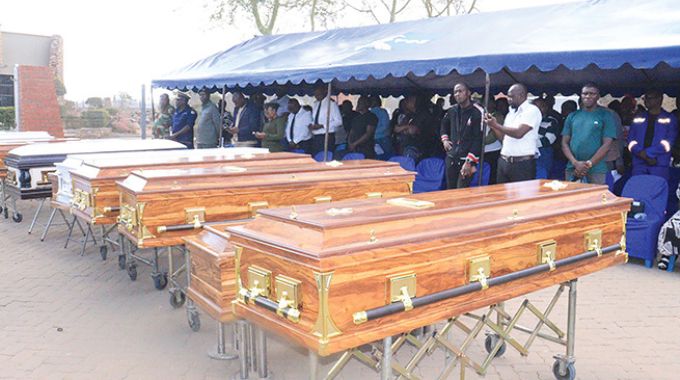
Thupeyo Muleya, [email protected]
MR Jefias Mukuwe had set out on what was meant to be a journey of belonging, memory and homecoming.
Travelling from Cape Town with his wife and three young children, he was eager to show them the Zimbabwe he had carried in his heart for years, the rural roots he never forgot despite building a life across the Limpopo. It was meant to be a reunion, a chance for his children to walk the dusty paths of their ancestral home and embrace family they knew only through stories. Instead, the trip ended in devastation, leaving a husband and father carrying a grief too heavy for words.
The cross-border bus carrying the family overturned along the N1 Highway near Trompsburg in South Africa’s Free State Province, claiming 11 lives. Among the dead were Mr Mukuwe’s wife and all three of their children.
For Mr Mukuwe, who had lived in Cape Town since 2009, life had been built through determination and sacrifice. He worked as a tiler and, together with his wife, Elsie Mutero, ran a small business that helped sustain their family. On
July 31, they boarded the bus with excitement and expectations of happier days ahead.
Their children, Star (13), Vallery (3) and Angel (2), had all been born and raised in South Africa. Zimbabwe existed for them largely through family conversations, treasured photographs and their parents’ recollections of home. This journey was to be their first real introduction to that heritage.
The children were especially excited about meeting their older sibling, who is in Form Four in Mutare. It was a reunion long anticipated by the family, one that never came to pass.
Somewhere near Trompsburg, the dream unravelled.
The bus was towing a trailer when it reportedly developed brake failure while travelling along the N1 Highway. The driver lost control and the vehicle began swerving across the road.
Inside the bus, fear spread rapidly. What had begun as an ordinary journey suddenly became a desperate struggle between hope and catastrophe.
Passengers rose from their seats and shouted at the driver as the vehicle zig-zagged unpredictably from one side of the highway to the other.
In those terrifying moments, as panic swept through the bus and uncertainty gripped every heart on board, Mr Mukuwe heard the words that would become his wife’s final message to him.
“This situation now needs God,” she said.
Moments later, the bus overturned. Ten people lost their lives instantly while another later died in hospital.
Mr Mukuwe survived the crash, only to be confronted almost immediately by an unbearable reality. The people he loved most were gone.
Amid twisted metal, shattered glass and unimaginable chaos, he searched desperately through the wreckage. Around him were injured passengers crying out for help as rescue workers struggled to reach those trapped inside.
His search led him to a heartbreaking discovery. His wife’s remains were found in a valley below the road. His children lay on the tarmac.
One memory continues to haunt him. Holding his severely injured two-year-old daughter Angel in his arms, he clung
to the hope that somehow she would survive. It was a hope that slipped away before help could save her.
“It was traumatising to walk through dead bodies and others trapped in the wreckage,” said the grief-stricken Mr Mukuwe.
“The worst moment was sifting through dead bodies looking for my family. Throughout the entire journey, I had been carrying my daughter on my lap while Vallery was carried by her mother and Star was busy with his smartphone.”
As shock gradually gave way to physical suffering, excruciating pain began coursing through Mr Mukuwe’s back, chest and hand.
Medical personnel attended to him before he lost consciousness at the accident scene. His next memory was waking up in hospital.
There, doctors delivered yet another devastating blow.
“I woke up the following day in hospital, where doctors told me that Angel had also died a few moments after we put her in an ambulance. It was painful and I still feel the pain,” he recalled.
Even before the crash, something about the journey had felt unsettled.
Mr Mukuwe recalled an incident involving another passenger who appeared mentally disturbed. According to his account, the man had been provoking confrontations with other travellers before being dropped off near
Bloemfontein, where he allegedly stripped naked and was restrained by police.
Not long afterwards, tragedy struck.
Back in Zimbabwe, preparations began for the burial of those whose lives had been cut short.
Mr Mukuwe’s wife and three children were laid to rest in Buhera under Chief Nyashanu in Chirozva village, where relatives, friends and community members gathered in mourning.
As he struggled to process the enormity of his loss, Mr Mukuwe received counselling support from Zimbabwean embassy officials in South Africa.
In the midst of sorrow, he also expressed appreciation for assistance provided by President Mnangagwa and the Government in repatriating the bodies of his family members, covering medical expenses and facilitating logistical support.
“I couldn’t have managed to bring back my family alone considering all the logistics involved, including paying for my medical bills. The President has shown compassion at my greatest hour of need,” said Mr Mukuwe.
He was among several survivors who benefited from emergency assistance after Government moved to support victims and grieving families.
Another survivor, 23-year-old Mr Kudakwashe Jena, carries his own painful reminder of the disaster.
Travelling from Cape Town to Harare, the delivery driver endured a traumatic ordeal that nearly cost him his life. Rescue workers initially mistook him for a deceased passenger because his body was covered in blood.
Mr Jena later fell into a coma and underwent surgery that resulted in the amputation of his right hand.
“The bus kept swerving and I became numb when I noticed we were about to get into an accident. This is very devastating; however, I thank the Government through all its agencies, and I appreciate the work of the embassy staff in South Africa,” he said.
Coming to terms with his injuries proved to be another difficult journey.
“It took a lot of counselling for me to go through the surgery to amputate my right hand,” he said.
While survivors continue to rebuild their lives, Government has said it will continue meeting the medical expenses of 13 victims who remain hospitalised in South Africa.
Five are receiving treatment at Pelonomi Tertiary Hospital, while eight are admitted at Universitas Academic Hospital.
The scale of the tragedy prompted Government to declare a State of Disaster on August 1, enabling the mobilisation of resources to assist affected families and survivors.
Zimbabwe’s Consul General in Johannesburg, Mr Eria Phiri, led the embassy team tasked with accompanying the bodies from the Free State to Beitbridge.
“We departed at 5PM on Friday. We received overwhelming support from our host Government,” he said.
The process of identifying some victims was particularly harrowing.
Mr Phiri said the severity of the crash left several bodies badly mutilated, making formal identification difficult and emotionally draining for relatives.
“Six of the bodies were badly decapitated and identification was difficult. However, the relatives had pictures and some knew the tattoos and other body features,” he said.
When the bodies finally arrived in Beitbridge, raw grief filled the air at the Doves Funeral Services parlour. Families
waited in silence, tears and disbelief, preparing to receive loved ones whose lives had ended so suddenly and so far from home.
Local Government and Public Works Deputy Minister Albert Mavunga, who served as chief mourner during the mass memorial service, conveyed condolences on behalf of President Mnangagwa and Government.
“It is with profound sorrow that I stand before you today. On behalf of His Excellency, the President of the Republic of Zimbabwe, Cde Dr E.D. Mnangagwa, the Government of Zimbabwe and indeed on my own behalf, I wish to extend our deepest and heartfelt condolences to the bereaved families on this sad, untimely and tragic loss of your beloved family members,” he said.
Among those gathered in Beitbridge to receive the remains were Doves Funeral Services chief executive officer Mr
Farai Matsika and Beitbridge Rural District Council chairperson Councillor Oscar Chiromo.
The deceased were identified as Grace Machingura, Michelyn Tinekutenda Makunura, Mashura Phillip, Mashura Shyln Merlin, Madhoro Nyaradzo, Mutero Ellis, Mukuwe Vallary, Mukuwe Angel Vanissa, Mukuwe Star, Sheilla Gondo and Praise Anyway Rukombo.
Minister of State for Matabeleland South Provincial Affairs and Devolution Albert Nguluvhe also extended his condolences to the bereaved families and commended Government for the assistance extended to victims and survivors.