Online Reporter
Robin Muchetu, Health and Gender Editor
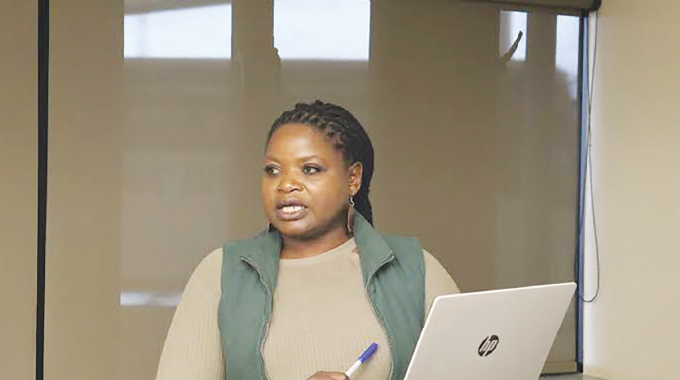
AFTER falling victim to an early unintended pregnancy at 18 years of age, and later having a second child at 21, Nkosiphile Ncube from Mawabeni Village in Umzingwane District, now 25, opted for a career as a Mortuary Attendant to fend for her children.
This is because she had realised her mistakes and that there was no help in sight from her partner.
With her mother in full support of her chosen career, offering her money for transport to and from Bulawayo daily, she is destined to make good use of her time at the Pathology Department at the United Bulawayo Hospitals (UBH), where she enrolled for the six-month course.
The daily commute, costing US$6, is being financed by her mother who works in Filabusi and herself as she is selling a few wares to complement her earnings.
“I had my first child at 18 and the second one at 21. They have the same father but we are not together. I am a student at UBH Pathology Department. I board to school daily and my mother helps me with the bus fares, which cost US$3 one way,” she said.
The pregnancy did not deter her after she completed her O-level studies, passing three subjects. She went on to study Nurse Aide and Bakery courses.
Asked on why she chose being a mortuary attendant, a profession dreaded by many, Nkosiphile said “someone has to do the job”.
In her class, there are 18 women and seven men enrolled for the course.
“I chose this because many people are afraid to do the job, there is also not much competition in the job market for this profession so I chose this one. I am scared a little sometimes but I know this is what will feed my children so it keeps me going. Fending for my children keeps me going, I need the income,” she said confidently.
While she is getting an education, her two children, one in Grade Two and another in Early Childhood Development also go to school in Mawabeni and she sees them after her lessons.
When she made her career path known to her family, Nkosiphile said there was strong resistance as it was an unusual path to follow, according to her family.
“Abadala bayala (the elders refused). Initially they never understood at all why I decided to be a mortuary attendant. I used to go alone when I was trying to register. They said I was too young to handle such a job.
“But my situation did not allow me to fold my hands and not do anything to care for my two children. I was going to continue having babies I cannot fend for. I needed to get a course, to do that would eventually help me put food on the table,” she said.
After some persuasion, her family gave in and allowed her to continue with her course of choice, which started in August this year and ends in February 2026.
She is praying to quickly get employed after her training and start to earn some money.
She said she still meets people who dissuade her from taking a course deemed odd by many but she says she is determined to pass and start working.
Asked on how she became a teen mom, she said she found herself in a predicament and did not know that it would not work according to plan and is not keen to make the relationship work.
“I just fell pregnant when I was dating the father of my children. He accepted the two cases. He never married me, I still stay at home. Now, I am not prepared for any reunion anymore. When we had a second child, I was willing to make it work but now no, we parted ways, I want to get my training done and make my own money for my children,” she said.
Through the National Aids Council Sista2Sista programme that also targets out of school girls, she has learnt to practice safer sex and family planning methods.
The programmes were designed to educate and inform Adolescent Girls and Young Women on HIV, STI’s and other related diseases as research has shown that females in the 15-24 age group are the most affected by HIV in Zimbabwe.
According to the Ministry of Health and Child Care, women and girls are disproportionately affected by HIV, making the interventions worthwhile as they target a key group.
“The Sista2Sista programme has taught me to protect myself and practice family planning. I now use Depo-Provera as a method and I ensure that I do not skip a dose until I complete schooling again, I am not planning on having a child anytime soon. Family planning is what I am prioritising,” she added.
Through the programme, she has been empowered to focus on the future and be economically active and create wealth for herself and family.
“I realised I must work for my family. I do not want to rely on anyone for financial support. I was speaking to my now mentor in the programme and she encouraged me to return to school and learn something,” she said. —@NyembeziMu