Vusumuzi Dube
WE conclude our interview with Cde Ekem Moyo pseudonym Cde Volta Siwela. Cde Moyo the current ZPRA chairman for NITRAM Properties has been telling our Assistant Editor Mkhululi Sibanda (MS) how he joined the armed struggle from his rural home in Gwanda District at a tender age when he and other locals were rounded up by he guerillas and taken to Botswana. Today he talks about his training in Libya.
Below are excerpts from the interview. Read on . . .
MS: Last time you were still telling us about your arrival at Nampundwe, let’s pick the conversation from there.
Cde Moyo: As I was saying the atmosphere at Nampundwe was depressing. The instructors such as Teddy and Finish were very rough, they didn’t have ubuntu. I thought those people were there to kill us, I remember one day when we were made to stand at attention, I mixed up my steps, in fact I took time to lift up my feet and there was Bhokhwa, another instructor watching me. Bhokhwa beat me up with a log as if he wanted to kill me. I was hurt on that day. Nampundwe was so horrible that I never thought one could live in a normal way again. There was this ritual that every recruit who went through Nampundwe was taken through, usually recruits would arrive there at night. They will then be told that the ZPRA Commander-in Chief and Zapu President, Dr Joshua Mqabuko Nkomo would the following morning be coming to welcome them. The excited recruits would then dress in their best clothes, but to their shock they would be taken to a mountain where they would be subjected to military drills, which would leave some struggling to walk. The recruits would even throw away their nice clothes such as jackets, jeans and handkerchiefs. If people had a choice, very few could have stayed at Nampundwe. Many could have run away. To make matters worse there was shortage of food. There were beans which were called tshatsha, which caused people to have running tummies. However, the treatment we received from the instructors was meant to remove the civilian life in us and usher us into military life.
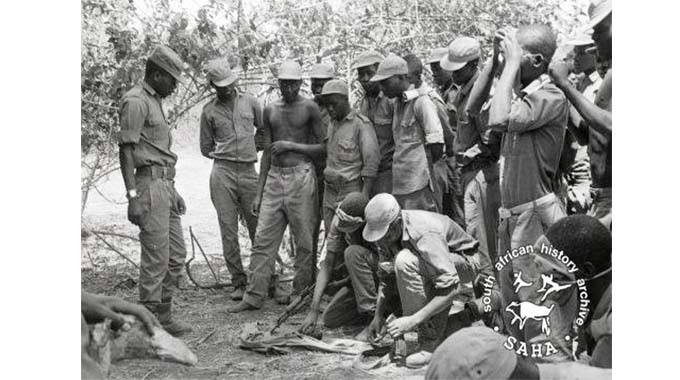
We also received political orientation where the instructors emphasised that silapha ngamaBhunu who took away our land and killed our fathers. The colonialists, it was drummed into us, also took away our cattle. We were made to sing songs such as uNkomo Wethu Somlandela and such songs turned us into animals. With the conditioning we were undergoing people were indeed turned into animals. If I am not mistaken when we got to Nampundwe at that time there could have been more than 5 000 people. Some of us who were deemed too young were staying separately from the rest of the group. Fortunately I had a relative, I think you have heard of him, Lasi Sebata, uDick Den who was a police officer who set free suspects in Gwanda and took them in a police vehicle all the way to Shashe River and they crossed into Botswana to join the armed struggle. Sebata who had already trained and was at Nampundwe used to give me small favours such as giving me food as trained personnel or instructors had privileges which us as recruits did not have. It was during those occasions when I would tell him that I was thinking of running away, a sentiment I shared with other youngsters. In his wisdom Sebata told me in no uncertain terms that I should not be entertaining such thoughts as that was impossible.
MS: So how long were you at Nampundwe?
Cde Moyo: We stayed until it reached a point where some had to go to Jason Ziyaphapha (JZ) camp, which was a camp for okijana and get an education while others were taken to Chikumbi. I was part of the Chikumbi group. There were, however, other dynamics and I was forced to go back and sent to join the JZ group because it was said I was too young. We were then sent to where there were okijana (boys), eJason Ziyaphapha Camp and then taken to Solwezi to a camp called Maheba which was near the border with Zaire, now Democratic Republic of Congo. JZ was a camp for youngsters, those deemed too young to undergo military training. A school was established at JZ where there were classes, starting at lower primary going up to secondary school. There was JZ One and when it was threatened with attack by the Rhodesians, its location was shifted with the occupants evacuated. That led to the establishment of JZ Two, which was within Solwezi and our number was around 13 000 boys. We later moved to JZ Three and that was a tactical move of hiding from the Rhodesians as there were fears of aerial bombings.
MS: Then when were you sent for military training?
Cde Moyo: In 1978 the Mkushi Camp, which was a facility for ZPRA was bombed in October on the same day as the Freedom Camp (FC). The women or girls as they were referred to at that time were brought to Solwezi after the bombing at Mkushi. Their camp was some distance from us, so one day we decided to visit their camp and we were eight. However, we were caught by the guerillas and beaten up for attempting to get into a women’s camp. Our names were written down and I was with Grammar, Gondoza, Nguboyenja, Ephraim among others. The guerillas said the fact that we were looking for girls meant that we were old enough and ripe for military training. We were sent to Libya and before we left Zambia we were addressed by Eddie Sigoge. A guy called Sipho was made commander of our group while I became his deputy. When we left the instruction was that we were going to be trained by Pakistans but ZPRA also brought its own instructors as well. Training in Libya was tough as we also spent time in the desert. It was a mechanised battalion with others specialising in communication, artillery including tanks and mortars. I specialised in mortar. It was said that after training and during deployment we were supposed to go to areas where ZPRA had taken the ground with us coming in to consolidate the positions. However, our training took too long and we ended up not getting deployed till 1979. We trained for almost two years so independence was attained when we were still there. The 1980 elections were held while we were still in Libya.
MS: So you came back home after the 1980 elections and where did you go?
Cde Moyo: When we came back we moved to Gwayi Assembly Point near Dete. In 1981 I was attested into the Zimbabwe National Army as a commissioned officer after going through at the then Zimbabwe Military Academy in Gweru. I was deployed to 4:9 Battalion in Zaka in Masvingo which was under the command of Lt-Col Hama who was deputised by the now late Ray Ncube. I stayed in the army until 1985 when I left to return to civilian life. From the army I went straight to school, enrolled at Mtshabezi Mission in Gwanda District to do Form Three. I wrote my O-levels in 1986 and I passed well. I got a job as a temporary teacher and during that time I was doing correspondence for my A-levels where I did English, History and Divinity. I then enrolled at Esigodini Agricultural College after which I went and taught at Mzimuni Secondary School at Matshetsheni. I then went to Belvedere Teachers College in Harare. I have furthered my education as over the years I have completed a Degree in Media Studies with the Zimbabwe Open University (ZOU), an Honours in Education with UNISA, a Special Honours in Land Reform and Agrarian Studies with the University of Western Cape (UWC) in South Africa. I have also done an MPHIL in Land Reform and Agrarian Studies with UWC.


 Online Reporter