Online Reporter
Rutendo Nyeve Victoria Falls Reporter
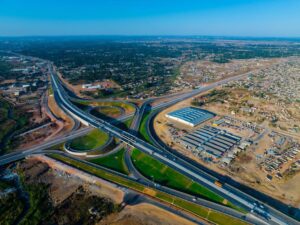
THE newly commissioned Trabablas Interchange in Harare has been described as a beacon of empowerment, a testament to Zimbabwe’s engineering prowess and a symbol of the National Development Strategy 1 (NDS1) in action.
Officially opened on 30 May, the infrastructure marvel has been tipped as not just a solution to traffic congestion but a landmark of local empowerment, innovation and resilience.
Speaking during the Projects Management Institute Zimbabwe (PMI) 2025 Annual Conference in Victoria Falls, the Head of Operations – Fossil Contracting Engineer Kudakwashe Maguta, highlighted how the project empowered communities, including women.
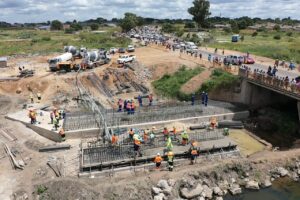
“The project became a lifeline for thousands, employing over 3 000 workers at its peak, 80 percent sourced from surrounding communities. Women constituted 30 percent of technical and leadership roles, breaking gender barriers in construction,” he said.
Among the success stories is Cream Nyambera, a former vendor turned safety spotter, whose journey embodies the interchange’s transformative impact.
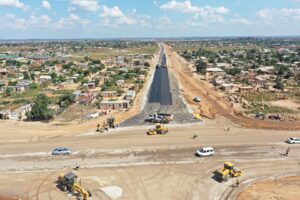
“Trabablas is more than concrete and steel; it is about people. We have trained locals in specialised skills, from steel fixing to surveying, leaving a legacy of expertise,” he said.
The project also adhered to ISO 9001, 14001, and 45001 certifications, maintaining 5 million fatality-free work hours, a record in Zimbabwean infrastructure history.
Beyond traffic flow, the interchange spurred local industry, sourcing materials like 11 000 tonnes of asphalt and 30 500 cubic metres of reinforced concrete from domestic suppliers.
Environmental stewardship included rehabilitating borrow pits under EMA guidelines and constructing pedestrian underpasses to enhance community safety.
Spanning Simon Mazorodze, Chitungwiza and High Glen roads, the interchange is a critical node in Zimbabwe’s trade corridor, designed to handle over 50 000 vehicles daily.
Constructed under a consortium led by Tefoma Construction, with partners like Tensor Systems and Masimba, the project achieved 85–91 percent completion by November 2024, culminating in its timely delivery.
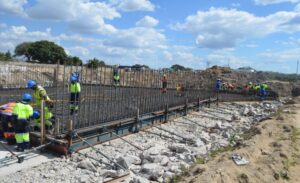
“The design, aligned with SADC standards, features 15 bridges (including river crossings and underpasses), six km of precast jersey barriers, and 11km of stormwater drainage. Notably, the project pioneered the use of locally manufactured precast pre-stressed beams—a first for Zimbabwe—alongside Grade 50 MPa concrete and mechanically stabilised earth (MSE) walls
“The precision in installing Bridges one and three within millimetre tolerances showcases Zimbabwean capability to world-class standards,” he said.
Eng Maguta said the project proves Zimbabweans can deliver complex infrastructure under fiscal constraints, turning challenges into triumphs.