

 Online Reporter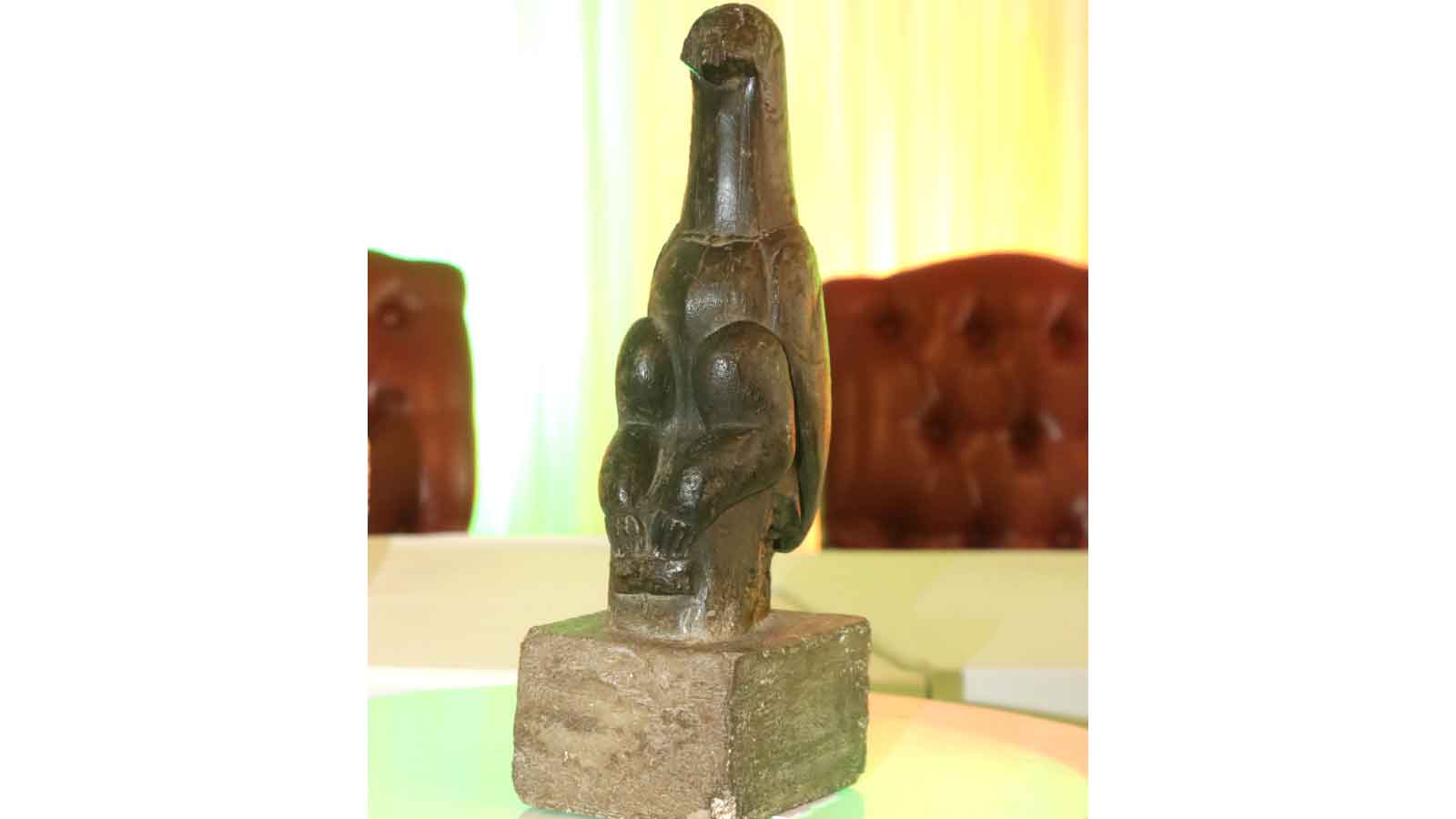
Sifelani Tsiko
Fact Check Editor
THE return of ancestral human remains and the Zimbabwe Bird – a priceless piece, which is part of a collection of eight birds identified by historical records as an integral part of the ceremony and spirit of Great Zimbabwe — from South Africa will finally restore heritage to the brilliant cultures that made them.
In a major cultural gesture, South Africa this week handed back to Zimbabwe ancestral human remains and a centuries-old stone carving of the sacred Chapungu (Eagle) soapstone bird – a priceless and sacred national emblem which was looted by early colonial plunderers more than 100 years ago.
The move is coming at a time when there is a growing push for the return of thousands of African irreplaceable cultural artefacts being held illegally in various European museums.
The irreplaceable artefacts were plundered during the colonial era. A number of African countries, have in recent decades reclaimed their cultural artefacts dating back to centuries ago.
Homecoming of human ancestral remains
The sad story of the return of human remains in eight coffins draped in the Zimbabwean flag is the epitome of racist colonial exploitation and of the commodification and dehumanisation of African people.
The remains were handed over in a Cape Town museum which was attended by officials from Zimbabwe and South Africa. In many ways, the remains tell of the tragic story much the same as that of Sarah Baartman, a South African woman, who two centuries ago was exploited for freak shows in Europe.
Sarah Baartman died on December 29, 1815, but her exhibition continued with a Paris museum displaying her brain, skeleton and sexual organs until 1974. Her remains were repatriated in March 2002 and buried in Hankey, in Eastern Cape province, 192 years after Baartman had left for Europe.
Similarly, the human remains of a number of freedom fighters executed and beheaded in Rhodesia by colonial British forces are still being displayed at the Natural History Museum in London and the University of Cambridge.
Some Zimbabwean descendants of the first chimurenga heroes, who led an uprising against British colonisers in the 1890s, are now pushing for the return of the skulls still being illegally held in the museum and university.
The descendants made a formal request to the institutions to collaborate in locating six of their ancestors’ remains.
In addition, they have also offered to provide DNA samples to assist with the research. Investigations by the Guardian indicate that UK universities, museums and councils hold at least 11 856 human remains from Africa.
The University of Cambridge holds most with at least 6 223 skulls and the Natural History Museum has the second largest collection with at least 3 375.
For years, Zimbabwe has been pushing for the repatriation of dozens of skulls of Zimbabwean war heroes, who were beheaded by British forces at the height of the first uprisings against colonialism.
Their remains are being held for display in British museums. The continued holding and warehousing of human remains in UK museums represents a shameful legacy of colonial violence and human exploitation.
Tracking the return of the soapstone birds of Great Zimbabwe
The Bateleur eagle (Chapungu) are among the priceless soapstone collection of the Zimbabwe birds revered by local Shona – speaking communities at the largest and most impressive archaeological site in Africa – the Great Zimbabwe Monument.
This ancient city was built with impressive granite walls, embellished with turrets, towers, decorations and elegantly sculpted stairways.
The most notable feature of the brilliance of the local artisans, craftsmen, was the carving of the priceless and iconic soapstone bird sculptures – the Chapungu which was the most adored and respected bird around Great Zimbabwe. The design and brilliant carving of the birds was unparalleled.
What led to the exposure of the birds to looting and plunder by colonial forces?
In various papers and reports, Edward Matenga and other notable archaeologists say that it was the inquisitive enquiry of a white trader – hunter Willi Posselt that led to interest and plunder of Zimbabwe bird carvings in 1889 which were under the custody of Haruzivishe – the Duma, Chief Mugabe appointed custodian of the Great Zimbabwe shrine.
Haruzivishe and his lieutenants resisted Posselt’s early moves to loot the birds. Posselt had to bribe them to get one of the prized birds. He gave them blankets and articles in exchange of one bird stone.
Where were the birds taken to?
Posselt opened the floodgates to the plunder of the Zimbabwe birds. The birds were stolen and taken to South Africa and Germany and five of them were returned in 1981 while the lower portion of one of the birds looted around 1890 was returned in 2003.
Only one Zimbabwe bird never left the country out of the original collection of eight.
According to Matenga, Posselt took the bird to South Africa and first approached Paul Kruger, president of the Transvaal, for a sale.
And when Kruger procrastinated, he took the bird to Cape Town where Cecil Rhodes, then prime minister of the Cape Colony, bought it.
“Rhodes is said to have been highly sentimental about his precious acquisition, which he kept at his official residence at Groote Schuur in Cape Town and many replicas were made, some of them planted at his original home in England. After his death in 1902, the bird remained at his residence, as his will dictated,” Matenga wrote in a report in 2004.
A total of five birds that had remained at Great Zimbabwe were also looted and taken to South Africa in 1891. Historians and cultural writers say the Zimbabwe birds are full of symbolic and emotional value for the people of Zimbabwe and they believe that they were about 10.
Why did Zimbabwe push for the return of Zimbabwe birds?
The homecoming of the soapstone Great Zimbabwe birds, from Europe and South Africa, has been celebrated in the country at various times.
The return of the bird fits perfectly with the country’s thrust of national identity and restoration.
About 10 Zimbabwe birds were all found at Great Zimbabwe monument – from which the country takes its name.
Historians and cultural experts say the repatriation of the birds was important in the shaping invention of a new Zimbabwe – soon after Independence in 1980.
They say the determination of the Zimbabwe government to reclaim the birds stemmed from desire to rehabilitate Great Zimbabwe as a cultural symbol of the African people.
“The desire was inspired by the belief that the potency of Great Zimbabwe as the guardian of the spirit of the nation lies in its possession of sacred artefacts such as the conical tower and the Zimbabwe Birds. It was imperative to bring back the bird emblems in order to re-equip and revive the shrine of Great Zimbabwe,” the experts said.
In 1980, the Zimbabwe bird became a national emblem and appeared on the flag, on coins and on bills and other important insignia.
In many ways, the repatriation of human remains and the birds, represents a huge victory not only for museums in Zimbabwe, but for Africa as a whole where its people had for long been the victims of plunder of their heritage and material culture.
Human remains and the Zimbabwe birds also represent the fragile pieces that make up for the country’s collective memory.
How did Zimbabwe manage to get back its prized Great Zimbabwe birds?
To jump to the end of the story, a motion was passed in the 1979 Parliament to take steps to negotiate for the return of the Zimbabwe Birds.
Soon after independence, the new Zimbabwe government took up the matter seriously and tasked the National Museums and Monuments of Zimbabwe (NMMZ) to open communications lines with the South African Museum (SAM).
After protracted negotiations with apartheid officials, the two agencies struck a deal that saw South Africa returning five carved birds that form part of Zimbabwe’s rich heritage.
In return, South Africa got a unique collection of bees, wasp and ants, described by some archaeologists as a collection “of world-class, unique and irreplaceable Hymenoptera collection, consisting of some 30 000 specimens, of which 1 000 were Types of incomparable scientific importance.”
This happened in 1981, at a time when there was animosity between Harare and apartheid Pretoria.
Zimbabwe did not get all the birds, with South Africa arguing that the bird Rhodes had bought fell out of the jurisdiction of the SAM.
It was a huge recovery for Zimbabwe which for the past 46 years has been battling to recover its heritage and remains of freedom fighters of the first Chimurenga war.
The second major victory came in May 2003 when Zimbabwe received the lower portion of the ancient Zimbabwe stone sculpture from Germany after spending close to 100 years in the hands of European collectors and museums.
Former President Robert Mugabe received the lower portion of the ancient stone sculpture from the German Ambassador Peter Schmidt at a ceremony in Harare on May 14, 2003.
“Like our land reform programme, today’s ceremony allows us to proudly assert ownership over our national resources and treasures,” said Cde Mugabe.
“What makes this day special is the fact that the lower half that was exiled is now back home and firmly and permanently re-united with the top half. Never again shall the bird be severed in two and never again shall any part of the bird find its way to foreign territory.”
The last bird to return was the one kept by Rhodes at his former residence in Cape Town, known as Groote Schuur.
It was received by President Mnangagwa on April 15 this year together with ancestral human remains that were repatriated from South Africa.
The repatriation was made possible after a directive issued by South African President Cyril Ramaphosa.
“The cooperation by our brothers and sisters demonstrate the power of pan-African solidarity,” said President Mnangagwa.
The iconic Zimbabwe Bird is the most symbolic cultural object of space and time. It helps Zimbabweans to connect the present with their past.



