Judith Phiri [email protected]
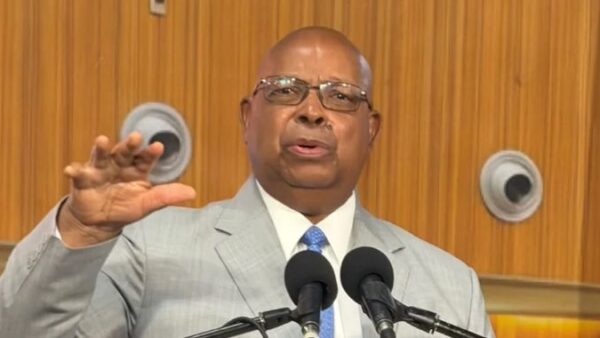
SPEAKER of Parliament Advocate Jacob Mudenda has challenged Treasury to release appropriated funds on time, warning that delays are undermining the implementation of Government programmes despite revenue collections exceeding targets.
Addressing the 2027 National Pre-budget Seminar in Bulawayo on Wednesday, Advocate Mudenda said Parliament’s budget allocations risked losing their intended impact when the money approved for them was not disbursed as planned.
He cited the 2026 Mid-Term Budget and Economic Review, which showed that Treasury collected ZiG137.8 billion against a target of ZiG124.4 billion, yet overall budget utilisation stood at 42.5 percent at mid-year.
“Treasury should work on disbursements of funds on time. The 2026 Mid-Term Budget and Economic Review highlights this conundrum. Although Treasury collected ZiG137.8 billion against a target of ZiG124.4 billion, overall budget utilisation stood at a troubling 42.5 per cent at mid-year.
“The clamour for timely releases should, in turn, be matched by an equally serious commitment to domestic resource mobilisation, because a budget is only as credible as the revenue that underpins it,” he said.
Advocate Mudenda said Zimbabwe needed to strengthen domestic revenue mobilisation alongside calls for timely releases of public funds.
He cited World Trade Organisation Director-General Dr Ngozi Okonjo-Iweala, who has emphasised the importance of attracting investment and mobilising domestic resources in Africa’s development.
“That is why Dr. Ngozi Okonjo-Iweala, the Director-General of the World Trade Organisation, has observed that ‘Africa has to focus on two things, attracting investment and mobilising our own domestic resources.’ Her counsel is a salutary reminder that national development must be anchored in the disciplined mobilisation and accountable deployment of our own domestic resources,” he said.
He commended the Zimbabwe Revenue Authority (ZIMRA) for using digital technologies to streamline customs processes and improve revenue collection.
However, he urged the authority to extend its digital transformation to closing revenue leakages at border posts, combating smuggling and accounting for every consignment entering or leaving the country.
“Beyond the formal sector lies the vast and largely untapped revenue potential of the informal economy where, according to ZIMSTAT, approximately 75 percent of economic activity takes place.
Government must unlock that potential while preserving the entrepreneurial resourcefulness that has long been the forte of ordinary Zimbabweans,” he said.
Advocate Mudenda said Rwanda, Ghana and Mauritius offered lessons in broadening the tax base through simplified presumptive tax regimes and digital registration systems that bring informal businesses into the tax system without stifling their operations.
He also called for stronger parliamentary oversight of public finances, saying accountability mechanisms must be consistently enforced to ensure that public resources were used for their intended purposes.
“This brings us back to the monthly, quarterly and annual reporting obligations under the Public Finance Management Act [Chapter 22:19]. Reports are often submitted long after financial matters have been overtaken by events, rendering their scrutiny a belated formality,” he said.
He urged Parliament to address persistent delays in financial reporting and consider whether statutory reporting deadlines should be shortened.
“You are encouraged, therefore, to brook no systemic delay and seriously consider whether the statutory windows themselves should be shortened. Where Accounting Officers persistently fail to comply, invoke disciplinary remedies as outlined in sections 85, 86, 87, 88 and 91 of the PFMA, including publicly summoning them to explain non-compliance on the record,” he said.
Advocate Mudenda said Section 35 of the Public Finance Management Act, read together with
Section 309 of the Constitution, required ministries, departments and agencies to submit their accounts for audit.
He said audit findings should inform future budget allocations, arguing that public institutions must account for previous funding before receiving additional resources.
“The Speaker of Parliament said those audit outcomes must, henceforth, inform budgetary allocation because prudence forbids entrusting fresh public resources to those who have failed to account for what they have already received,” he said.
He added that programme-based budgeting and the Integrated Results-Based Management framework should ensure that public spending was linked to measurable results.
“Programme-Based Budgeting and the Integrated Results-Based Management framework give this principle practical force by requiring that every dollar appropriated be traceable to an output and every output to an outcome the citizen can see or experience.”