admin
admin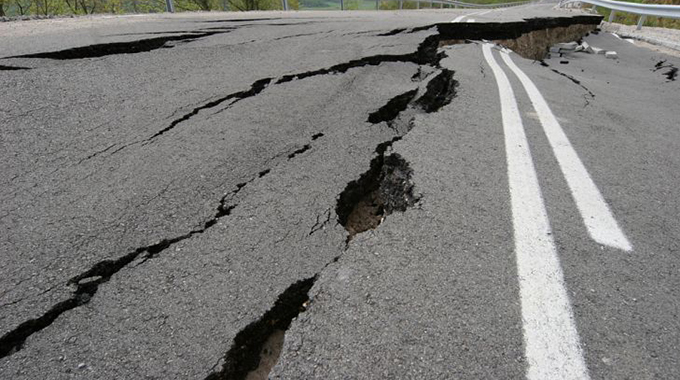
Sifelani Tsiko
Agric & Environment Editor
A minor tremor of magnitude 4.3, less than a tenth as severe as the last tremor felt in the area just over two years ago, was felt in Chipinge and neighbouring Mozambican districts near sunset on Monday evening, with no reports of damage or injury.
The epicentre was in Mozambique along the Save Valley, about 69km from Chipinge, and according to the United States Geological Survey, which maintains a worldwide network to monitor earth tremors and earthquakes, hit at around 6.55pm local time on Monday at a depth of 10km.
There is a fault line in Mozambique that generates occasional earthquakes and tremors. The fault is the southern branch of the African Rift Valley system.
The last tremor in the area was in December 2018, when a 5,5 magnitude earthquake occurred in roughly the same area 53km south-east of the town, affecting parts of Zimbabwe and the Manica province of Mozambique.
The magnitude scale is logarithmic, with a jump in number signifying a 10-fold increase in the power of a quake. So Monday’s 4,3 was less than one tenth as powerful as 2018’s 5,5.
The district Meteorological Services Department has assured locals that there was no immediate danger and no need to evacuate people.
A number of people, on various online platforms confirmed that they had felt the tremors.
Tarwira Chitombo, of Mount Selinda High School, told our sister paper in Manicaland, Manica Post, that rooftops “rumbled” during the tremor.
“We were watching television when we felt the tremors and the subsequent rumbling of rooftops which lasted for a few seconds,” he said.
Besides the quakes in the lower Save Valley in Mozambique, Zimbabwe at one stage during much of the 1960s and 1970s had the occasional tremor or quake centred on Lake Kariba, caused by the settling of the earth from the huge weight of the newly-impounded lake.
Some of those were felt as far as Harare.
But Zimbabwe lies on a shield of ancient crust, one of the cratons that merged to form the continent of Africa, so has never had major earthquakes.
However, the bottom limb of the Great Rift Valley does pass to the east of Zimbabwe and generates most seismic activity felt in the country.
A 1997 study by seismologist Dumisani Hlatywayo indicates that the western arm of the east Africa rift passes through Malawi into Mozambique.
“South of latitude 16, the rift is ill-defined by surface features but manifests itself as a broad zone of seismic activity. The eastern border of Zimbabwe with Mozambique lies along the western flanks of this zone,” he noted.
“The main lineaments trend in a north-north-easterly direction. A branch of the western arm of the east Africa rift starting from northern Malawi passes through the Luangwa rift in eastern Zambia, southwestwards into the mid-Zambezi basin and the Deka fault zone in western Zimbabwe.”
Numerous studies by seismologists all concur that almost all earthquakes in Zimbabwe occur in the Hwange-Zambezi-Kariba or Eastern Highlands areas. The largest earthquake to be recorded in Zimbabwe occurred at Kariba Dam in 1963 and had a magnitude of 6,3, according to local seismology records.
But more severe earthquakes, including a pair in the 2000s, hit Mozambique and were felt in Zimbabwe. The largest was a 7.5 magnitude earthquake in 2009 that was felt as far as Harare, with Mutare shaken more.
That quake was more than 10 times as powerful as the largest Kariba quake and more than 1 000 times as powerful as the one on Monday night.
Prof Desmond Manatsa, a climate science and disaster risk management expert at Bindura University of Science Education said there were various possible explanations for the occurrence of the earthquake now.
The US National Earthquake Information Centre now locates about 20 000 earthquakes around the globe each year, or approximately 55 per day.
Most are very small.



 Online Reporter