Sundaymail Editor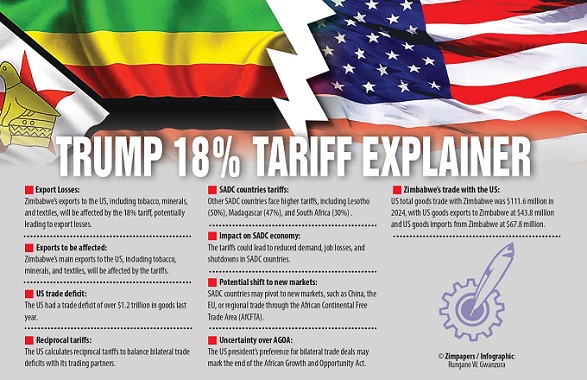
ON Wednesday, United States President Donald Trump imposed a baseline 10 percent tariff on all exports to the United States.
In essence, all imported goods started attracting a 10 percent tariff from yesterday.
And on Wednesday, the higher tariffs, which President Trump calls “reciprocal”, will kick in.
Zimbabwe, like many other countries, is in this category, as it was hit with an 18 percent reciprocal duty.
Zimbabwe exports more to the US than it imports.
According to latest statistics from the Office of the United States Trade Representative, the volume of trade between Harare and Washington topped US$111,6 million in 2024.
US exports to Zimbabwe were US$43,8 million in the review period, up 10,6 percent (US$4,2 million) from 2023.
Its imports from Zimbabwe were US$67,8 million, down 41 percent (US$47,1 million) from 2023.
This means the US trade deficit with Zimbabwe was US$24,1 million last year, a 68,1 percent drop (US$51,3 million) over 2023.
Zimbabwe’s main exports to the US include tobacco, minerals and textiles.
With an 18 percent tariff slapped on these goods, American buyers might start looking for cheaper alternatives, resulting in lower demand for Zimbabwean exports.
Conversely, Zimbabwe does not import much from the US, with most imports coming from China, South Africa and the European Union (EU).
The real issue are export losses, especially in the event that Zimbabwe cannot sell to the US as easily as it used to.
What are US reciprocal tariffs?
The Office of the United States Trade Representative says reciprocal tariffs “are calculated as the tariff rate necessary to balance bilateral trade deficits between the US and each of our trading partners”.
This means reciprocal tariffs are calculated as per the deficit the US has with a particular trading partner.
Last year, the US’ trade deficit in goods exceeded US$1,2 trillion.
According to the same source, “reciprocal tariff rates range from 0 percent to 99 percent”.
Six other member states of the Southern Africa Development Community (SADC) have been hit harder than Zimbabwe.
Lesotho has been hit with a tariff of 50 percent; Madagascar (47 percent); Mauritius (40 percent); Botswana (37 percent); Angola (32 percent); South Africa (30 percent) and Namibia (21 percent).
Both Zambia and Malawi will be hit by a tariff of 17 percent.
Likely impact on the SADC economy
The reciprocal tariffs align with President Trump administration’s “America First” stance.
In the US’ own words, the tariff rates were computed in a way that “would drive bilateral trade deficits to zero”.
But the cost to other countries could be crushing.
Trade “goes south”
Many SADC economies thrive on exports, particularly in textiles, agriculture and raw materials.
But, with US buyers now forced to pay more for these goods, demand will likely fall.
With loss of a significant market, manufacturers in some countries, especially those that are hardest hit by the new measures, may be forced to slow down production, lay off workers, and, in some cases, shut down.
This can negatively impact employment and government tax revenues.
Shifting trade winds
It is, however, unlikely that the rest of the world and SADC countries in particular will just sit back and take the hit.
Some countries will likely pivot to new markets such as China, the EU and the Middle East.
There is also scope to deepen trade through the African Continental Free Trade Area (AfCFTA).
End of AGOA?
While Zimbabwe is not a party to the African Growth and Opportunity Act (AGOA) — a US trade agreement that provides preferential access to the US market for eligible Sub-Saharan African countries — the US President’s seeming preference for bilateral trade deals, rather than broad agreements such as AGOA, could mark its end.
AGOA was set to expire in September 2025; its renewal is increasingly uncertain.
Expanding horizons
Zimbabwe, under its engagement and re-engagement foreign policy, which is largely underpinned by economic diplomacy, has been expanding its markets abroad.
As a result, it has managed to exponentially increase trade with old trade partners such as China and new ones like the United Arab Emirates (UAE).
Last year, for example, bilateral trade between Harare and Beijing rose by 23,9 percent year-on-year to US$3,8 billion.
Similarly, shipments to the UAE have been growing in leaps and bounds, rising from US$96 million in 2014 to US$1,9 billion in 2023.
Before 2018, the UAE did not even feature among the top 10 export destinations for Zimbabwe’s products, but it is now one of the country’s largest trading partners.
Overall, Zimbabwe’s exports rose to a record US$7,43 billion in 2024, which was a 2,9 percent jump from the US$7,2 billion recorded in 2023.
This was despite the El Niño-induced drought and low commodity prices.
So, increasingly translating political relations into economic ones, deepening trade relations with traditional partners and spreading wings to new markets — pursuits that are encapsulated in the Government’s ongoing engagement and re-engagement drive — will more than make up for the hit, if any, that Zimbabwe must suffer from the new punitive US tariffs.



 Online Reporter