Online Reporter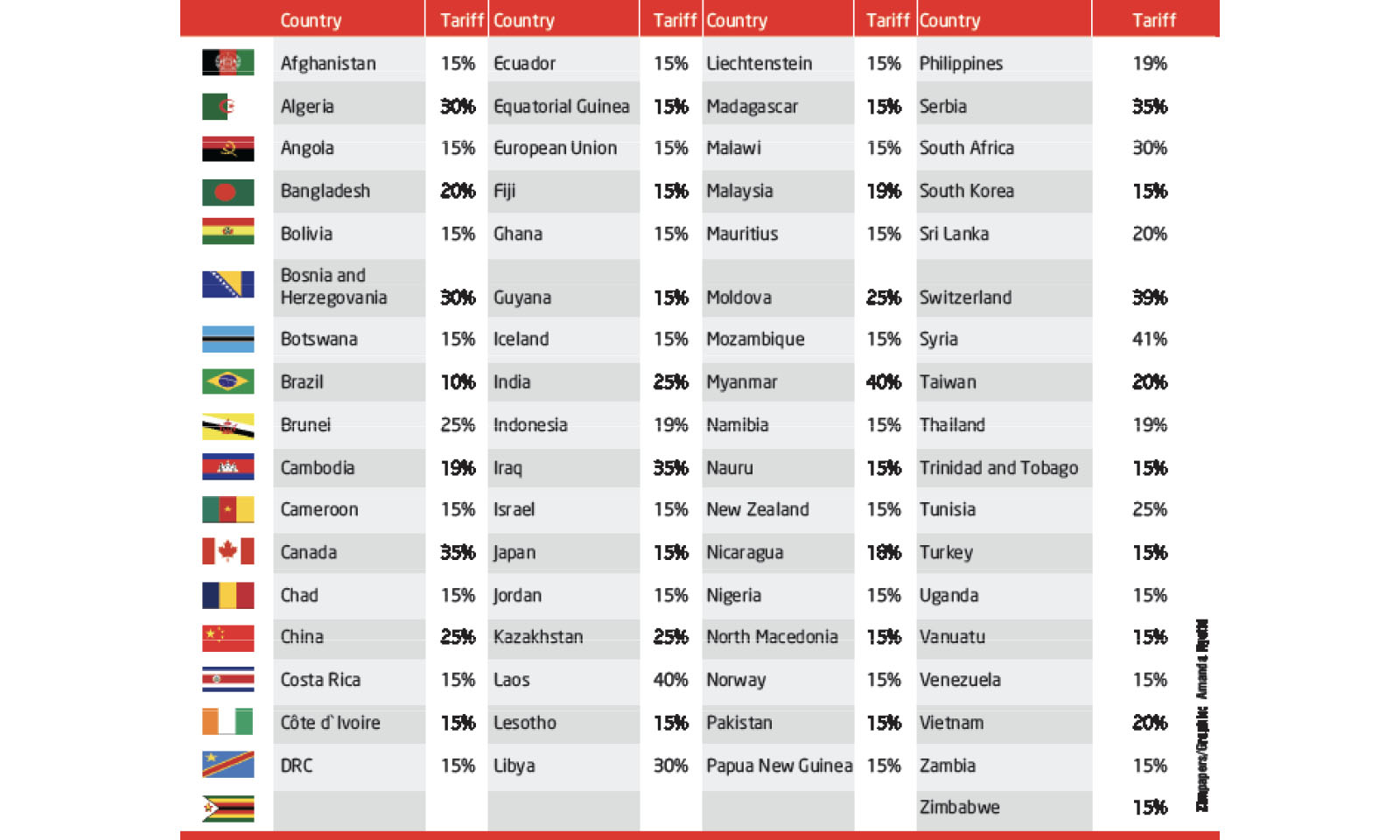
Dr Michael Musanzikwa
When United States President Donald Trump staged a remarkable political comeback through his re-election, his biggest mandate was to make the American economy better for its people.
This was followed by a barrage of tariffs against countries around the world based on political and non-political reasons.
From an economic point of view, Trump believed America had to regain its trade surplus.
He, therefore, imposed trade tariffs on countries he perceived as threats to the American economy.
The latest US trading partners to be hit by new tariffs are shown in the table on the right.
The trade tariffs show America’s dominant influence on international trade, which ultimately compromises the efficient and effective flow of the supply chain around the globe.
Notable is the high cost of products exported to America, which makes them very uncompetitive.
Historically, many American companies migrated off-shore to seek favourable conditions that could make their business competitive, such as cheap labour and attractive conditions.
The companies would later export back to America.
This is what Trump would like to reserve to curb the flood of imports causing the US deficit.
For many years, America provided a lot of funds for global aid, famine and development programmes.
Trump has, however, withdrawn the aid as he feels it is an unnecessary cost to the American people.
These unexpected and untimely decisions have consequently interrupted global supply chains through high costs, delays and shortages of goods in some parts of the world.
On the other hand, this move by Trump must be viewed as an opportunity for other continents, especially Africa, to move away from dependence.
Africa is a continent endowed with vast resources, such as minerals, good soil, vegetation and favourable weather conditions.
Africa is a sleeping giant that must now awaken and leverage its resources in order to industrialise and modernise.
Most importantly, it needs to value-add its resources.
All this can be achieved if economies mostly affected by Trump’s unilateral actions consider supply chain as very strategic in emancipating themselves economically.
Through global trade associations such as the World Trade Organisation, supply chain must be the basis of attaching the strings of trade among nations.
This must be initiated and strengthened from the global to continental, regional and down to country level.
In simple terms, supply chain involves the management of processes that transform raw materials into finished products through planning, procurement, operations management, logistics and marketing channels.
It is critical for countries affected by Trump’s tariffs and sanctions to embrace supply chain as a competitive tool which they must use for their survival.
Boosting trade by strengthening the African Continental Free Trade Area (AfCFTA) is a good opportunity for the affected countries to strategically adopt the supply chain aspects.
Some of the objectives of AfCFTA are:
To create a free market for goods and services
To combine the economies of Africa as a big market
To overcome dependence on exporting primary products
To enhance market efficiency and inclusive growth
To support structural economic transformation
To use supply chain as an anti-corruption tool in African trade
To expand value chains on the local basis
To be able to identify own problems and find solutions to make money
So, the affected countries must diligently identify their local and regional suppliers, whom they should consider to be their business partners.
They should also collaborate and develop each other’s value chains as this is integral to the production process.
This process has to be smart by employing all the supply chain aspects efficiently and effectively by considering the total life costs, maintaining quality, meeting the delivery schedules to the final consumer, as well as retaining value for the shareholder.
This must also be enhanced by the use of digital technology in all aspects of the supply chain so as to realise value.
Emphasising on the young populace — from primary to tertiary levels — the importance of using available resources through research and development is also critically important.
Ultimately, appreciating the importance of the supply chain at an early stage and in all sectors will result in a multiplier effect of supply chain activities from the local, regional, continental and international level, leading to the availability of goods and services at reasonable cost.
This will cushion countries from Trump’s unilateral tariffs.
Overall, it is high time for countries affected by Trump’s unilateral trade tariffs to consider supply chain as a tool for development and a bridge to prosperity, if employed diligently.
Dr Michael Musanzikwa is the Chief Director (Procurement and Disposal of Public Assets) in the Office of the President and Cabinet.