admin
admin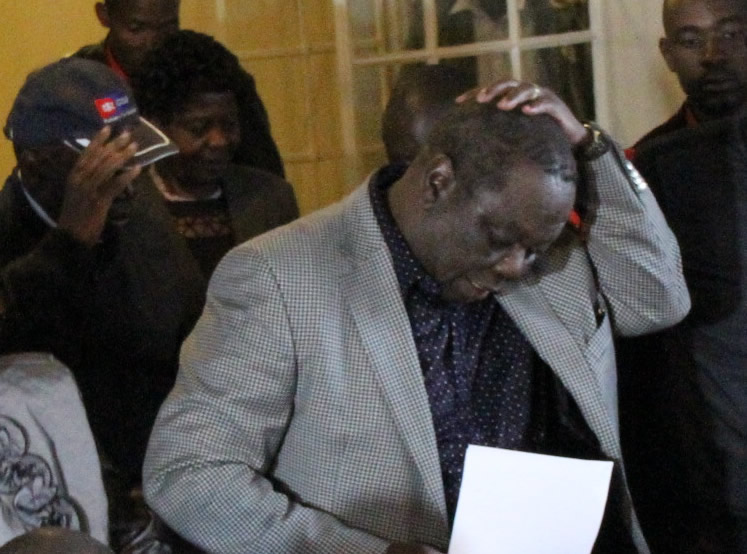
Benny Tsododo
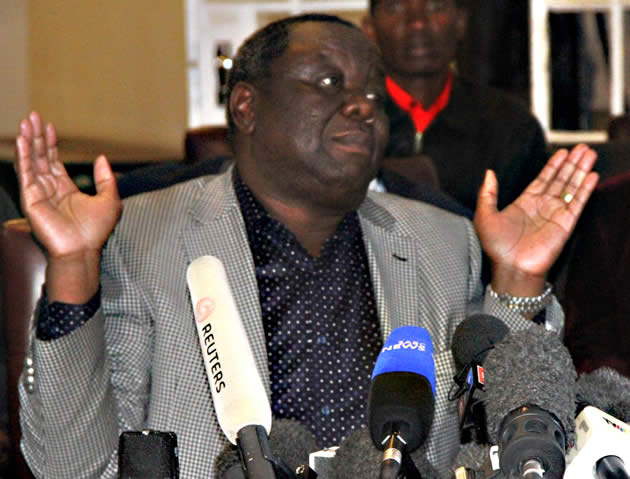
Tsvangirai has been challenged to a leadership contest by the party’s deputy treasurer, Elton Mangoma, who in one of the options he proffered to the beleaguered leader, asked him to convene an early congress where his leadership would be contested and tested. Tsvangirai could not countenance such a challenge. He demonstrated his aversion to such a democratic challenge by unleashing violence on proponents of leadership renewal and those planning to take the baton away from him.
He even placed a gag order on those who intend to debate this supposedly unsavoury issue in public.
For his efforts, Mangoma received a spectacle-smashing and bloody bashing from die-hard Tsvangirai supporters, who reacted violently to growing calls for leadership renewal. Other party activists suspected to have links to Mangoma got their unsolicited share of indiscriminate kicks and claps at an MDC-T rally held recently in Glen Norah.
Wrapped in illusion, Tsvangirai believes that he is so popular to the unimaginable extent that no one should challenge or contest him.
To prove this, he has embarked on a countrywide tour to meet his supporters and demonstrate his invincibility. He has even summoned and arm-twisted party district chairpersons into parroting that no one else but Tsvangirai has their unshakeable support.
Blinded by his imagined invincibility and incredible support, Tsvangirai believes that participating in elections or intra-party leadership selection processes is demeaning for him. He fancies not contesting in elections with President Robert Mugabe and other presidential aspirants. He is convinced that, because of his make-believe popularity, the people must spontaneously rise up against the Government of the day and consequently instal him as the president of the country.
Driven by this unsubstantiated conviction, Tsvangirai last week took a swipe at his supporters for their supposed cowardice.
The media quoted him at the Glen Norah rally fuming that “you have to act and not sleep in the house while the country is burning and only blame Tsvangirai. Don’t be cowards, why are you afraid of going to jail?”
One wonders what it is that Tsvangirai wants his supporters to do that would lend them in jail because people cannot be sent to jail for participating in elections.
People can only be sent to jail for perpetrating violence and lawlessness. As such, Tsvangirai is clearly trying to incite his supporters to take the law into their own hands and catapult him to power through illegal and violent means.
Notably, this is not the first time that the MDC-T leader has tried to get into power through unconventional means. In June 2003, Tsvangirai tried to bulldoze his way into State House through a treasonous uprising dubbed “Final Push”. He had previously tried to incite people to rise up against Government through job boycotts, which degenerated into violence after his supporters stoned and burnt commuter buses taking people to work.
The MDC-T leader was once hauled before the courts charged with treason for trying to remove Government through an alleged coup he allegedly plotted with a Canadian firm. Tsvangirai’s call for South Africa to cut electricity and fuel supplies to Zimbabwe together with the invitation of the West to impose sanctions on the country were designed to create hardships for the people.
He wished these hardships could impel the people to rise up against the ZANU-PF Government and possibly elevate him into power.
Tsvangirai has tried whenever possible to avoid elections by claiming that the playing field is not level.
Last year, Government had to use a Supreme Court order to hold elections after the MDC-T had dragged its feet, giving one excuse after another in an attempt to duck the polls.
Throughout his political career, Tsvangirai has several times threatened to boycott elections and subsequently rejected the results after being repetitively wallopped by President Mugabe.
It would be instructive to highlight to Tsvangirai that current global trends have shown that violent takeover of power does not yield peace.
So far all governments brought about by usurpation of power under the so-called Arab springs have not known any peace.
In Libya, the uprising has degenerated into war among various rebel groups that toppled Muammar Gaddafi. In Egypt, the “revolution” led to the current coup.
In Syria, the failed “revolution” has led to a civil war that is responsible for the destruction of essential infrastructure and unselective killing of civilians.
Similar disturbances currently underway in Ukraine point to a drawn-out political impasse that is deteriorating into an exchange of gunfire between contesting parties.
The situation is likely to flare up into another civil war that could lead to massive destruction of infrastructure and unnecessary loss of life.
Tsvangirai should ask himself if Zimbabweans really deserve such upheavals, potential demolition of essential infrastructure and loss of precious life.
Why should he resort to violence when elections are regularly held to provide him with a platform to present himself for selection as President of the country?
Instead of unleashing drunken hoodlums on Mangoma, Tsvangirai should have accepted the leadership challenge and immediately invoked internal constitutional measures to hold an early congress.
As a politician who claims to have immeasurable support from the grassroots, he should simply submit himself to internal selection processes that will measure if he truly has the support to lead the opposition party.
Tsvangirai should not be fooled by those who opine that he is the “face” of the regime change struggle and thus irreplaceable.
Politics is not about “faces”. It is about what you offer as a politician. It is about the ideology of your party and its commitment to national aspirations. So far, the electorate has rejected him five times.
They have found him bankrupt on the ideological front and thus could not trust him with the country’s reins.
Tsvangirai should be schooled that as a leader of a party that claims to be pushing for “democracy”, it is undemocratic for him to reject elections or frown at intraparty leadership selection processes.
It is also undemocratic for him to use violence or incite lawlessness in his bid to get into power.


 Online Reporter