admin
admin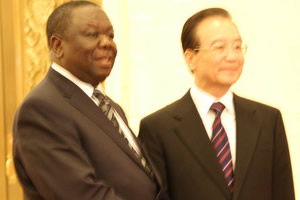
resources in Africa.
He made the remarks at the first International Fair for Trade in Services in Beijing during his visit this week.
PM Tsvangirai is known locally as a fiery opponent of Chinese investment in Zimbabwe and has often accused the country of exploiting local resources.
“We have resources that China needs and I do not believe China is plundering our resources,” he said at the fair.
“My hope is that my country can cope with a variety of challenges in its development, such as energy, water supply, roads and education . . . and China can play a significant role in this process.”
PM Tsvangirai dismissed accusations of China “robbing” resources in Africa, saying despite the presence of Chinese investments in a wide range of areas, Zimbabwe had full control over how the contracts should run.
The fair attracted more than 22 000 service providers from 82 countries and regions to foster trade in the sector.
Also see
China has become the largest trading partner to Africa, with the bilateral trade reaching a record high of US$160 billion in 2011.
The continent has become a major investment destination for Chinese enterprises where over 2 000 Chinese companies have invested in various sectors ranging from electronics, telecommunications to transport.
But these co-operations had triggered criticism from the likes of PM Tsvangirai, while his colleagues also accused China of practising “new colonialism” in Africa.
Instead of resource plundering, Bheki Langa, South African ambassador to China, said at the forum that Chinese projects on the African continent, including dam construction, telecommunications, airports and roads, had helped create jobs and drive technological development.
Compared with European countries and US, China’s trade growth with African countries has been relatively steady.
“African countries’ foreign trade has taken a hit from the global financial crisis of 2008, especially exports to the European countries and US, but Sino-African trade has maintained steady,” said Mr Henri Mumba, Malawi’s deputy ambassador to China.
He said claims that “Sino-African cooperation puts African countries at a disadvantage” were “definitely wrong”.
While calling for more co-operation in the traditional sectors of infrastructure and manufacturing, officials on both sides now seek to expand trade in the service sector.
Chinese vice minister of commerce Li Jinzao said that China will further deepen co-operation with Africa in the service trade.
“Sino-African co-operation in the service sector, though at a small scale currently . . . has ample room for growth in the future,” he said.
With China’s expanding presence in the continent, African countries also expressed hope that China could help further facilitate their development efforts. — Xinhua/Herald Reporter


 Online Reporter