

 admin
admin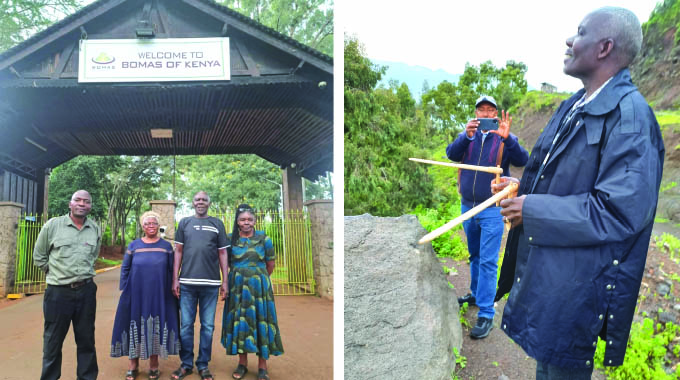
Isdore Guvamombe and Valerie Mpundu
After putting a lot of effort to get to the sacred shrine via a bad dirt road under repair, the resilient Toyota engine got the three of us there at night when proceedings had already started.
We quietly parked our car at a safe distance and moved towards the drumbeat.
An assortment of footwear, from shoes to slippers was stashed a spitting distance from the doorway of the shrine, a sign that everyone inside had taken off their shoes. Sacred!
The sacred shrine, is a stone and grass-thatch round hut, built on a rock promontory on the foot of a mountain range in Musana communal lands, north-east of Harare.
A woman in front of us, practised a knee-breaking stance twice, knelt down and crawled inside. A man removed his hat, bowed and walked in on a stoop. We followed suit.
Inside, women sat on the right and men on the left.
Bvumavaranda, the oracle, occupied the centre back, wrapped in black traditional regalia and surrounded by a glut of Gothic traditional paraphernalia.
A cross rhythm of drums and mbira resonated throughout the shrine, shifting in percussion, pitch tempo and crescendo. Songs — not ordinary songs — but traditional songs that remind you that you are now in the spiritual realm, backed the instruments.
Four mbira players thumped the instrument in frenzied gait, heads tossing sideways, backwards, forth and little everywhere else. Soon I realised it was mbira player Nyamasvisva and his team performing.
One giant man stood up playing the shakers, while a slim tall man, pumped the ox-hide on the drum with open palms as if there was no tomorrow.
The shakers made adrenalin rush and skip. It made blood scamper. Then there was the pulsating drumbeat. Eish that one.
The shrine exuded an aura which is Gothic, inexplicably eerie and profound; that which makes the heart beat fast; that which makes the mind, heart and soul depose to the world yonder, the world of spirits.
Indeed, before you know it, you are in a spiritual realm that gives life its real meaning.
At this moment, the situation defined for itself the difference between religion and religiosity, the belief and the execution of the belief. Traditional religion, you felt, was still alive and kicking.
Women of all shapes and sizes, from the pencil slim to the chubby ones, from the yellow-boned to the charcoal-boned up to those with long dreadlocks, came, sang and danced
The difference, though, is that everyone was decently dressed.
In the shrine, women walked on their knees from corner to corner, only standing on their feet to dance.
Traditional beer was in abundance and clay pots and drinking gourds made the rounds to little everywhere else. So, did pouches of traditional snuff. They exchanged hands too. There was snuffing all over the place. Nostrils got busy.
But that was a preamble, a prelude. The night was still young. Everyone was still just warming up.
The medium of Bvumavaranda lay shiftily on a reed mat to our left, surrounded by his paraphernalia, which included leopard skins, black cloth, a scullery of walking sticks, pouches of tobacco, among others.
He struck me with his composure, calmness and regalia as the one the ancestors anointed.
One particular war song swept everyone off their feet.
“Bvumavaranda mukono…!
Bvumavaranda mukonooo!
(Chorus) yea aheye , pasi paita mhanda
Bvumavaranda Mukono, yea eheye.. pasi paita mhanda” (x10)
The thudding feet escorted the song to finality, with thunderous aplomb.
Soon the spirit manifested and the medium went on stage and danced with steady feet, but with staggering gait.
The main officiant, (Muzukuru) who apparently shared the same totem with me, Mhofu (the elegant, exquisite and flamboyant eland) lined up clay pots of beer before the medium for a prayer.
We all went on our fours in affable greetings. We were greeted by our totems (much to our surprise). You cannot hide anything from the spirits. They see tomorrow, today!
After the prayer, each of the chiefs present was identified by totem and welcomed through a clay pot of beer.
A small gourd full of beer was given to the chief and he accepted by drinking. Then followed ululation and clapping.
Boy, ooh boy, it was the difference in greeting etiquette and clapping rhythm that differentiated the Rozvi autochthon. That’s the marvel of African tradition. Thereafter the spirit left.
Then the singing and dancing fiesta took all night. So did the many people in the shrine go into trances. So, did solutions get proffered.
The mbira players were at it again, this time around thumping our hearts and souls to a soothing eternity. Everyone danced up and about. Some went into trances, clay pots with frothing beer circulated and drinking gourds exchanged hands. It was unbelievable. The waist-wriggling dances, the deft and fancy footwork and the melodious singing, all gave the traditional binge its credence.
There was song and dance, again and again.
By 4am, the time elephants normally bath, the spirit manifested again, this time around silencing everyone with a huge lecture on morality, personal development, African humanism and family relations.
By the time the lecture ended, it was almost sunrise. The binge adjourned for breakfast, amid dance and song.
After a few hours of relaxing, the dancing and singing continued, this time outside the shrine. During the day, food and drink were plenty and day two was loading. Private consultations.
One would be forgiven for assuming the masses were worn out from their previous thumping and thudding the night before.
Bvumavaranda has directed for the first time in the history of Zimbabwe, that the spirit medium should go all over the world to collect historical artefacts of its lineage.
“I am sending you to collect historical artefacts of our clan from wherever they are. My medium and his team will have to go to every place where I left any piece of thing so that the history of our clan is correctly documented.
“Even where I left the phlegm of my sputum, this time around you must go and collect,” said the spirit in sarcasm.
In the past few years, Bvumavaranda’s team has been all over the continent, going as far as Egypt, Kenya and Tanzania collecting historical artefacts, some of them as old as time.
In Zimbabwe, Bvumaranda used his ephod to identify and exhume the paraphernalia of a Rozvi autochthon, Bvumavaranda, who lived and sunk into a swamp in anger and disgust, after his trusted friend Mbauro breached longstanding taboos, way before the construction of the Great Zimbabwe National Monument.
He also unearthed a cup hidden hundreds of thousands of years in Sijahunda Mountains in Gwanda.
The spiritual journey has taken him to Cairo, Egypt, where a cup left by Bvumavaranda while working on the construction of pyramids as a young man, was brought back home two years ago, after staying on display in the museums there until it was decommissioned.
In Tanzania, Bvumavaranda sent a delegation to identify a place where his great grandfather Dembe was buried, at Mt Kilimanjaro. They indeed identified the place.
The delegation also visited Mt Meru in the heart of Arusha National Park, where the clan’s great grandmother was buried.
He has traced the routes of the Rozvi people from Lalibella, Ethiopia to Egypt down to Zimbabwe, picking relatives and artefacts.
He has also identified undiscovered minerals from a village in Ethiopia using the ephod, much to the surprise of the local people.
Bvumavaranda has built a museum adjacent to the shrine where he is keeping a collection of the clan’s artefacts. This is a first for a local spirit medium.
During his trip to these places, Bvumavaranda has linked up with relatives and friends of his clan.
He has also attended churches linked to his tribe like the Orthodox Church in Addis Ababa.
His is a calling which will set the Rozvi record straight.
The mission is good and sets records straight. Like we said, this was and is a first.
There might not be partiality in our judgment, but Bvumavaranda is real and genuine in his endeavour to write the correct Rozvi history. Do elders with cotton tuft hair not say, until lions learn to write, their story will be written from a hunter’s perspective?
So, Bvumavaranda is right, writing the correct story of his clan.



 Online Reporter