admin
admin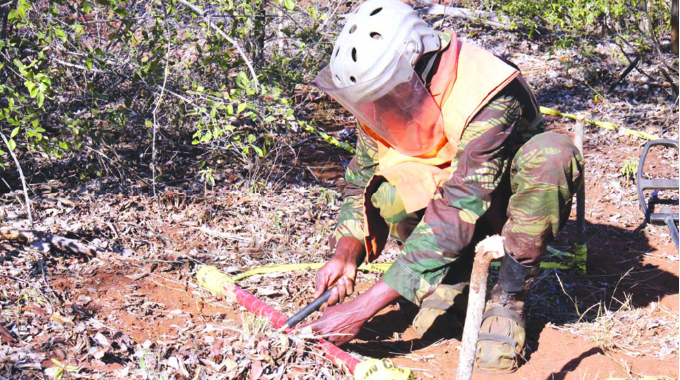
Ranga Mataire, Zimpapers Politics Hub
THE African Union (AU) recently commended Zimbabwe’s efforts in ensuring a landmine-free country by engaging various stakeholders to clear millions of anti-personnel landmines, planted mostly by Rhodesian forces, during the country’s arduous liberation struggle.
Since 1982, Zimbabwe Mine Action Centre says over 209 430 anti-personnel mines were planted at the peak of the liberation struggle between 1976 and 1979.
The Government has worked closely with a number of non-governmental organisations and organisations linked to some embassies over the years to clear the landmines mainly located on the eastern border with Mozambique.
African Union’s ambassador for Political Affairs, Peace and Security, Mr Limam El Jalil, told the media after meeting Defence Minister Oppah Muchinguri-Kashiri in Harare recently that the continental body was happy with what the Government had done to reach a tremendous milestone in demining.
“This visit is part of the AU commitment to a mine-free Africa, so we are here as part of this oath; this is due to the political and humanitarian will as Africans to achieve our continental goal of a mine-free Africa,” Mr El Jalil said.
The AU and the United Nations Office to the continental body is supervising the implementation of the Anti-Personnel Mine Ban Convention in Zimbabwe.
Since independence, the Zimbabwe National Army has coordinated with a number of organisations to clear the mines that have maimed or killed ordinary citizens living close to the borders.
The Government figures indicate that about 1 500 people have been injured or killed by the landmines since independence.
One such organisation is the Norwegian People’s Aid (NPA) humanitarian group that has recruited and trained female de-miners in a development that has been hailed by local communities who view the move as deconstructing gender stereotypes.
The teams are exclusively made up of women and are led by a fellow woman as team leader.
Not so long ago, Context News, an online publication documented a story of a female de-miner, Ms Memory Mutepfa, from Chipinge who used to lead a team of 10 and is passionate about the programme.
Ms Mutepfa is quoted saying that, “On a daily basis, we used electronic detonators to destroy the landmines without fear. We excelled in the landmines clearing industry as an all-female team just like out male counterparts.”
For the women themselves, the work is a source of pride and economic independence that allows them to challenge deep-rooted patriarchal notions in Zimbabwe about the kind of jobs women should.
On its website, the Norwegian People’s Aid says it has managed to clear 1 322 landmines in Chipinge in the past decade releasing a total of 5 million square metres (54 million square feet) of landmine-affected land for productive use.
Recent reports that the British government had committed an additional US$5,5 million to support landmine clearance in Zimbabwe’s Mashonaland East and Central provinces are most encouraging.
The funding was announced last week when the British Ambassador Pete Vowles said the funds were part of the UK’s Global Mine Action Programme (GMAP) and will be distributed to two organisations – the HALO Trust and the Mines Advisory Group (MAG).
The increased funding is aimed at accelerating Zimbabwe’s progress towards its goal of becoming a landmine-free by next year.
The clearing of landmines is critical for making available land for agriculture, housing and social services while reducing the risk of landmine-related accidents.
The funding is also expected to create new employment opportunities, particularly for women, in demining operations.
During a recent visit to Rushinga in Mashonaland Central, Amb Vowles commended the local de-miners for their courage and dedication.
“I want to salute the bravery of the de-miners working to create safe environments in Mashonaland East and Central. The UK is committed to achieving a mine-free world, and this additional funding will enable MAG and HALO to continue saving lives and supporting economic development in affected communities,” Amb Vowles said as he highlighted the fact that the new funding followed the UK’s previous commitment of US$22,2 million, announced earlier this year in February to support demining in eight countries, including Zimbabwe.
The British government bears historical and moral responsibility for clearing landmines because of the need to deal with its colonial legacy as Zimbabwe was once a British colony from around 1890 to 1980.
It was during the height of the liberation war that a minority regime supported by the British laid landmines along the country’s borders.
As a signatory to the Ottawa Treaty of 1997, the British government has committed to clearing mines and providing assistance to affected countries like Zimbabwe.
It is known that landmines have continued to cause harm to civilians, including innocent children, women, and farmers in Zimbabwe.
At a humanitarian level the British government has an obligation to assist in clearing the landmines to build on new post-colonial bilateral relations.
In summary, the British government can assist in technical expertise, financial support and work through other organisations like it is doing with MAG and GMAP as a well to build goodwill and trust in a New Dispensation that has ushered forgiveness and national reconciliation.
By acknowledging its historical and moral responsibility, the British government can play a crucial role in supporting landmine clearance efforts in Zimbabwe, ultimately contributing to the country’s development and the well-being of its citizens.
Today, around 18,3km² of land remains contaminated, posing significant risks to local populations.
Zimbabwe is among the few countries actively working to meet the 2025 mine clearance deadline set by the Ottawa Convention.


 Online Reporter